dailynewsnblog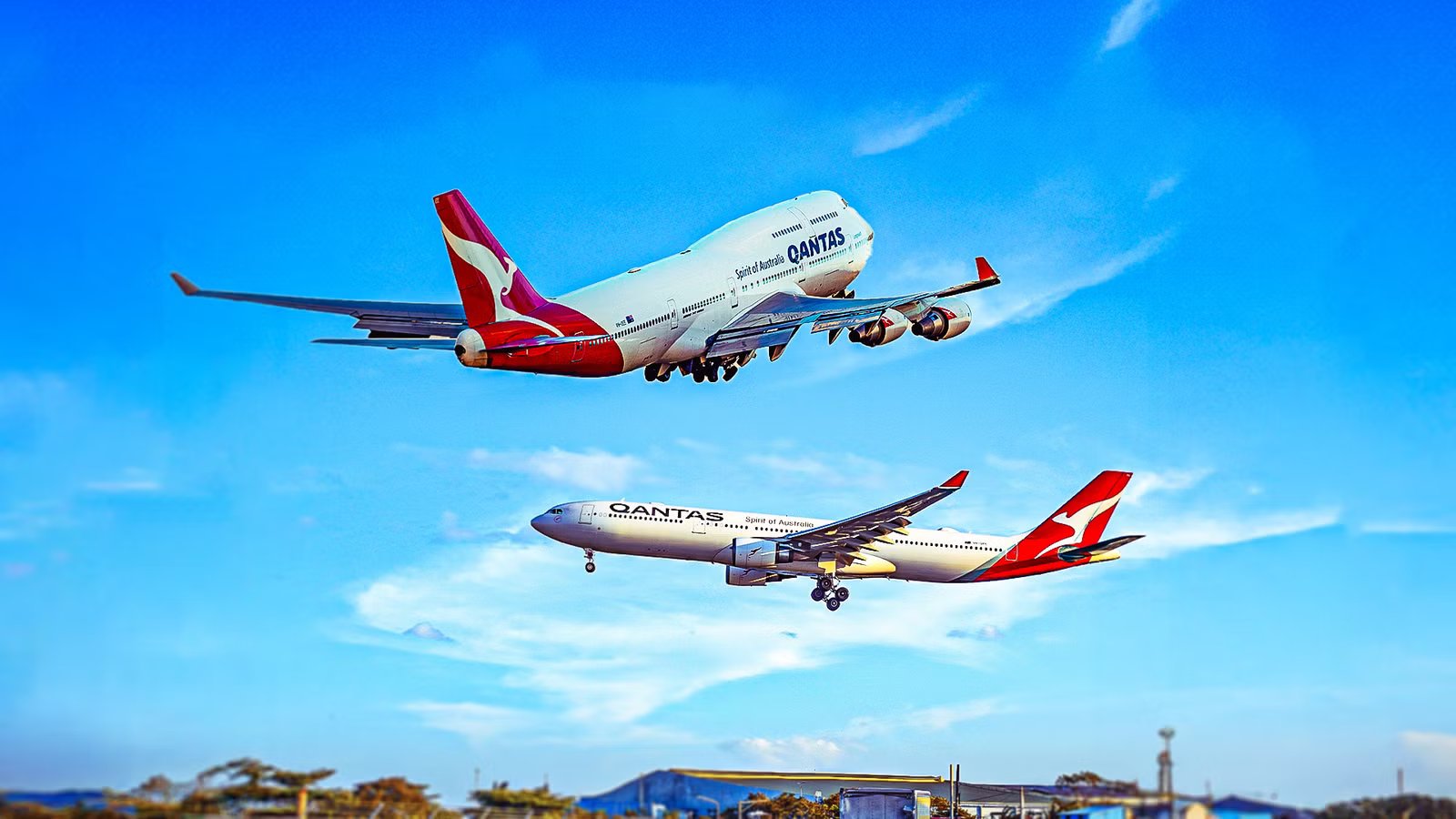
If you read about the development of the Boeing 777, you’ll notice something strange. Boeing partnered with eight major airlines for feedback about what they wanted in its next-generation widebody, slotting in between the 747 and 767. As such, it consulted with All Nippon Airways, American Airlines, British Airways, Cathay Pacific, Delta Air Lines, Japan Airlines, United Airlines, and Qantas.
Qantas, however, never ordered the 777, and even passed on ordering the upcoming 777X. Former Qantas CEO Alan Joyce stated in an interview in 2014 that he believed a 2000-order made by the carrier for the Airbus A330, A380, and Boeing 747-400ER was a mistake, wishing that he had ‘a time machine’ so that he could go back and order the 777 instead.
Given Qantas’s involvement in the 777’s development, as well as the success of the 777-200ER and especially the 777-300ER, it’s unusual that an airline with such a large long-haul network has never ordered the type. However, this doesn’t necessarily mean that the decision was a mistake.
The 2000 Order That Joyce Referred To

In 2000, under CEO James Strong, Qantas placed an order for 13 Airbus A330s (split between seven A330-200s and six A330-300s), 12 Airbus A380-800s (then known as the A3XX), and six Boeing 747-400ERs. Although the order gave the 747 program some new life, with Qantas essentially launching the 747-400ER variant, it was a major win for Airbus.
Qantas had been a near-exclusive buyer of Boeing aircraft for decades, having consolidated its mainline fleet to just the Boeing 737, 747, and 767 at the time. It’s this order that Alan Joyce, who served as Qantas’s CEO from 2008 to 2023, is referring to. 2000 was the same year that the Boeing 777-300ER was launched, and since then, almost every large airline with a long-haul network has ordered the type.
It’s one of the most impactful aircraft ever built: smaller than a 747-400 yet still big enough to serve as an effective airline flagship, exceptionally fuel-efficient, and just as capable as a 747-400. Joyce wished that he had two dozen of these planes instead of the A380s and 747-400ERs that Qantas actually purchased. Joyce, however, is a fairly outspoken person who has criticized the A380 on multiple occasions and would not have ordered the type if he were in charge at the time.
A fleet of young 747-400ERs is also hardly the best way to boost economics on costly long-haul routes. Speaking about this topic in 2014, however, means that you have prior knowledge of what the 777-300ER can do, and the regulatory environment in 2014 was very different from that of 2000. Qantas, too, is a different airline now than in 2000.
The Background Of The 2000 Order

Qantas was consulted on the development of the 777, but the airline lacked the need for the plane during the 1990s. At the time, Boeing was only selling the first-generation 777, consisting of the 777-200 (essentially a replacement for the McDonnell Douglas DC-10), the long-range 777-200ER, and the stretched, short-to-medium range 777-300.
Qantas wasn’t yet ready for a large domestic people-mover, while its long-haul strategy revolved around high-volume trunk operations to London, Los Angeles, Hong Kong, and Singapore with 747s. In 2000, Ansett Australia was failing, providing a place for Qantas to expand its domestic operations beyond its 737s and 767s, while the carrier was also looking to expand its long-haul network.
Qantas took a good look at the second-generation 777, consisting of the 777-200LR and 777-300ER, but it was also enthusiastic about the A3XX concept. It was a natural progression from the airline’s large 747 fleet, and several other airlines were also initially excited about the A3XX. The 777-200ER was a good size for Qantas’s domestic and Asian operations, while the 777-300ER would have been excellent for the carrier’s US flights.
However, Airbus instead sold Qantas the A330 and A380 for a reportedly excellent price, thereby shutting the 777 out. Meanwhile, Qantas also required better short-term performance for its existing 747-400 routes to the United States, which pushed the envelope of the 747-400’s performance. To keep its fleet simple, Qantas requested an improved variant of the 747-400, and ended up ordering six 747-400ERs, the only passenger airline to do so.
Why The Order Ultimately Worked

Qantas’s decision to reject the 777 has attracted criticism in the past, and some within the company questioned the decision to go with the Airbus A330 instead. A 777-200/777-200ER is only slightly larger than an A330-300, while the 777-200ER has far more range. The 777-300ER would have significantly boosted the economics of Qantas’s long-haul operations compared to the 747.
However, although Qantas’s decision to reject the 777-300ER seems odd today, it was hardly the last airline to choose the A330 over the 777-200ER. The A330-300 is simply a more fuel-efficient aircraft than the 777-200ER. The 777-200ER’s advantage is its true long-haul range, but the A330-300 has received multiple boosts to its range over the years, which eroded the market for the 777-200ER.
Aircraft | Total Orders |
|---|---|
Boeing 777-300ER | 833 |
Airbus A330-300 | 776 |
Airbus A330-200 | 667 |
Boeing 777-200ER | 422 |
Boeing 777-200 | 88 |
Boeing 777-200LR | 61 |
Boeing 777-300 | 60 |
If an A330-300’s range is enough to cover most or all of an airline’s routes, then it’s the superior choice in many cases, and Qantas has used the A330 effectively, even topping off its orders in later years. In addition, there’s also the presence of the A330-200, which is much smaller and has longer range. Alan Joyce has criticized the A380, but it was ordered when the airline was more focused on trunk routes than today, and it’s not clear that the A380 on its own was ordered over the 777-300ER.
Instead, Qantas discussed a comprehensive fleet plan with  Boeing as well as Airbus, and selected Airbus’s offer due to the qualities of its planes and pricing, an important factor in any order. The A330 has generally worked well for Qantas, while the A380 remains in the fleet despite its huge size and fuel burn. Meanwhile, the 747-400ER did its job when it was in service.
Other Factors Behind Qantas’s Decision

The Boeing 777 debuted with FAA ETOPS 180, the first airliner ever to do so. However, Australia’s Civil Aviation Safety Authority was more conservative with ETOPS approval than the FAA. ETOPS approval was granted on a case-by-case basis, and ETOPS is an expensive process that requires added contingencies, equipment, and proof of operational reliability.
Under the CASA’s strict requirements at the time, the 777’s twin-engine layout came with significant drawbacks for long-haul flights rather than being a plus. While Alan Joyce would have loved to have his airline operating 777-300ERs in 2014, the situation is not so cut-and-dry when you put yourself in the shoes of James Strong in 2000.
Strong was looking at an efficient, capable airliner with a smaller variant available for domestic and Asia operations, but with the drawback of requiring ETOPS certification. Airbus stepped in by offering a plane designed for Asia operations with a variant smaller than the 777-200ER available, along with the A3XX that Qantas had wanted, all available at a low price. It’s also worth noting that the 777-300ER was still essentially a concept in 2000 when the order was made.
The original specifications Boeing provided were promising, but the General Electric GE90-115B beat initial fuel burn projections, making for a more compelling aircraft than what Qantas was originally looking at. Much of the 777-300ER’s success came after it entered service and proved itself better than promised, and it was also helped by the fact that its direct competitor, the Airbus A340-600, was extremely heavy and had unreliable engines.
Qantas Has Since Shut The Door Again On The 777X

Project Sunrise is the carrier’s effort to launch the world’s four longest nonstop routes, connecting Sydney and Melbourne to London and New York. Talked about for years, Qantas pitted Boeing and Airbus against one another to win the order, with Qantas requesting a specialized variant of the Airbus A350-1000 while Boeing submitted the 777X. However, in 2022, Qantas officially rejected the 777 again, when it ordered 12 examples of an extended-range A350-1000, now dubbed the A350-1000ULR.
There are several factors as to why Qantas selected the A350-1000ULR, but what’s certain is that Airbus’s win would have been far tougher if it had let Qantas go with Boeing in 2000. Had Qantas gone with the 777, it likely would have favored the 777X for Project Sunrise for fleet commonality. However, as Qantas ended up ordering more Airbus widebodies over the years, this made it the favorite going into the order.
Origin | Destination | Great Circle Distance (NM) | Great Circle Distance (km) | Airline | Aircraft |
|---|---|---|---|---|---|
Sydney | London Heathrow | 9,188 NM | 17,016 km | Qantas | Airbus A350-1000ULR |
Melbourne | London Heathrow | 9,127 NM | 16,904 km | Qantas | Airbus A350-1000ULR |
Melbourne | New York JFK | 9,015 NM | 16,695 km | Qantas | Airbus A350-1000ULR |
Sydney | New York JFK | 8,646 NM | 16,013 km | Qantas | Airbus A350-1000ULR |
Singapore | New York JFK | 8,288 NM | 15,349 km | Singapore Airlines | Airbus A350-900ULR |
Since the 2000 order, Airbus has continuously sold its lucrative A330s to the Australian flag carrier, and while Qantas has expressed buyer’s remorse with the A380, the planemaker was also able to sell it the A321XLR as well. Furthermore, in addition to the A350-1000ULR, Qantas has since ordered 12 standard A350-1000s. Therefore, the 2000 order can be considered one of Airbus’s best wins, as it was able to turn a Boeing loyalist into a steady customer for decades afterward.