dailynewsnblog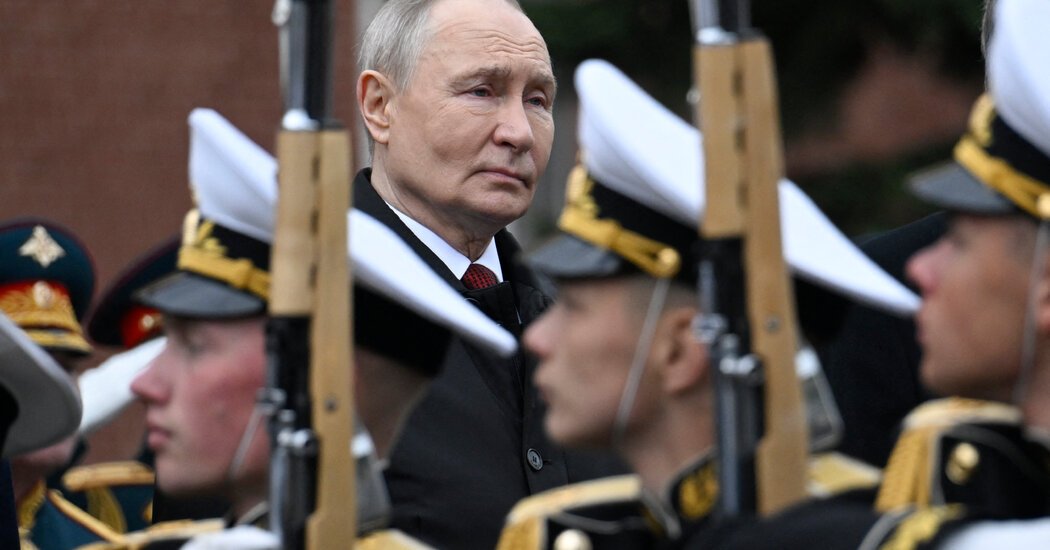
One thing seemed apparent after Moscow’s muted commemoration this weekend of the Soviet victory over Nazi Germany during World War II: President Vladimir V. Putin is feeling the pressure.
Some of it is coming directly from Ukraine, as Kyiv increases its strikes deep into Russian territory and holds Mr. Putin’s forces in a virtual stalemate on the front lines. But some of it is also coming from the home front, with rising discontent among Russians over internet restrictions and economic challenges.
So when Mr. Putin took the rostrum in front of a group of journalists after Saturday’s festivities ended, the Russian leader seemed to feel the need to send a message that he was not waging a forever war.
“I believe the matter is coming to a close,” Mr. Putin said.
That comment was the one that generated headlines. But other remarks by Mr. Putin were far from a capitulation, and showed the needle he is trying to thread as he continues to pursue a war in which many of his major objectives remain unmet.
Russian military hardware was kept away from Red Square on Saturday not only for security reasons but also because the Russian force “must focus its attention on the final defeat of the enemy,” Mr. Putin said during the news conference. He also railed against Western elites for disregarding Moscow’s interests, for what he called provoking the conflict in the first place and for mistakenly expecting Russia’s collapse. He gave no indication that he would modify his demands with a view toward ending the war.
“He wants to send a message: ‘I understand this war needs to end soon, but it needs to end on my conditions,’” said Stefan Meister, a Russia analyst at the German Council on Foreign Relations.
Though Mr. Putin’s approval ratings have fallen recently, they remain significantly higher than they were in the years before he launched his full-scale invasion of Ukraine in 2022, according to the Levada Center, an independent pollster. (Approval polls have obvious limitations in an authoritarian system.)
“It’s not that this regime is now suddenly breaking down and there is no support anymore,” Mr. Meister said. “I think what we understand now is, he is under pressure. And pressure works. He has to react somehow to it.”
Peace talks once channeled public hopes for an end to the war. But they have disappeared from the news as the Trump administration has turned its attention to the Middle East.
Boris B. Nadezhdin, an opposition politician who tried to run for president against Mr. Putin in 2024 on an antiwar platform but was barred from the race, has been gearing up to run in parliamentary elections scheduled for the fall. As part of the process, he has been conducting focus groups. He said he had not seen Russians so angry about the government since the 1990s.
“Somehow, things have taken a sharp turn for the worse since the beginning of this year,” Mr. Nadezhdin said in a phone interview.
The discontent, he said, is split into three main camps: older people who are upset about their low incomes and increased living costs; younger people who are unhappy about the new internet outages and app throttling; and a broad section of society that is frustrated by a war in its fifth year.
People tend to blame the government broadly or the local authorities, rather than the Russian leader himself, for the range of problems, Mr. Nadezhdin said.
“For the time being, the prevailing view is ‘the tsar is good, the boyars are bad,’” Mr. Nadezhdin said, repeating a common saying in Russia that refers to supposedly benevolent leaders misled by their advisers.
While Mr. Putin faces no threat from elections, Mr. Nadezhdin said that the Russian people were in the “first stage of awakening.”
Mr. Putin has appeared uncommonly vulnerable recently. The killings of Iran’s top leaders by the United States and Israel stoked the Russian leader’s fears about his own security, analysts say, and provided a rationale to disrupt the public more boldly with internet restrictions. At the same time, Kyiv has stepped up long-range strikes on Russia with new cruise missiles and drones produced domestically.