dailynewsnblog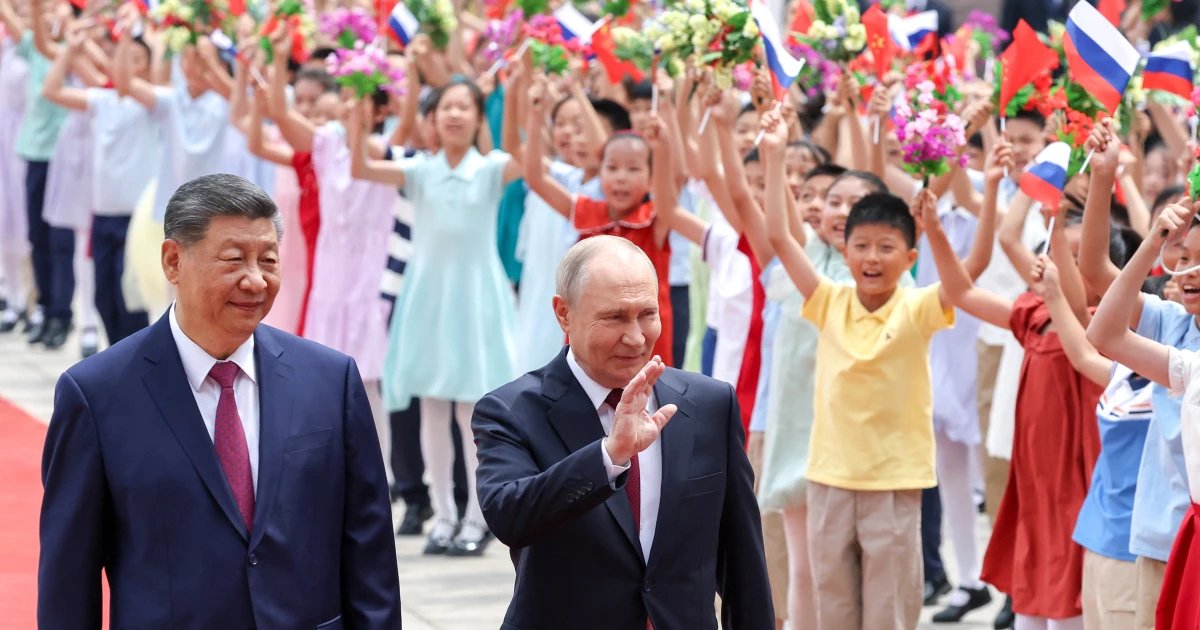
HONG KONG — China-Russia relations are at a “historic high,” Chinese leader Xi Jinping said Wednesday, as he met with Russian President Vladimir Putin in Beijing days after hosting U.S. President Donald Trump.
Subscribe to read this story ad-free
Get unlimited access to ad-free articles and exclusive content.

“The international landscape is undergoing profound changes, and the world faces the danger of sliding back into the law of the jungle,” Xi said during bilateral talks, describing China-Russia cooperation as a stabilizing force in the world.
Earlier, Xi welcomed Putin outside the Great Hall of the People in a welcome ceremony that echoed the one for Trump during his state visit last week. A military band played the Chinese and Russian national anthems, and a 21-gun salute was fired in Tiananmen Square.
For China, Putin’s two-day trip is about reassuring a trusted ally after the Trump visit offered a reset in Beijing’s turbulent ties with Washington.

Though neither Xi nor Putin referred to the United States directly in public remarks, Xi appeared to make a jab when he said the current global situation was “marked by intertwined turbulence and transformation, while unilateral hegemonic tendencies are on the rise.”
Like Putin, Xi has criticized the U.S.-Israeli war with Iran as a violation of international law, and he repeated his call to end the conflict in order to “reduce disruptions” to global energy supplies.
Putin said China-Russia relations had reached an “unprecedented level” and that Russia was a “reliable energy partner” amid the conflict in the Middle East.
Calling Xi his “dear friend,” Putin invited Xi to visit Russia next year. Not seeing Xi for a day “is like being apart for three autumns,” Putin said, using a Chinese idiom.
00:18
Putin in China for meeting with Xi Jinping
00:0000:00
The two leaders later signed nearly two dozen agreements in areas including economy, trade, education, science and technology. The Kremlin also said there was general agreement on a second gas pipeline from Russia to China, the Power of Siberia 2, though there is no timeline for implementation.
In addition, Xi and Putin signed joint statements on strengthening their countries’ “comprehensive strategic partnership” and advocating for a multipolar world. They also agreed to extend the Sino-Russian Treaty of Friendship originally signed in 2001.
They criticized Trump’s “Golden Dome” missile defense project as a threat to global stability and said the U.S. had been “irresponsible” by allowing the 2010 New START nuclear arms control treaty to expire earlier this year.
Putin also touted Russia and China’s deepening trade relationship, which had already been boosted in the wake of Russia’s invasion of Ukraine.
While Putin is no stranger to China, having visited 25 times since becoming president, he arrived Tuesday feeling a rare sense of pressure at home. His war in Ukraine looks increasingly uncertain, with losses piling up on the battlefield without meaningful progress and Kyiv expanding the reach of its drones, including into the heart of Moscow.
China has strived to portray itself as a neutral in the conflict while backing Russia diplomatically and economically. Earlier this week, the Chinese foreign ministry rejected a Financial Times report that Xi had told Trump that Putin might regret his February 2022 invasion of Ukraine, saying it “does not accord with the facts and is purely fabricated.”
In the joint statement on Wednesday, Russia said it welcomed China’s “desire to play a constructive role” in finding a peaceful solution to the Ukraine war.
U.S.-China agreements
Also on Wednesday, the Chinese Ministry of Commerce confirmed some of the details of the U.S.-China agreements previously announced by the White House.
They included the Chinese purchase of 200 planes from U.S. company Boeing in its first major Chinese deal in almost a decade. The ministry said Washington had agreed in exchange to “provide sufficient supply guarantees” for jet engines and airplane parts that Beijing has accused it of weaponizing.
The ministry said China would restore market access for U.S. beef and resume poultry imports from U.S. states deemed free of bird flu. It also confirmed the establishment of a board of trade to facilitate tariff reductions on some $30 billion in non-sensitive goods, as well as a board of investment for the two governments to discuss investment-related issues.
Neither the commerce nor the foreign ministry has confirmed the White House announcement that China has agreed to buy $17 billion in U.S. agricultural products each year through 2028.
Treasury Secretary Scott Bessent told Reuters on Tuesday that the U.S. was “not in a rush” to extend a tariff and critical minerals trade truce with China that expires in November, saying “things are stable” and “we’re seeing them again.”
Speaking to reporters in Tokyo on Wednesday, United Nations Secretary-General António Guterres said that while the Trump-Xi summit had a “certain cordiality” and may have lowered tensions between the world’s two biggest economies, the lack of any major agreements raises the stakes for Xi’s U.S. visit in September.
“Let’s be clear: No major breakthrough was achieved, and so the visit of President Xi to Washington gains an enormous importance,” Guterres said.

Trump and Xi could meet as many as four times this year, with Xi potentially traveling to Miami in December for the Group of 20 summit and Trump potentially traveling to China in November when it hosts the Asia-Pacific Economic Cooperation (APEC) summit in the city of Shenzhen.
Russian officials said a meeting between Trump and Putin could also be on the table during the APEC summit.
“I think that if both leaders are in China, they will probably cross paths and hold some kind of meeting,” presidential aide Yuri Ushakov told Russian state media. “This has not yet been agreed upon, but since there is such a prospect, it is unlikely that anyone will refuse it.”