dailynewsnblog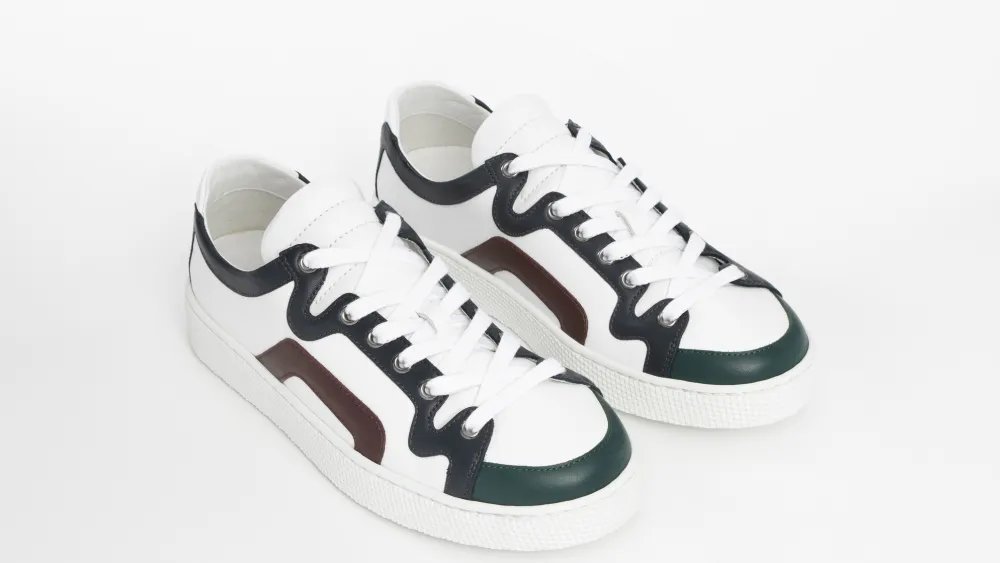
Countless brands introduce shoes and handbags with the ambition of reaching the holy-grail status of “iconic” — though only time, fickle consumer tastes and the zeitgeist determine that.
Pierre Hardy steered clear of the “I” word when discussing the relaunch of his first sneaker, dubbed the 104 when it was introduced in 2006, and now rechristened the Alpha, and zhuzhed up with colorful nylon.
But he allowed, “it’s here since 20 years, and I think it’s still relevant.”
Indeed, backed with a K-pop-inspired campaign of dancing, black-clad figures, the Alpha should appeal to new generations with its low-profile shape, graphic lines and low-key retro allure.

The new campaign for the Alpha.
Courtesy of Pierre Hardy
“When I created it, I remembered my adolescence with roller skates,” said the French designer, who founded his signature brand in 1999, nearly a decade after he began designing women’s footwear for Hermès.
Somewhat to his surprise, the 104 was a “big success” nearly from the get-go, landing on the famous feet of Usher, fanning its popularity further.
“It was very unexpected for me, because the brand was known for graphic, feminine, quite sophisticated, elegant shoes, especially for women,” he recalled in an interview.
The 104 also foreshadowed what would ultimately become a tsunami of designer sneakers, which has ebbed in recent years as the streetwear juggernaut ran out of steam amid a return to more dressed-up fashions.
In Hardy’s estimation, sneakers have now settled into the status of a wardrobe staple that instantly adds youthful zing.
“Just wear a sneaker with the most classic outfit, and it becomes something different. That’s what fashion taught us in the last 20 years, definitely,” he said. “Sneakers also opened the door for men to wear pink, yellow, orange — whatever.
“It’s a fantastic game of colors, because it’s absolutely the field where you can mix almost everything.”
A campaign image for the Alpha sneakers in colorful nylon.
Courtesy of Pierre Hardy
Hardy’s main angle on the refresh was removing a Velcro strap, and using nylon for the first time in four upbeat colors. “I wanted to make it even more young and even more fresh, and for the construction, it’s lighter and softer, too,” he said.
As part of the relaunch, he recolored his signature Alpha bags in similar shades and in three different sizes.
The sneakers, which are made in Portugal and retail from 350 to 390 euros, are to debut this week in Pierre Hardy’s two Tokyo boutiques and his four Paris locations, which include two stand-alone boutiques and shops-in-shop at Galeries Lafayette and Le Bon Marché.
“For me, it’s like a standard, I would not say basic,” he said. “If I have to keep one sneaker, it would be this one.”
At present, sneakers represent about 30 percent of Pierre Hardy’s global business, account for roughly 20 percent of the women’s business, and half of the men’s business.
To be sure, the impulse Hardy is putting behind the Alpha arises from pure instinct, rather than some scripted business strategy.
“I think that’s maybe one of the reasons people are still coming and buying shoes from me, because of this freshness or this spontaneity,” he mused.
Alongside his signature house, Hardy continues to design multiple product categories for Hermès, including footwear, fine jewelry, high jewerly, beauty products and Apple Watch Hermès.
Pierre Hardy
Courtesy of Pierre Hardy