dailynewsnblog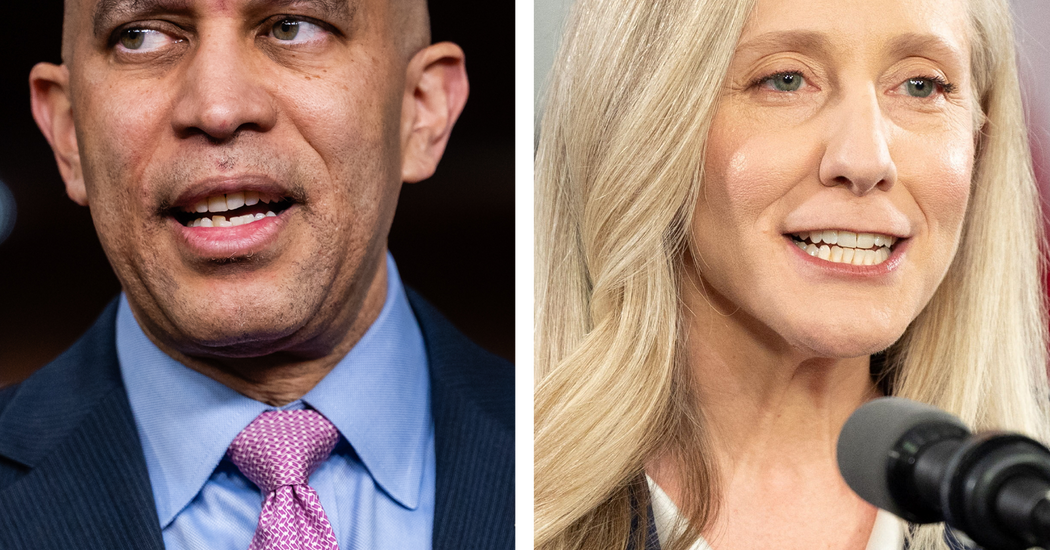
With Democratic efforts to redraw Virginia’s congressional boundaries in shambles for now, two central figures in the fight are at odds over what to do next.
Representative Hakeem Jeffries of New York, the minority leader, continues to push for “maximum warfare, everywhere, all the time,” vowing with a phrase he borrowed from Republicans to redraft lines to give Democrats an advantage not only in Virginia but across the country before the 2028 elections.
Gov. Abigail Spanberger of Virginia, whose approval ratings dropped precipitously as she campaigned for her state’s redistricting referendum, is urging her party to drop its quest for partisan advantage in favor of a more pressing issue: winning the midterms.
“It is outrageously premature of us to be talking about any sort of redistricting or map changing effort when we have to win the most consequential midterms of my lifetime this November,” Ms. Spanberger said in an interview this week, taking an unsubtle jab at Mr. Jeffries and reflecting broader disquiet among Democrats about how to counter Republican gerrymanders after the Virginia Supreme Court ruled the referendum there unconstitutional.
The issue burst into view this week on the sidelines of a policy conference hosted by the Center for American Progress in Washington. Ms. Spanberger said her party’s continued focus on redistricting was a distraction from addressing affordability, President Trump’s leadership and other issues that she said would matter far more to voters this year.
She did not say she would oppose implementing a partisan gerrymander in Virginia before the 2028 elections. But the issue is one she and some other Democrats would prefer to leave aside for now and instead focus on this fall’s midterm elections.
For years, Democrats have cast themselves as the party of good governance, offering support for initiatives that mandate nonpartisan redistricting.
But they also want to win, prompting Ms. Spanberger to focus on November.
“Anytime someone — whether it’s Hakeem or anyone else — talks about some other point off in the future, it is a distraction from the task at hand, which is winning in November,” she said.
As for talk of redistricting, the governor said, “That time is over now.”
Mr. Jeffries, who declined to comment for this article, also mentioned the goal of flipping multiple seats in Virginia this year during his public remarks this week.
At the conference, he pledged that Democrats would again seek to redraw Virginia’s maps in the next two years.
“We’re going to work as hard as we can in advance of 2028 to restore that 10-1 map, because that’s what the voters decided would be appropriate moving forward,” Mr. Jeffries said at the conference.
The dust-up comes during a week of internal conflict among Democrats, who spent Thursday confounded by the Democratic National Committee’s release of an error-ridden draft report about how and why then-Vice President Kamala Harris lost the 2024 presidential election to Donald J. Trump.
The twin disputes have put the party in disarray at a moment when Mr. Trump’s approval ratings are sinking under the weight of his unpopular war in Iran and increased prices for gasoline, groceries and other essential items. Even as some Senate Republicans on Thursday were bucking Mr. Trump’s demands, Democrats created their own challenging news cycle by releasing the 2024 autopsy.
Ms. Spanberger’s and Mr. Jeffries’s differing approaches reflect a simmering debate among Democratic leaders and voters about how best to win the midterm elections. Ms. Spanberger, who swept into Congress in 2018 and into the Virginia Executive Mansion last year with a disciplined economic message, counts herself among those Democrats who would prefer a focus on cost-of-living concerns, which they believe are central to regaining control of the House.
Mr. Jeffries and the activists who support his effort believe they can also energize the party’s base with promises of a muscular response to bare-knuckle Republican tactics, in which Democrats press for more power in blue-state legislatures across the country.
Democrats made the political calculation to fight fire with fire in response to a Republican campaign to redraw congressional districts to maximize the G.O.P.’s structural advantage in a bad political environment.
Their efforts largely failed: Republicans are expected to gain between six and 12 G.O.P.-leaning districts before the midterms. (Mr. Jeffries, at the Washington conference, put the number at three to four.)
The Virginia governor was initially a reluctant supporter of Virginia’s redistricting efforts, but she said she broadly supported attempts by Democratic-controlled state legislatures to redraw lines.
Now, she said, Democratic leaders must turn their attention to issues such as affordability and what she described as the chaos and corruption of the Trump administration.
Ms. Spanberger’s remarks were her most extensive yet on the demise of a plan hatched without her input this year to allow for a mid-decade redistricting in Virginia.
She spoke to The Times following remarks from Mr. Jeffries at the same conference in which he telegraphed a desire to implement the congressional map that Virginia voters approved in a referendum last month. The map was subsequently overturned by the State Supreme Court.
Mr. Jeffries has staked significant political capital on a nationwide push to create more blue districts. His effort has prompted cheers from Democratic activists who are eager to see their leaders push back more forcefully against Mr. Trump.
Yet the effort in Virginia reveals the complexity of the issue among voters. It featured more than $100 million in advocacy spending, but it passed by a margin far narrower — about three points — than Ms. Spanberger’s 15-point victory last fall. It also coincided with a precipitous drop in her approval ratings. In recent weeks, her approval ratings in public polls have fallen under 50 percent.
Continuing to focus on redistricting sends an inherently deflating message that those four Republican-held seats are unwinnable in their current form, she said. Mr. Trump won two of those districts by five percentage points or less. He won a third district that Democrats believe is competitive by 12 points.
“I would love it if every person who spent time in Virginia, or sent their money to Virginia, or gave opinions about what should happen in Virginia, would now spend their time sending money to the candidates who are now desperately trying to win races that are winnable,” she said.
The party’s voters are divided over the redistricting efforts. In a recent CBS News Poll, just 32 percent of Democrats said they wanted their state to draw more districts to benefit Democrats (39 percent of Republicans shared similar beliefs about Republican districts). Another poll, from Politico, found that 45 percent of people who had voted for Ms. Harris in 2024 said that Democrats must counter G.O.P. efforts, “even if it means reducing the number of majority-minority districts.”
While most Democratic governors or candidates for those offices have not been as explicit as Ms. Spanberger, a number of them are avoiding full-throated support of 2028 redistricting, at least as a midterm message.
Asked if he would support a new map to benefit his party, Gov. Josh Shapiro of Pennsylvania said he was “not going to focus on some hypothetical in the future.”
He added: “We’re running under these maps, and we’re going to have four competitive — at least, let me restate that, at least four competitive congressional races this cycle. That’s all I’m focused on.”
A spokesman for Senator Amy Klobuchar’s campaign for Minnesota governor pointed to limits in the state’s Constitution regarding redistricting in the middle of a decade as a reason she had not been making it part of her pitch to voters. A spokesman for Gov. Katie Hobbs, a Democrat in Arizona, declined to comment on a potential redistricting effort there.
Other Democratic governors or candidates for those offices are fully supportive of the effort.
“We have to do everything we can to fight back,” Senator Michael Bennet, a Democratic candidate for governor in Colorado, said in a statement. He said he supported the “one-time change to Colorado’s Constitution.”
Gov. Kathy Hochul of New York also supports a redistricting push ahead of 2028. “It’s a fight for our democracy,” she said in remarks this month. “I want to make sure that New Yorkers have representation when it comes to decisions affecting their lives.”
Katie Glueck contributed reporting.