dailynewsnblog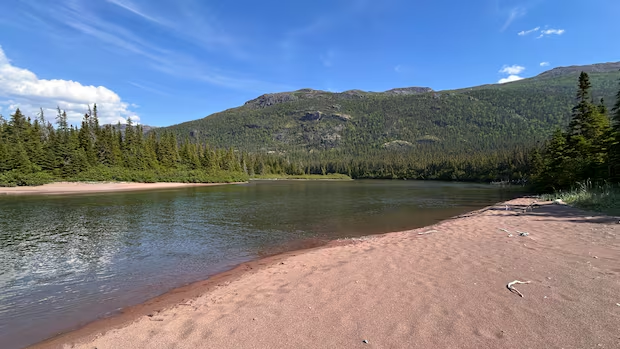
A recent report on the Akami-Uapishku-KakKasuak-Mealy Mountains National Park Reserve says Parks Canada is operating in a “complex and highly charged context” in Labrador — and recommends the federal agency end its existing agreement with the NunatuKavut Community Council (NCC).
The report was commissioned by Parks Canada as an independent, general review of how the park has been established and managed so far. Eric Maldoff, a Montreal-based lawyer and political advisor, conducted the review over an 18-month period and wrote the final report.
Spanning an area of about 10,700 square kilometres, the Akami-Uapishku-KakKasuak-Mealy Mountains National Park Reserve includes the renowned Wunderstrands stretch of sandy beaches, boreal forest landscapes and the Mealy Mountains.
Currently in the early stages of development, park entrances are planned for the communities of Sheshatshiu, Rigolet and Cartwright. This means members of Innu Nation, the Nunatsiavut Government and the NCC will all live on the park’s doorstep.
Parks Canada signed agreements with all three organizations “in good faith,” Maldoff writes in the report. He says the Nunatsiavut Government and Innu Nation are able to work together with relative ease.

However, neither Nunatsiavut or Innu Nation recognize NCC as an Indigenous organization.
Inuit Tapiriit Kanatami, which describes itself the national representative organization for all Inuit in Canada, also disputes NCC’s claim of Inuit identity.
“Relations between NCC on the one hand and the two recognized Indigenous groups on the other hand have been extremely strained and have resulted in a standoff impeding Parks Canada’s ability to advance its work in managing and developing the Park based on a collaborative approach,” writes Maldoff in the report.
Differing agreements with Parks Canada led to ‘discord and confusion,’ says report
Maldoff’s task was to identify sources of ongoing friction at the park, and chart a practical path forward. Assessing Indigenous identity and/or determining section 35 rights was not part of the process, he writes.
Maldoff said from time to time, Parks Canada enters collaborative management agreements for national park reserves, which typically happens when park land overlaps with an Indigenous land claim that’s already accepted for negotiation.
Eight per cent of the Akami-Uapishku-KakKasuak-Mealy Mountains National Park Reserve overlaps with Nunatsiavut’s land claim, which was settled in 2005.
Innu Nation is currently negotiating its final land claim agreement. One hundred per cent of the First Nation’s land claim overlaps with the park reserve.
Because of these land claims, Maldoff writes, Parks Canada signed impacts and benefits agreements with both Nunatsiavut and Innu Nation, entitling them to “very high, if not the highest level” of consultation on park development.
Although NCC has submitted a land claim that includes the entirety of the park, it has not been accepted for negotiation.
Parks Canada signed a shared understanding agreement with NCC in 2015. Maldoff says this agreement is similar to an impacts and benefits agreement, but not as “precise and rigorous.”
The shared understanding agreement, writes the political advisor, “seems to have created the impression” that NCC is entitled to the same level of consultation as Nunatsiavut and Innu Nation. But this isn’t actually the case, Maldoff says.
“This has been a source of discord and confusion,” he writes.
Maldoff says little has been accomplished in the 10 years since Parks Canada signed its shared understanding agreement with NCC. His main recommendation is for Parks Canada to end that agreement.
He also recommends Parks Canada consult and work with NCC on a separate basis from Nunatsiavut and Innu Nation, and that it should create a traditional land users advisory committee, representing the views of Labradorians living near the park.
If Crown-Indigenous Relations and Northern Affairs Canada determines NCC is an Indigenous group with Section 35 rights, Maldoff recommends Parks Canada negotiate an impacts and benefits agreement with NCC at that point.
NunatuKavut, Nunatsiavut and Innu Nation weigh in
Derek Simon, a Halifax-based lawyer for NCC, said the organization was disappointed with Maldoff’s report — but not surprised.
“They had a number of concerns with this process from the outset,” Simon said.
One of their main issues, said Simon, is the fact that Maldoff served as a federal negotiator involved in Innu Nation’s land claim.
“I think that raises a serious question of, you know, real or perceived conflict of interest,” he said.
A decision to terminate the shared understanding agreement with NCC would do “significant damage” to its relationship with Parks Canada, said Simon.

For its part, the Nunatsiavut Government is lending the Maldoff report its full support.
“As the only Inuit Treaty Organization in Atlantic Canada, the Nunatsiavut Government affirms that programs, rights, resources, and opportunities intended for Inuit must benefit Inuit and should not be diverted to unrecognized groups,” reads a Nunatsiavut statement.
Jack Penashue, Innu Nation’s superintendent working with Parks Canada, also welcomes Maldoff’s report.
He said NCC’s claim to 100 per cent of the park reserve — which is included in Innu Nation’s land claim — has angered a lot of Innu.
“To be blunt, really, I guess it’s an attack on you and your families and your ancestors, your everything else that you’ve been told and believed, that this is Innu land,” Penashue said.
Penashue said NunatuKavut’s agreement with Parks Canada was holding up processes and leading to arguments. He believes park development will move more quickly if Maldoff’s main recommendation is accepted.

Penashue also welcomes Maldoff’s recommendation to create a traditional land users committee for the park.
“There’s a lot of good people in Labrador that really use the land and respect the land,” he said.
“We need to have a conversation with people in Labrador in terms of, how can we build a relationship with the Innu, and how can we develop a relationship with Labradorians working and developing a national park,” said Penashue.
In a statement, Parks Canada said it was reviewing the recommendations of Maldoff’s report, “and will determine next steps in due course.”
Download our free CBC News app to sign up for push alerts for CBC Newfoundland and Labrador. Sign up for our daily headlines newsletter here. Click here to visit our landing page.