dailynewsnblog
There are so many reasons a show based on Among Us shouldn’t work. The show is debuting in 2026, years after the multiplayer game had its cultural moment. It’s on Paramount Plus, during an economic crunch when viewers might be paring down streaming subscription services. The game itself is improvisational, and heavily dependent on what players bring into it. The characters you play aren’t really people: they’re literally visors differentiated only by suit colors.
Yet, despite all odds, the Among Us show doesn’t just work. Based on the five 13-minute episodes I previewed, Among Us is a contender for one of the best animated shows of the year. Even more surprising: It’s a sharply written show that can appeal to everyone, whether they’ve played the game or not. It’s faithful to the games and constantly hilarious. But what caught me most by surprise is just how political it is. The social commentary is constant, but without feeling too on the nose or overshadowing the show as a whole.
The show takes place on a ship tasked with delivering a precious resource to a corporation. We join the crew as two new recruits, Green (Elijah Wood) and White (Patton Oswalt), are given an orientation that stresses the company’s supposed progressive values. An HR representative, Orange (Yvette Nicole Brown), introduces the new workers to the rest of the squad.
The show transforms empty avatars into zany, Julio Torres–like archetypes. Purple (Ashley Johnson), the cop-like color, serves as the security chief. The ship’s captain, who desperately wants to be competent, is Red (Randall Park). Black (Liv Hewson) is the cynical, no-nonsense worker, who is paired up with the spiritually breezy gemologist, Cyan (Kimiko Glenn). Every characterization makes sense without ever feeling predictable. Among Us cleverly captures every color’s vibe in a way that makes the viewer aware they have made complex, unspoken associations.
Among Us is a hand-drawn and scripted production. Maybe that sounds like any other TV show, but series creator Owen Dennis (best known for Infinity Train) says it is a rarity in the world of animation. These days, most cartoons are storyboarded and animated via computers or puppet animation, not painstakingly rendered by a human hand, frame by frame. It’s a time-consuming process, but one that paid off for Among Us. Jokes constantly build on one another in ways that are difficult to achieve when there are too many cooks in the kitchen.

Despite the fact that all the characters in Among Us are shaped exactly the same — and obscured by spacesuits — the show is also wildly expressive. Dennis, who previously animated characters like One One on Infinity Train, told Polygon that visually distilling emotions with limited character designs was still one of the most challenging aspects of the show.
Thinking abstractly about facial expressions helped.
“In this show there’s only one circle, it’s the big visor, and you can shape the visor in different ways to make it feel almost like a face,” Dennis tells Polygon. “Like the eyebrows, or the top half of the visor; and the mouth is the lower half of the visor.”
They were never like: Hey, that joke’s too weird.
Animators brought onto the show needed to be able to think outside the box.
“I wanted to make sure we brought people who had a mental library of comedy anime,” Dennis says, “because comedy anime are more likely to do things like break characters or change the models, or do things that are quite extreme in their humor.”

Though it’s a straightforward murder mystery, the show as a whole isn’t afraid to get experimental. Gears shift rapidly from moment to moment, in ways that are reminiscent of classic cartoon episodes like SpongeBob’s iconic time-travel odyssey “SB-129.” Not only does the show’s intro change from episode to episode, artists sometimes shift dramatically from scene to scene.
Artists were “given as much freedom as they could have,” Dennis says. No jokes got cut during production. Among Us game developer Innersloth was also happy to give guidance when needed, and some rules had to be followed. Characters had to be depicted with backpacks that were visible at all times, for example, and the signature shine in the character design couldn’t be used like a pupil. Aside from these simple edicts, the studio was otherwise hands-off.
We are currently living within a bunch of systems that have really failed us.
“Everyone always says, take some wild swings, do something weird, and that’s not true,” Dennis says of his previous experiences. But this time, the studio really meant it. “They just let us go nuts with it.”
“I was really surprised,” he adds. “They were never like, ‘Hey, that joke’s too weird.'”
The permissive attitude is remarkable when you consider the subject matter. Dennis describes Among Us as a workplace comedy, less in the vein of The Office and more in the realm of The Thing. There’s a monster lurking about — an impostor if you will — that kills crew members. Even so, the true antagonist of the story could be seen as the company that everyone works for, like in Alien. No matter how bad things get, the crew still has to make its delivery.

The company never threatens anyone, and you can’t draw a straight line between the danger faced by crew members and official company mandates. Among Us deftly captures the banal doublespeak of a corporation that can ruin a life with a cheerful email. Some might see the show’s sensibility as ‘woke.’ As far as Dennis is concerned, he’s tapping into something much more universal.
“I think any of us can look around at the world right now and feel a thing or two about corporations,” Dennis mused, “These are things I’ve been feeling for decades, and I think they’re things other people have been feeling for decades. I think a lot of people are feeling very tired of ‘them’ winning all the time, you know? We are currently living within a bunch of systems that have really failed us.”
Among Us does touch on mature topics, but it’s not necessarily a show aimed at adults. There’s some social critique here, for people who want to read into things. For everyone else, the show is serious and goofy in equal measure. For Dennis, the ultimate goal is to make you fall in love with these weird little characters that were never meant to have any personality in the first place.
“I want to make people feel emotionally attached to these characters that look stupid.”
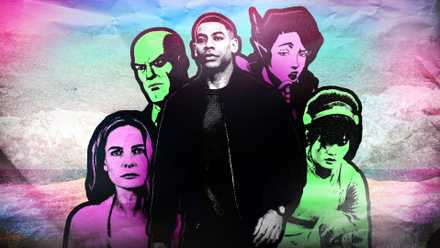
The 10 most anticipated TV shows of summer 2026
It’s a season of superheroes, spacefarers, vampires, and dragons