dailynewsnblog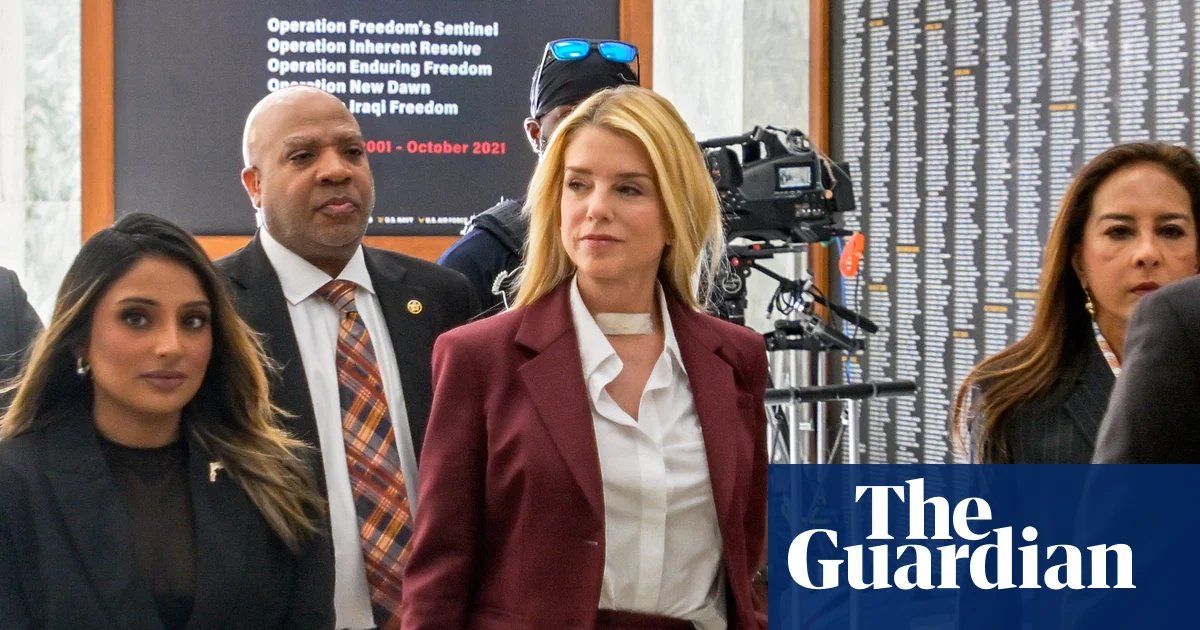
Pam Bondi, the former attorney general, defended the Department of Justice’s (DoJ) handling of the Jeffrey Epstein files under her leadership on Friday, and told lawmakers on the House oversight and reform committee that she did not “lead every aspect” of the department’s effort, but rather she delegated oversight of the process to Todd Blanche, her former deputy attorney general, who is now acting attorney general.
Democratic lawmakers also said that Bondi refused to answer questions about Donald Trump’s involvement in the release of the files.
“We demonstrated an unprecedented commitment to transparency in the department’s search for, collection and review of the Epstein files,” Bondi said in her prepared opening statement, obtained by the Guardian.
Bondi appeared before the committee on Friday morning to answer questions from lawmakers about the Department of Justice’s handling of the Epstein investigation and its release of the files under her leadership.
“This was an enormously complicated and labor-intensive process,” Bondi said in her remarks. “To the best of my knowledge, the department produced everything required under the Epstein Files Transparency Act.
“As the head of a large department with broad responsibilities, I did not lead every aspect of this effort or conduct that document review myself,” she added, saying that she “delegated oversight over this process to Deputy Attorney General Todd Blanche”.
“The team of professionals who reviewed all of the materials that we collected assured me the only materials that were withheld were either nonresponsive, privileged or duplicative,” she said.
During her opening statement, Bondi also admitted that “there were redaction errors” but said that “since day one of this process, this department has been committed to accountability and transparency”.
“Our stance has always been that the department stands ready to review any potential evidence of criminal activity related to Epstein and his associates and would pursue appropriate investigative or prosecutorial action wherever the facts and law warrant.
“The bottom line is: justice and transparency in this matter have been delivered at the direction of President Trump and his administration,” she concluded.
The committee announced in late April that Bondi would be appearing before the panel as part of its investigation into Epstein, shortly after Democrats on the committee filed a civil contempt resolution against her.
Bondi’s appearance comes as the justice department has faced criticism in recent months over its compliance with the Epstein Files Transparency Act, after the department failed to meet the act’s 19 December deadline to release the relevant files, instead releasing what it claimed were the full files on 31 January.
“What documents remain?” the representative James Comer, the Republican who chairs the committee, said on Friday ahead of Bondi’s deposition. “Why haven’t they been turned over? We’re going to try to determine whether or not there can be more documents legally turned over.”
Robert Garcia, a representative and the top Democrat on the committee, said on Friday morning that “we continue to be incredibly disappointed of the decision to not have this interview videotaped and then released to the American public”.
Several hours into the questioning on Friday, Garcia came out of the room where the interview was taking place, and told reporters that Bondi told the lawmakers that “it was Todd Blanche, the current acting AG, that was leading the Epstein investigation and quite frankly, all of the mistakes that we saw, the redactions, not protecting survivors, she continues to push that back on to the acting AG Todd Blanche”.
Garcia also said that he asked Bondi “five times and five different questions about her conversations with President Trump, whether he directed her on the Epstein files, what he knew, what he asked her to redact or not, and she refused to answer any questions about President Trump”.
On Friday afternoon, Bondi pushed back on Garcia’s claim that she pushed “all of the investigation and the blame on Acting AG Todd Blanche”, calling it “NOT TRUE” in a post on social media, adding that she “praised Acting AG Blanche’s management of this Herculean task. I said his ethics are beyond reproach and that he is an incredible Attorney General.”
Survivors of Epstein’s abuse have also in recent months raised concerns that sensitive personal information was improperly disclosed in the files, while several lawmakers have also criticized some of the redactions in the documents. The department has maintained that it acted in accordance with the law.
Ahead of Bondi’s deposition, several survivors held a brief news conference in which they said that they were hoping for “truth and transparency” and to get “some answers” from Bondi’s testimony on Friday.
“We hope that there is no deflection,” said Danielle Bensky, one of the survivors. She added: “Survivors were outed, there were Jane Does in these files who were mentioned over 500 times, that is so unacceptable, nude photos.”
Maria Farmer, another Epstein survivor, also released a statement on Friday several hours into Bondi’s questioning, in which she said that Bondi’s “continued evasion of questions about her grave mishandling of the release of the Epstein files was not surprising – it’s a pattern of behavior”.
“At every turn, Bondi has ignored and disregarded the will of Epstein survivors who have waited for justice for decades and even now, as a private citizen, she refuses responsibility for her missteps and failures,” Farmer added.
“I have waited for justice since I first came forward to the FBI in 1996 – enough is enough,” she added.
Bondi was formally subpoenaed by a bipartisan group of lawmakers on the committee in March, while she was still serving as attorney general. In that subpoena letter, Comer wrote that there were “questions regarding the Department of Justice’s handling of the investigation into Jeffrey Epstein and his associates and its compliance with the Epstein Files Transparency Act”.
However, after Donald Trump removed Bondi from her role, the committee said it was informed by the justice department that Bondi would not be appearing for the scheduled deposition, arguing that “the committee issued the subpoena to Ms Bondi in her official capacity as attorney general” and Bondi “no longer holds that office” and therefore “the subpoena no longer obligates her to appear”.
Bondi did not appear for her requested deposition date, and in late April, Democrats on the committee filed a civil contempt resolution against her. Shortly afterward, the committee announced that Bondi would appear before the panel on 29 May. Her interview will be transcribed and the transcript will be released at a later date.
In a statement to the Guardian this week, a spokesperson for the Department of Justice said that the assistant attorney general, Harmeet Dhillon, and other Department of Justice personnel would attend Bondi’s transcribed interview “to assist the committee in understanding the department’s role in implementing and complying with the Epstein Files Transparency Act during her tenure”.
“Because former attorney general Bondi oversaw the department at the time the act was enacted and carried out, [the justice department’s] presence is solely to ensure accurate representation of department processes, facilitate any necessary clarifications and support a complete factual record for the committee,” the spokesperson said. “As with any congressional engagement involving past department actions, [the justice department] routinely provides staff with relevant institutional knowledge to support transparency, accuracy and cooperation with oversight responsibilities.”
In mid-March, Bondi appeared for a closed-door briefing with the panel, during which Democrats stormed out, accusing her of refusing to commit to complying with a subpoena for her sworn testimony in front of the committee.
Earlier this week, Axios reported that Trump had recently appointed Bondi to an advisory committee focused on AI policy. It was also reported this week that Bondi was diagnosed with thyroid cancer shortly after leaving the justice department. She told CNN that she was undergoing treatment, and was still recovering.