dailynewsnblog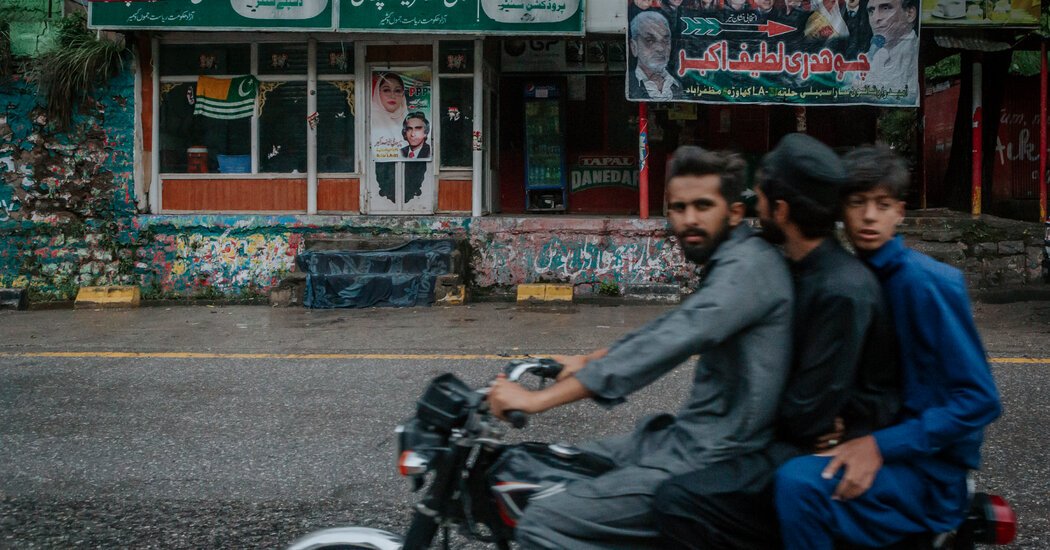
Pakistan has begun a sweeping new crackdown on reporters that rights groups and local journalists say will close off one of last remaining ways to get independent journalism about the world’s fifth-most-populous country.
The government imposed new restrictions that require all journalists working for foreign media outlets to seek permission to travel outside Pakistan’s three major cities. The rules come after a surge of media covering elections in the Pakistan-administered part Kashmir, a disputed region where protesters have been campaigning since early June for more political autonomy.
“The requirement that journalists obtain state approval to report from large parts of the country sends a chilling message: that critical reporting is unwelcome,” Pakistan’s leading human rights organization said in a statement.
Pakistani journalists covering the unrest in Kashmir are facing especially intense pressure.
Two independent Pakistani journalists working in the part of Kashmir that Pakistan controls were detained on Aug. 1 and taken to an undisclosed location, according to the Committee to Protect Journalists, a New York-based nonprofit. Several other journalists who work for Pakistani news organizations said they have been summoned to court for their reporting on the region under a law criminalizing “false and fake information.”
On Sunday, the government criticized the reporting of a Pakistani journalist working for Al Jazeera, who was covering the provincial elections in Pakistan-controlled Kashmir. (India rules the other part of the region.) Pakistan also ordered all journalists working for foreign outlets to leave the territory immediately.
The government then announced that any journalist working for an international news organization must obtain authorization from the government to report from anywhere other than the capital, Islamabad, and Pakistan’s two largest cities, Karachi and Lahore.
Foreign reporters were already limited to those three cities unless they apply for and are granted permission from the government to travel elsewhere. In practice, it can take months to get that permission, and in some cases, there is no response at all.
The new restrictions on journalists’ work would represent an “alarming step in the country’s narrowing space for press freedom and free expression,” said Patricia Gossman, Human Rights Watch’s senior associate Asia director. Pakistan ranks 153rd out of 180 countries in the Reporters Without Borders’ Press Freedom Index.
The Pakistan Federal Union of Journalists called for an end to the reporting restrictions. “If the government is really interested in showing that it believes in democracy and press freedom, then it should immediately lift this ban,” the group said in a statement.
In a statement, Pakistan’s Ministry of Information said that foreign media outlets would be able to operate as usual despite the new rules. It said the ministry was working on a new system for issuing travel permits.
“The Pakistani leadership has to know these moves will not work and in fact will backfire,” said Kamran Bokhari, a Pakistani analyst and senior resident fellow at the Middle East Policy Council, a research center based in Washington. “It is a classic case of trying to control the narrative, but in this post-social media and post-AI age these tools of a bygone era do not work.”
It is unclear how the Pakistani government will enforce the new rules, since many of the Pakistani journalists who work with foreign news outlets are already based across the country.
While the new rules apply to reporting throughout Pakistan, they will have an immediate effect on coverage of the elections in Pakistan-administered Kashmir, which is scheduled to end on Aug. 10. A political protest movement in the region is calling for constitutional changes that Pakistan has refused to consider.
Pakistani government officials have accused the protesters of using violence against security forces, while demonstrators have accused the police of repressing a peaceful movement with force. At least 30 people, including protesters, law enforcement personnel and bystanders, died in clashes in June and July, according to local officials and independent estimates.
Reporters in Pakistan have in recent years faced increased censorship and financial pressure, including frozen bank accounts and the suspension of government advertising, forced removal, and arbitrary arrests and imprisonment, according to journalists and human rights groups.
And over the past year, representatives of Pakistani security agencies have lobbied journalists to start state-friendly English-language news outlets, according to journalists who were approached for the ventures and officials.
The country’s leading editors’ organization has referred to the government’s approach to the Pakistani press as one of “complete control.”