dailynewsnblog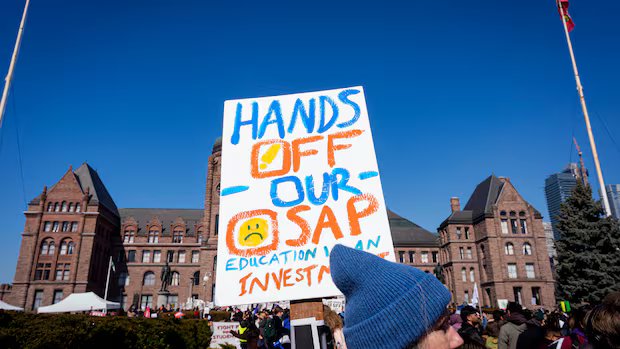
When Ontario Premier Doug Ford’s government drastically cut student assistance grants earlier this year, it cited “unsustainable” costs, but new figures show nearly all of the recent growth was among private career college students.
Data obtained by The Canadian Press through a freedom of information request shows that between the 2023-24 and 2024-25 academic years, the province spent $465 million more on Ontario Student Assistance Program grants, and 95 per cent of that went to private career college students.
That points to a problem of the government’s own making and the solution did not have to penalize students at universities and publicly funded colleges, opposition critics said.
“Doug Ford used the rising cost of OSAP as his excuse to gut student aid, slashing the grant portion from 85 per cent down to 25 per cent and leaving students to take on more debt,” Liberal critic for colleges and universities Tyler Watt wrote in a statement.
“These numbers show that excuse doesn’t hold up.”
When students apply for Ontario financial aid, they are also assessed for federal assistance, and the new data shows that while overall both the Ontario and federal portions of what students have been receiving are on the rise, one category stands out.

In the wake of Premier Doug Ford’s OSAP cuts, questions persist around how the program actually works. CBC’s Julia Knope breaks down what we know.
University students received about $370 million in Ontario Student Grants in 2023-24, an amount that actually decreased the following year to about $354 million. Students at publicly funded colleges received $349 million in 2023-24 and $386 million the next year. Canada Student Grants rose at relatively similar paces.
Career college students, however, received about $554 million in Ontario Student Grants in 2023-24, and the following year they received about $994 million.
That is more than the amount of Ontario Students Grants for public college and university students combined.
During the same time period, the amount of Canada Student Grants those same students received was far lower, and was a smaller relative increase, from $201 million in 2023-24 to $338 million the next year.
NDP Leader Marit Stiles said with most of the increase coming in career college usage, it looks like the government was just looking for an excuse to cut all OSAP spending.
“I think they were unwilling to only make cuts that impacted their friends at the private career colleges,” she said.
“It just shows me that they never actually explored options that would have saved the program, and it’s students that are going to pay the price.”
Career college students no longer eligible for OSAP grants
Colleges and Universities Minister Nolan Quinn earlier this year announced that career college students would no longer be eligible for OSAP grants, following similar federal changes, but he also made sweeping changes to financial aid for university and college students, citing unsustainability.
The proportion of non-repayable grants a student can receive through OSAP was reduced from 85 per cent to a maximum of 25 per cent.
Students and advocates said the greater emphasis on loans to fund their education would leave students graduating with much higher levels of debt amid an affordability crisis.

Hundreds of Ontario students gathered at Queen’s Park in protest of Doug Ford’s cuts to the Ontario Student Assistance Program. CBC’s Ali Chiasson spoke with students who fear not being able to afford their education.
The College Student Alliance, which represents students at four publicly funded colleges, said the new data raises important questions.
“Grant funding for students at private career colleges appears to have grown much faster year over year than funding for students at publicly funded colleges,” the alliance wrote in a statement.
“Students deserve to know what evidence is informing OSAP policy changes, how impacts are being tracked, and whether support is being delivered fairly across the system.”
Until 2017, the grant and loan ratio was 15 to 85 per cent, with then-premier Kathleen Wynne flipping the ratio late in her tenure.
The province’s auditor general in 2018 said that the province projected a 50 per cent increase in net annual costs of OSAP due to those changes, to $2 billion in 2020-21. Provincial spending on OSAP grants is only just now reaching that level, however, due to a drop in demand during the pandemic.
Government projections show the grant spending rising to $2.7 billion by 2028-29, but would not say how much of that would be due to private career college students and those at publicly funded institutions.
The auditor made no specific conclusion that the spending was unsustainable, but she found that even that sharp rise was likely underestimated, since the ministry did not factor in increased uptake.
Career college students got more in grants on average
Quinn said there has been significant growth at private career colleges, but also at publicly funded colleges, and the government needed to act to rein in spending.
“As the auditor general stated, when the changes were made in 2017 it was unsustainable,” he said recently at the legislature. “We want to ensure it’s available for the next generation of students as well.”
Career colleges often have higher tuition levels and a recent freedom-of-information request on OSAP by news outlet the Trillium found that in 2024-25, university and college students received $5,500 to $7,000 on average in grants, while career college students received more than $15,000 on average.
Quinn’s OSAP announcement was made along with news of $6.4 billion over four years for colleges and universities, funding that the sector had long urged after years of low levels when compared to other provinces.
That became critical after federal government changes to immigration removed much of the ability for the institutions, particularly colleges, to get large amounts of revenue from international students, who pay higher tuition.