dailynewsnblog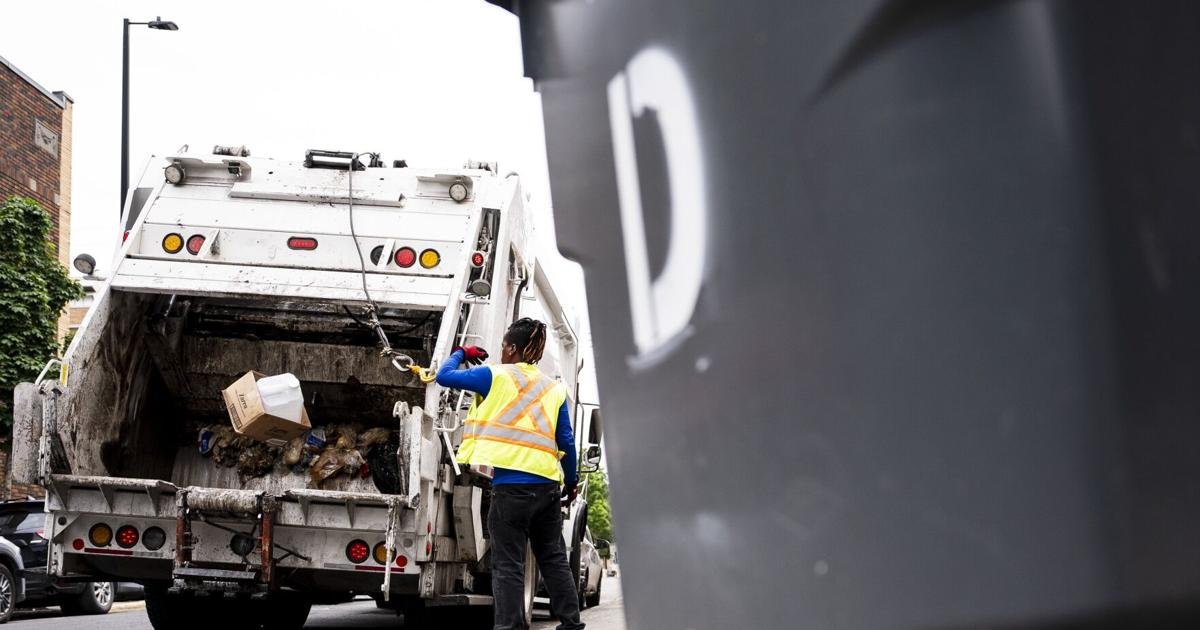
Montreal’s garbage collection might seem like the Bizarro world to Torontonians: each of its 19 neighbourhoods, or boroughs, sets its own schedule and handles its own contracts, and collection is done not at night but during the day, typically the early morning. The labourers who run behind the truck picking up the waste are called helpers. In this book now available in English, “Trash! A Garbageman’s Story,” we meet those workers: flawed, hard-working, self-destructive and vital.
Old André was one of the first helpers I ever worked with. When we met he was fifty-two, with graying hair licked back and forever covered by a dirty, faded cap that sat crooked on his head. Picture your mental image of a paragon of fitness. Now imagine the opposite. That’s André: smoke in his mouth, big stout gut, and always a beer on the go somewhere in the truck. There was nothing graceful about the man’s style. Both carrying his body and carrying the garbage seemed to demand a painful effort from him. When he worked, his face would screw up into terrible grimaces.
And yet — the old guy just kept on going. He could run for ten hours, if that was what it took. Meeting Old André blew my mind. He was truly built different. I’d never seen anything like it. He was an athlete of a kind I’d never come across or known about: a real working man.
André was in most ways a typical garbageman of his generation: heavy drinking, but not into drugs. The younger ones, my generation, prefer smoking weed. Some take speed, to boost their performance, and others do harder drugs, for the high. But you don’t find many alcoholics. And you definitely don’t get many like me who lead relatively healthy lives. I work out, I try to eat a healthy diet, and when I get home, I don’t spend the rest of the night getting bombed. I grew up with a mom who protected me from my dysfunctional, violent, alcoholic father who could have destroyed my self-esteem. My upbringing made me keenly aware of my limitations. For all these reasons I have always worked in the garbage business, but only part-time. That way I can stay in shape, and pursue other projects, like writing a book.
You won’t find many garbagemen who age well. I’m thirty-nine now, and for at least five years people have been asking me if I’m going to stop running soon.
Beaujeunehomme
It’s early in the morning, and my day starts off on Avenue des Pins, in Montreal’s Plateau district. As we’re picking up the very first bins, Beaujeunehomme rolls up. The nickname, which means “handsome young man,” is clearly a relic of the past. Beaujeunehomme isn’t young anymore, and as for handsome, let’s just say he’s not what he used to be.
Though it’s eight in the morning, he’s drunk. Although drunk doesn’t cover it. Beaujeunehomme is pissed to a degree that’s hard to fathom. His face has that telltale red tint from high blood pressure, his eyes are yellow, and it’s not hard to imagine that if you made an incision in his arm a stream of alcohol would spurt out. I let the driver know, and he tells the boss. The answer? Don’t worry: it’s just Beaujeunehomme’s normal state.
So we carry on. Beaujeunehomme is fifty-two, and running around in a state of inebriation that would make even the hardest drinkers stagger. Yet I know plenty of people who could show up stone cold sober, and in perfect health, and not come close to working as hard or as well as he’s managing to do. It’s kind of sad that there’s no award for this rare ability.
Despite his spectacular work ethic, Beaujeunehomme has hit a dead end in the industry. He doesn’t have a driver’s license, so he can’t climb the only ladder within reach and start driving the truck. It may seem surprising, but making the move to driver is what finally helps many garbagemen outrun their problems. It’s not a cushy job by any means, and it comes with heavy responsibility. The driver is in charge of everything — the crew, the route, and of course the truck itself.
On the personal front, Beaujeunehomme is also in a rut. He’s living on his own. His girlfriend has left him, and his daughter doesn’t want to see him anymore. But he keeps right on trying to save money, for her sake. He talks about it with pride, gets emotional. She’s at university. Beautiful, bright, and healthy, and Beaujeunehomme loves her. He’s always waiting for her call, but isn’t holding his breath.
Beaujeunehomme lives in a basement apartment in Laval, furnished with mismatched flea market furniture he’s picked up here and there. Everything Beaujeunehomme owns is worn out. The man has a thousand and one great stories to tell — tales of inheritances, financial investments, and Ali Baba’s caves, a trove of treasures he’s owned and then lost.
His buddies — all garbagemen themselves — love the guy. They all know Beaujeunehomme’s life will come to an abrupt end one day — and I think they’re good with that. Sure, his benders are the stuff of myth and legend, but the brokers always hire him back anyway. Everyone in the garbage business accepts him just the way he is, unconditionally, few questions asked. Sometimes keeping your mouth shut is an elegant way to love someone.
Beaujeunehomme is a castoff who feels right at home surrounded by garbage.
Jo
Word has gotten around: a broker that I’ve worked for before is losing its contract in Montreal’s Saint-Michel district. When that happens, the guys start jumping ship, before it sinks altogether. And if a broker is so short-staffed that they can no longer service a route, they can face hefty fines from the City. Add in the fees incurred by the subcontracting firm, and the broker can be staring down bankruptcy.
For the mercenaries of the garbage business — people like me — the misfortunes of brokers are great news. Since I don’t work full-time, I’m not at the mercy of any one boss. I sell my services to the highest bidder. And when a broker finds itself short-staffed, I can choose to help them out — for the right price. The broker knows it’s better off overpaying me than breaching its contract.
That’s how I find myself here, at the meeting point in Saint-Michel. The man driving the truck is my old acquaintance, Frank the Runner. And once I’m in the back, I realize that the other guy I’m running with is Jo. Amazing. He’s one of the first guys I worked with, back when I was just eighteen. A real athlete, who could be counted on to knock off the most demanding routes. Intense is a good word to describe Jo. He’d run behind the truck with his mouthpiece on, all day, to train his breathing for his boxing class later that evening. But the man I see opening the truck door looks less fit than the Jo I once knew. I watch him with concern, out of the corner of my eye. His movements are jerky, disjointed, more robot than human. He contorts himself into strange positions, goes off on weird tangents. His mouth is pasty. I say hi. Jo can barely get a word out.
“He’s having a bad trip,” Frank explains.
We assess the situation. Even Frank, who used to be a serious drug user, is in shock. We talk about Jo as if he weren’t there, which in his current state isn’t far from the truth. He looks like he might keel over and die right here in the truck. We’re not sure what we should do: Take him to a hospital? Let him work anyway?
As we’re talking, our fucked-up buddy somehow manages to open the cab door, put his feet up on the running board, and jump down onto the ground. When the first garbage cans come into view, he springs into action like an automaton. At first his movements are freakish and chaotic, but with time they grow more precise, until they achieve a surprising smoothness. I start working with him. We polish off the route in record time.
Etched deep in our brains is the trace of the moves we repeat day after day. Our bodies don’t soon forget. Jo’s, for one, remembers.
In any other job, an employee who shows up bombed out of their skull will be shown the door. But here’s the thing: even as stoned as he was, Jo still managed to keep up with me. Whenever we got a break or he experienced a rare moment of lucidity, we’d catch up. It’s the usual litany, same as it ever was: emotional crises, struggling to see his children, a strained relationship, living in an apartment with a bunch of other garbagemen, in debt up to his eyeballs.
Jo fills me in on one of the brokers that subcontracts for a larger firm, which has made loansharking an integral part of their operations. I imagine Jo must be in pretty deep with them. He explains that the broker pays bail when a garbageman ends up in jail. Then they hire the guy and garnish his wages to pay off the debt — with interest, of course. As business models go it may be twisted, but it’s sadly not uncommon. I’ve known brokers that find out all about their employees’ purchases, figure out how much they owe to their bank or in car loans. This information gives the brokers a sense of how much control they’ll be able to exert. It’s not uncommon for helpers to get into debt with their brokers, just as brokers often go bankrupt. You could even say that these two players in the garbage economy are bound together by chains of debt. One is indebted to the little boss, the other to the big conglomerates, which are themselves no doubt in debt to big banks.
In Quebec, you can make a decent living as a garbageman. But if the wages of your job include your freedom, and your work doesn’t provide a degree of social mobility and independence from big business or sketchy brokers, then you’re not really further along. The abject poverty that brought you to the garbage business in the first place will only keep getting worse and worse. I imagine that’s how it went for my pal Jo.
I’m clicking through Facebook posts from garbagemen looking for work. What’s striking is how many of them demand, right out in the open, to be paid cash (i.e., under the table). Others mention they’ve completed therapy, or stopped drinking or using. In other fields, being fresh out of rehab isn’t generally what you list on the top of your resumé! But garbagemen do things differently.
For one small broker I knew, hiring workers coming out of rehab or therapy was a point of pride. Another broker I knew also welcomed guys with addiction issues, and not because he wanted to take advantage of them. A lot of people might picture the garbage business as a retrograde world, but in fact, it’s admirably open-minded. I worked with one driver who was only allowed to leave his live-in rehabilitation centre for his shift driving his truck.
Stop and think about the meaning of rehabilitation. When your life goes sideways, what you need most to get back up on your feet is to not be judged. One thing the garbage community offers everyone working in it is the chance to keep on being who they are, making progress at their own pace, by holding down a job. Garbagemen are held in such low social esteem that no one really pays attention to their existence. And that contempt isn’t all bad, from our point of view. Garbagemen live life free of the scrutiny of others, with all its attendant pressures. With no identity to lay claim to or defend, garbagemen can’t climb the social hierarchy, because they’re stuck forever on the bottom rung.
Excerpted from “Trash! A Garbageman’s Story” by Simon Paré-Poupart. Copyright © 2024 by Lux Éditeur. Translation copyright © 2025 by Pablo Strauss. Reprinted by permission of Melville House.
Opinion articles are based on the author’s interpretations and judgments of facts, data and events. More details