dailynewsnblog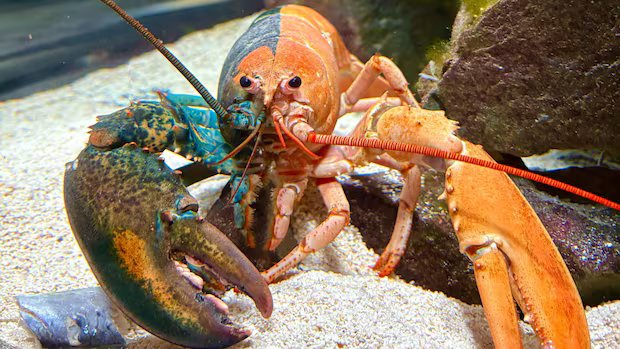

Listen to this article
Estimated 3 minutes
The audio version of this article is generated by AI-based technology. Mispronunciations can occur. We are working with our partners to continually review and improve the results.
In his 40 years as a lobster fisherman, Robert Wagner had never seen a critter like it: a half-blue, half-orange lobster, split down the middle from head to tail.
“I said, ‘Wow! I’ve never seen that like that in my life,'” said Wagner. “It was quite interesting.”
The lobster was in the second-last trap hauled aboard one day a few months ago from waters near Blue Rocks, on Nova Scotia’s South Shore.
Wagner decided to name him Oscar, because he felt as lucky as any Academy Award-winning movie star. And like the shiny golden statues, he wanted Oscar to be seen by others.
His daughter suggested contacting Dalhousie University to see if they’d be interested in taking Oscar.

Nadia Stewart, visitor experience facilitator for Dalhousie’s Beaty Centre for Marine Biodiversity, said the offer was potentially life-saving.
“We’re so happy that they think of us when they do find a cool lobster cause in the wild they often get predated upon very quickly just because of their standout colours,” she said.
Stewart said Oscar’s mutation occurs in about one out of every 50 million lobster.
“When two of these fertilized unlaid eggs come in contact with each other, it actually causes one to absorb the other, so this creates Oscar, our lobster with two different sets of … genetic information,” she said.
The only thing more rare than Oscar’s colours is an albino lobster, which is found in about one out of 100 million lobster, said Stewart.
Wagner and his family took care of Oscar for a month before he was taken to his new home. Oscar was in a crate in the water near Wagner’s boat. Every second day, Wagner would feed it.
A special licence was needed to transport Oscar to Halifax, said Wagner.
Shell shedding
Stewart said Oscar has acclimated to his new home, but he surprised staff when he shed his shell a few days ago.
She said the centre decided to put the old blue-orange shell on display and give him time off, so he can recover from moulting.
She said he’ll be back on display once his new shell hardens up, which should take about 14 to 30 days.
Because Oscar’s colouration is genetic, his new shell will also be blue and orange.
Wagner is happy with the decision to donate Oscar.
“We’re just grateful that it got in the right hands and hope [Oscar] has a good life,” he said.
MORE TOP STORIES