dailynewsnblog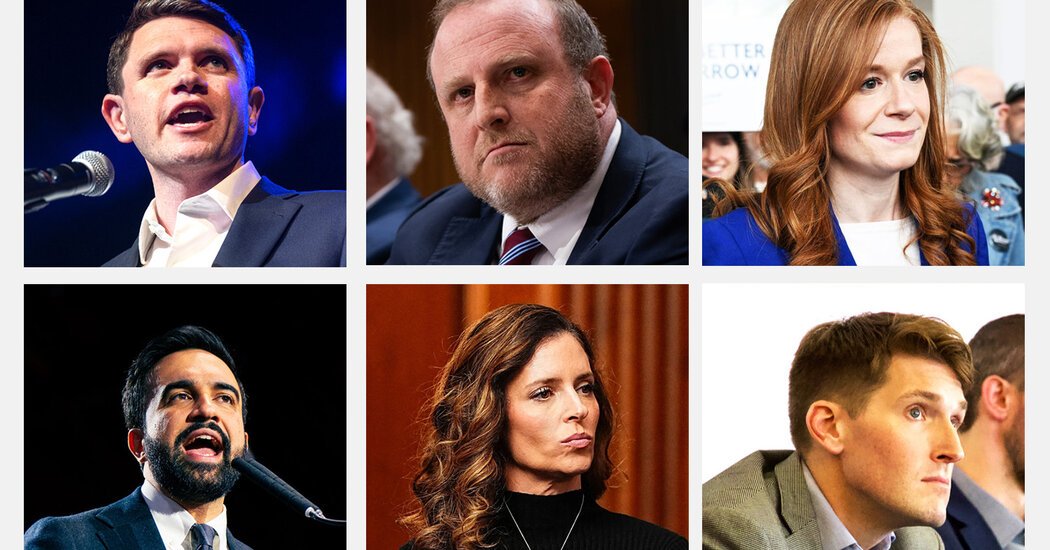
Mallory McMorrow, a Democratic candidate for Senate in Michigan, recently found herself at the center of an increasingly common brouhaha in modern politics: She was forced to answer for a series of unfortunate tweets.
In decade-old deleted posts unearthed by CNN last week, Ms. McMorrow, 39, had expressed liberal views out-of-step with her current moderate image. Perhaps more damaging, she complained about the Midwestern weather shortly after moving from California — “I don’t like you, Michigan” — and joked that “cars are dead,” striking a nerve in the heart of the American auto industry.
Ms. McMorrow’s primary opponents were quick to criticize, but she defended herself in a CNN interview, suggesting that her posts were evidence that she was a regular person who had not been carefully cultivating her public image years ago in anticipation of a future political bid.
“I am not somebody who wanted to be in office or wanted to be in Congress when I was in diapers,” she said. “I tweeted normal things, like a normal person.”
Such uproars have become so frequent that the pattern of reaction to them now feels routine.
First: Long-ago social media posts or video clips by political candidates get exposed online, prompting a backlash from rivals.
Second: The candidates downplay the comments and distance themselves, often insisting their views have changed.
Third: In some cases, voters and the news media tire of the topic and move on. Or they don’t.
With a new generation of candidates who were active on X, Reddit and YouTube years before announcing political careers, it’s unsurprising that so many are seeing their past statements come back to haunt them. (It has become so common that Ms. McMorrow is not even the only Democratic Senate candidate in Michigan to deal with such a controversy: Abdul El-Sayed, 41, also faced backlash for deleted posts from 2020, in which he had described the police as “standing armies we deploy against our own people.”)
Opposition researchers have never had more content to draw from. Yet they say that voters also seem more willing than ever to forgive past unsavory viewpoints and social media misdeeds — spurred in part by President Trump, who has proved that voters can overlook outrageous statements.
“Before Trump, you could be really surprised by something you saw in the news about a politician,” said Pat Dennis, the head of American Bridge, a Democratic opposition research firm. “After Trump, everything is kind of boring in comparison, compared to the level of scandal.”
A test case may well be Graham Platner, the 41-year-old presumptive Democratic nominee for Senate in Maine, who has had to apologize for a host of disparaging and offensive past online comments about rape; police officers; and white, rural Americans. It didn’t hurt him in his Democratic primary campaign, but it could still become an issue in a high-profile general-election race this fall.
Voters seem to be acknowledging a trade-off: If political parties are going to run more candidates who are viewed as normal people, the inevitable skeletons in their closet are more likely to surface online.
“Everybody has probably said something on social media at some point when they were mad,” said Chuck Rocha, a veteran Democratic strategist who has advised a variety of Democrats who have had to address uncomfortable old posts.
If candidates own up to their mistakes and say, “‘that was stupid, it was a long time ago,’” Mr. Rocha said, “I have found that the American people will be very forgiving.”
But trying to cover up a past misdeed, he added, “makes you seem like just another politician.”
Not every regrettable social media post or video clip falls into the same category. Some misdeeds do still sink — or at least sully — careers and campaigns, as candidates like Mark Robinson, a Republican candidate for governor in North Carolina in 2024, have found out the hard way. Mr. Robinson’s campaign tanked after CNN reported that he had called himself a “black Nazi,” defended slavery and left sexually explicit messages on a pornography website.
Social media blunders seem to break down into three categories.
Embarrassing or unusual
James Talarico, the Democratic nominee for Senate in Texas, announced that his state legislative campaign would purchase only vegan products in a 2022 speech posted online. The resurfaced video prompted backlash in a state known for its barbecue. “This freak wants to ban BBQ,” posted Senator Ted Cruz of Texas, a Republican.
In response to the beef about beef, Mr. Talarico’s campaign spokesman posted a photo of the candidate chomping down on a turkey leg. And Mr. Talarico, in front of a live podcast audience, drew laughter by saying, “I deny all accusations of veganism.”
Mr. Talarico faced criticism for other past comments in speeches archived online and in social media posts. “God is nonbinary,” he said on the state House floor in 2021. In 2020, talking about the “virus of racism” and the Black Lives Matter movement, he wrote, “White skin gives me and every white American immunity from the virus. But we spread it wherever we go.”
In an interview with The New York Times in March, Mr. Talarico said the principles he was espousing “are certainly principles and values that I still hold.” But, he acknowledged, “I probably would have said them differently today.”
In 2011, shortly after giving a viral speech as a 19-year-old about his experience being raised by a lesbian couple, Zach Wahls replied with specificity to a Reddit question about what type of pornography he liked. He also wrote that “My moms bought me a subscription to Playboy when I was 16 at my request.”
In 2025, as he prepared to launch his campaign for Senate in Iowa, political strategists circulated the comments and conservative media outlets picked at the lewd nature of his remarks.
“I think it’s a little funny that some folks are worried about Democrats’ ability to connect with American men, while others think that old Reddit posts by me as a college kid, talking about Playboy and porn like a normal guy would do, would scare me off from running,” Mr. Wahls, now one of the front-runners for the nomination, told The New York Times last year.
Old beliefs inconsistent with their current platform
Julia Letlow, a Republican candidate for Senate in Louisiana, is running to Senator Bill Cassidy’s right, accusing her fellow Republican of being insufficiently devoted to President Trump.
But in 2020, Ms. Letlow herself expressed views that clash with MAGA priorities. While interviewing to become the president of the University of Louisiana at Monroe, she told a hiring panel that she would prioritize diversity, equity and inclusion initiatives if she got the job, and lamented the lack of Black female faculty members.
The interview, posted to YouTube, caused a stir when Fox News resurfaced it this spring. “Liberal Letlow was pushing D.E.I. policies at U.L.M.,” a spokesman for Mr. Cassidy said.
Ms. Letlow’s campaign pushed back, saying that “She stood with President Trump as he dismantled this ideology across the federal government.”
While running for mayor of New York City last year, Zohran Mamdani was forced to answer for past statements that critics used to hammer the democratic socialist as far left and out of step with most New Yorkers.
He said he would apologize to police officers for one 2020 tweet, which accused the department of being racist and homophobic and included a call to defund the police. Mr. Mamdani said his old comments were “made at the height of frustration” and did not reflect his current “view of public safety and the fact that police will be critical partners in delivering public safety.”
Especially inflammatory
Nate Blouin, one of the leading Democratic candidates for a House district in Utah, came under fire last month when the news outlet Punchbowl News reported that he had made a series of crass and offensive jokes and comments on Reddit and niche sports forums between 2009 and 2015.
He insulted members of the Church of Jesus Christ of Latter-day Saints, saying their ideology was “fostering ignorance and intolerance.” And he made light of sexual assault after a Brigham Young University student was charged with sexual battery, writing, “good ol’ mormon kid. had to let out the pent up sexual frustration somehow.”
Utah Democrats condemned the comments, and some called for him to drop out of the race. “There’s no excuse for these posts — they’re vulgar, stupid and reflect a version of me in my early 20s that I’m ashamed of and have thankfully evolved past,” Mr. Blouin told Punchbowl.
Jeremy Carl, a conservative commentator who was nominated by Mr. Trump to be an assistant secretary of state, floated controversial views about Israel and used inflammatory rhetoric when talking about race, “white identity” and his political opponents. Mr. Carl suggested that a prominent union leader should go on trial and “get the death penalty,” and wrote that he would “rather be a black man on trial for the assault of a white man in 1930s rural Mississippi than I would be a right-winger in DC today on trial for political crimes.”
In his confirmation hearing, Mr. Carl explained some of his views, saying he was “concerned with the majority common American culture that we had for some time, that through, particularly, mass immigration I think has become much more balkanized, and I think that weakens us. And again, I’m not running away from that comment.”
But Mr. Carl’s comments generated a bipartisan backlash, and he ultimately withdrew from consideration.
Top photos by Tamir Kalifa for The New York Times, Elizabeth Frantz for The New York Times and Jose Juarez/Associated Press. Additional photos: Nick Rohlman/The Gazette, via Associated Press, Aaron Schwartz/Reuters, Angelina Katsanis for The New York Times, Hannah Schoenbaum/Associated Press.