dailynewsnblog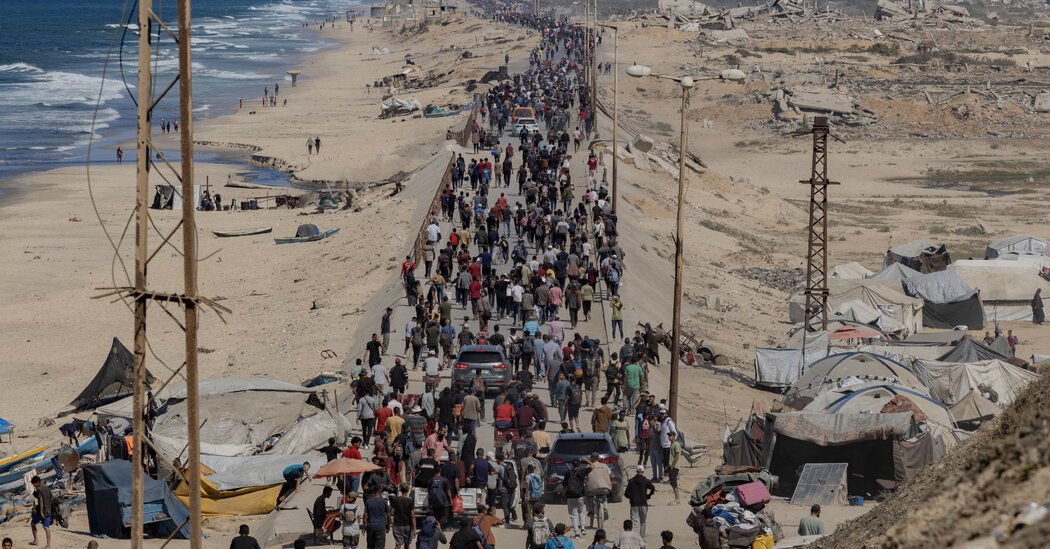
The Israeli government honored a rabbi who had called to “flatten” the Gaza Strip, reflecting how views once seen as extreme in Israel have become more mainstream after more than two years of war.
The rabbi, Avraham Zarbiv, was saluted at a ceremony celebrating the 78th anniversary of the country’s founding on Tuesday night. He had served as a reservist during the war in Gaza, mostly razing parts of the enclave with a bulldozer. After becoming popular on social media, he was chosen to light a torch at Israel’s national independence day ceremony, one of the country’s highest honors.
“The victory will be that there is no more Hamas,” Rabbi Zarbiv said in one interview last year, referring to the war. “And to do that, we apparently need to flatten the Gaza Strip.”
Israeli forces leveled much of the Gaza Strip during the two-year war with Hamas, the Palestinian militants who control much of the enclave. The war began with a Hamas-led attack on Israel on Oct. 7, 2023, in which some 1,200 people were killed and 250 abducted, most of them civilians.
Rabbi Zarbiv became a kind of wartime influencer who blended militarism and religious nationalism by frequently filming himself in his bulldozer in Gaza and posting clips on social media. Some of his fans turned his name into a verb — “to Zarbiv” — meaning to inflict destruction.
In one video, he vowed that Israel would inflict “the Ninth of Av” on Gaza — the date when Jews recognize the destruction of both ancient biblical temples that preceded their exile from Israel. “We’re destroying and advancing, destroying and advancing,” he added, calling for Israel to build new settlements in Gaza.
Rabbi Zarbiv said in a television interview last year that he was destroying dozens of buildings per week. He said the mass demolitions were necessary in part to protect Israeli soldiers from ambushes by Hamas fighters in Gaza’s crowded streets or being blown up in booby-trapped buildings.
“I saved the lives of many soldiers through my work,” Rabbi Zarbiv said in a short phone call on Monday, declining to answer further questions.
But Mr. Zarbiv also seemed to celebrate the mass destruction of some Gazan cities, where he said Palestinians had “nowhere left to return.” And in the same interview, he mourned “the missed opportunity” of having left another city, Beit Hanoun, only “half-destroyed.”
The Israeli military campaign against Hamas destroyed huge parts of the Gaza Strip, hollowing out entire cities and towns. More than 70,000 people were killed, including thousands of women and children, according to the Gaza health ministry, which does not distinguish between civilians and combatants.
Six months after a cease-fire took effect between Israel and Hamas, many Palestinians are still displaced, living in squalid tent camps, and have no homes in Gaza to return to. The United Nations has estimated that more than $70 billion is needed to rebuild Gaza, and little work has begun amid entrenched disagreements over the next steps in the truce.
Mr. Zarbiv’s latest videos are now from southern Lebanon, where Israel is conducting demolitions across an area of Lebanese territory that it now occupies. Israel Katz, the Israeli defense minister, has vowed to raze towns there as Israel did in Gaza.
Israel’s national independence day ceremony is traditionally seen as an opportunity for the country to honor leading public figures, exceptional artists, and others — showcasing the best and brightest. Others saluted this year include Assaf Granit, a superstar chef with restaurants in Paris and Berlin; Gili Raanan, an Israeli venture capitalist; and Ari Spitz, an Israeli soldier who was grievously wounded in Gaza.
Miri Regev, the government minister directing the ceremony, said she had selected Rabbi Zarbiv because he “represented a generation that does not shirk its responsibility.” She praised him for “strengthening the spirit” of the country.
Some opponents of the current government, led by Israel’s prime minister, Benjamin Netanyahu, denounced the choice. Yair Golan, the leader of the left-wing Democrats party, said the government was “pushing a radical agenda and appeasing extremists.”
The destruction and devastation in Gaza has prompted fierce criticism of Israel around the world. The International Criminal Court has ordered the arrest of Mr. Netanyahu and his former defense minister for war crimes. Both men, as well as the Israeli government, strongly reject the accusations.
But in Israel, criticism of the war’s fundamental justice and the military has been muted. The brutality of Hamas’s attacks — which included the killing of hundreds of civilians at a rave — horrified Israelis and led many to harden their views on Gaza.
Yagil Levy, a professor at Israel’s Open University and expert on civil-military relations, said Mr. Zarbiv’s rhetoric openly turned “the exercise of violence into a source of pride,” reflecting a hard-line shift in Israel after the Oct. 7 attacks.