dailynewsnblog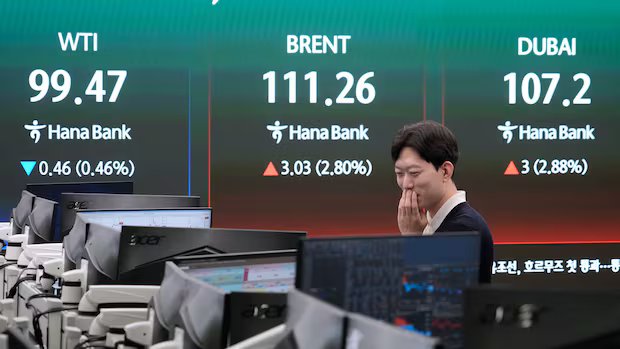

Listen to this article
Estimated 4 minutes
The audio version of this article is generated by AI-based technology. Mispronunciations can occur. We are working with our partners to continually review and improve the results.
The price of Brent crude oil briefly surged past $126 US a barrel early Thursday as stalled U.S.-Iran talks raised doubts over the reopening of the Strait of Hormuz and a permanent end to the Iran war.
Brent crude to be delivered in June jumped 3.3 per cent to $121.90 after briefly soaring past $126 per barrel, the highest since March 2022. Brent to be delivered in July rose 1.4 per cent to $112.02.
Before the war began in late February, Brent crude was trading around $70 per barrel. Benchmark U.S. crude climbed 1.3 per cent Thursday to $108.28 per barrel.
There’s no clear path to an end to the war. The U.S. has implemented a blockade of Iranian ports, pushing oil prices higher. Reports Thursday suggesting a possible escalation by U.S. President Donald Trump doused hopes for a quick end to the conflict.
“The breakdown of talks between the U.S. and Iran, along with President Trump reportedly rejecting Iran’s proposal for a reopening of the Strait of Hormuz, has the market losing hope for any quick resumption in oil flows,” ING Bank strategists Warren Patterson and Ewa Manthey wrote in a research note.
Dismal Euro zone report
The U.S. blockade came after Iran effectively blocked the Strait of Hormuz, the waterway through which some 20 per cent of the world’s oil formerly passed on its way to customers from producers in the Persian Gulf.
The surge in oil prices has been quickly reflected at gas stations and in the price of jet fuel, though the impact varies by exposure to energy flows through the strait. In the U.S., gas prices are now below pre-war levels.

CBC’s senior business correspondent Peter Armstrong explains why oil prices are so significant to federal revenues after Prime Minister Mark Carney’s government delivered its spring economic statement.
Soaring oil prices pushed inflation higher in Europe in April. Annual inflation in the 21 countries that use the shared euro currency rose to 3.0 per cent from 2.6 per cent in March, fuelled by a 10.9 per cent increase in energy prices, the European Union statistical agency Eurostat reported Thursday.
Meanwhile euro-area growth for the first three months of the year disappointed with a marginal increase of 0.1 per cent over the quarter before.
ING’s head of global macro Carsten Brzeski said another month of Hormuz disruption would likely trigger at least a technical euro zone recession.
Oil prices vary depending on the type of crude oil, where it’s being traded and under what terms, for futures contracts. By some measures, Brent has hit its highest level since its peak of $147.50 per barrel in 2008 during the global financial crisis.
Front Burner26:59How the petrodollar took over the world
The shockwaves triggered by the U.S.-Israeli war on Iran have made clear the extent to which the global economy relies on oil, and the U.S. dollar. It’s no accident.
So today we are going to try and understand how and why the U.S. and Saudi Arabia created this system, and how severely it’s being tested by this war. David Wight is our guest. He’s a lecturer at the University of North Carolina Greensboro and the author of Oil Money: Middle East Petrodollars and the Transformation of U.S. Empire, 1967–1988.
For transcripts of Front Burner, please visit: https://www.cbc.ca/radio/frontburner/transcripts [https://www.cbc.ca/radio/frontburner/transcripts]
With the war rattling world markets, the U.S. dollar fell to 160.02 Japanese yen after surging earlier Thursday to its highest level in nearly two years. It closed at 160.44 yen on Wednesday.
The U.S. dollar has gained against other major currencies partly due to its status as a safe haven for investors in times of risk, and partly because U.S. interest rates have remained relatively high as the Federal Reserve strives to balance a need to boost the economy with curbing the higher prices that partly are a result of the war.
The Fed’s decision to keep interest rates steady at its policymaking meeting Wednesday further supported the dollar.