dailynewsnblog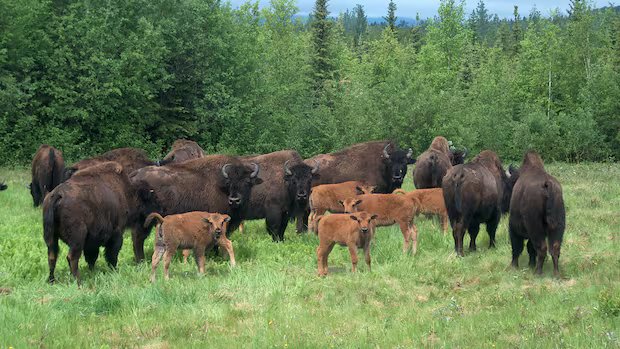

Listen to this article
Estimated 3 minutes
The audio version of this article is generated by AI-based technology. Mispronunciations can occur. We are working with our partners to continually review and improve the results.
The number of bison being hit on roads in the N.W.T. appears to be on the decline. From 2021 to 2025, the N.W.T. Department of Environment and Climate Change (ECC) recorded 60 collisions with bison. So far in 2026 however, there has been only one.
Terry Armstrong, Bison Ecologist with ECC, says the territory may actually have wildfires to thank for those statistics.
“The immediate effect of fire is that bison change where they’re spending their time,” he said. “Bison have a habit of moving into recently burnt areas and benefiting from those.”
He says they can start to return even while the area is still smoking, attracted to newly sprouting vegetation he says bison find “very attractive.”
Bison frequent roads looking for delicious roadside vegetation, he says. But, with huge areas burnt the last few years, it appears more bison may be choosing recovering wildfire areas instead. And that means fewer collisions.

That’s good news for the N.W.T. bison population. Wood bison are listed as a threatened species both territorially and nationally. Armstrong estimates the population currently is several thousand, with estimates from ECC putting the population at just over 2,500.
Toyeke Adedipe, a spokesperson for ECC, said collisions between 2021 and 2025 resulted in the deaths of at least 76 bison.
“In some cases, a single collision involved multiple bison,” she said in an email. She said most of the incidents occurred along Highway 3, accounting for 45 collisions and 56 bison deaths.
Armstrong says August into September is rutting season, when people are more likely to encounter aggressive behaviour from bison on the road.
“During the rutting season, they are mating, but they’re also fighting with each other. The bulls are fighting for dominance and access to the cows in the herd,” said Armstrong. “They can run into your vehicle or go sideways because they’re not paying any attention to your vehicle at that point. They’re just in that fight.”

He says the return of darkness also means reduced visibility, especially at dawn and dusk.
“We’re coming up to the more difficult time of the year, when we have more collisions,” he said, adding that “summer driving conditions” continue, with bare roads and no snow, which increases the chance of a collision.
“It’s very difficult to see a dark animal against a dark background when there’s no snow,” he said.
He says the best thing to do is drive slowly, give bison space, and avoid doing anything that might cause them to run, like honking at them, as that can increase danger especially with aggressive males involved.
And, most importantly, stay in your vehicle and under no circumstances attempt to pet them.
“They’re the largest land mammal in North America and they’re survivors. They existed here for thousands of years,” said Armstrong. “They’re unique and there aren’t very many of them.”