dailynewsnblog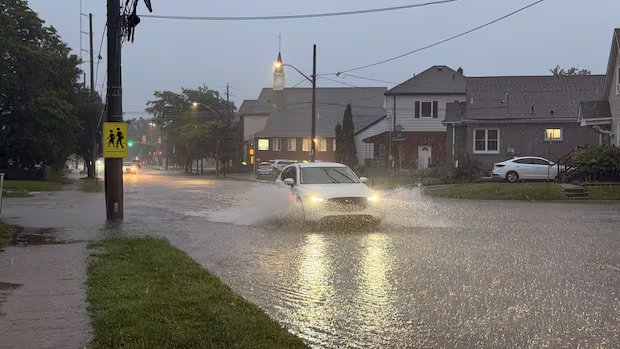
Alongside the streets of St. Catharines, Ont., the signs of recent flooding are still piled at the curb.
Couches, mattresses and drywall sit outside homes, a reminder of the damage left by multiple major storms in under two weeks.
“We had three major storm events,” Mayor Mat Siscoe said Tuesday. “These are the biggest storm events the city’s ever seen in quick succession over the course of 11 or 12 days.”
Siscoe said the first storm was largely handled by the stormwater system, but the ground was saturated by the time the second and third storms hit, and the system couldn’t handle the volume.
That led to widespread overland flooding and sewer backups into homes.
“In many cases, it was sewage that was coming into the home,” Siscoe said.
‘They’re back under water again’
Dave White, who owns White Orchard Farms outside St. David’s, grows garlic on nearly nine hectares of land near the bottom of the Niagara Escarpment.
During the latest storms, his fields were completely under water, but he didn’t lose any crops.
“Luckily, we did harvest our garlic a week before the floods,” White said.
He pre-emptively took action based on what happened a year ago, when he wasn’t able to get his entire crop out before heavy rain and lost part of it, as well as what he had been seeing over the last couple years.
“We’ve been making sure our ditches are cleaned and our fields are able to handle [excess of water],” White said. “We made some trenches in the field to help escort some of the water out of here because of the last four or five years.”

Grape growers in Niagara are scrambling to save their crops after two extreme rainstorms flooded thousands of homes and businesses in the region in just a few days.
White also operates a restoration company. He said the past few weeks have been overwhelming, with a wave of calls from homeowners whose properties have flooded.
“You’re depressed because I’m getting calls back from jobs I did three, four years ago, and they’re back under water again.”
In some cases, the cleanup had already finished before another storm hit.
“These people have been pumping out their basements,” White said. “Two days later, we get hit by a storm that’s twice as much.
“People are crying for help and they just want to build.”
White believes the flooding will only get worse in the coming years unless there’s real investment in upgrading the drainage sewage infrastructure that he says is being overwhelmed partly by new housing and building development.
“We’re running old sewage plants that have been here for 150 years and we are tripling the capacity that goes to them.”
System built 150 years ago
Siscoe said the city hasn’t identified blockages or a single infrastructure failure that caused the flooding.
Instead, he said, the system was overwhelmed.
“What failed was 150 years of history.”
It’s reflective of issues felt across the country.
The most recent Statistics Canada data says over 11 per cent of Canada’s water and wastewater infrastructure is already reported to be in poor or very poor condition.
Much of the older part of St. Catharines was built with combined sanitary and storm sewers. Newer neighbourhoods have more separation, but Siscoe said only about 30 per cent of the city has separate stormwater infrastructure.
He said spending on sewer systems has increased, tripling the money that’s gone into sanitary and storm sewers over the past decade and doubling the city’s capital budget over the past four years.

But replacing the entire system would cost billions of dollars. The mayor also said there aren’t enough contractors and workers to replace the infrastructure quickly.
“There’s a cost issue, but there’s also a labour issue.”
Anneke Smit, director of the Centre for Cities at the University of Windsor, told the CBC in May that “cash and resource strapped municipalities are also struggling.”
“It is discouraging to see the lack of priority that is placed on climate mitigation in particular,” she said, adding that a climate change focus should be baked into land use and infrastructure planning decisions.
“Climate change is something that has to run across the full gamut of municipal governance, but it’s not yet.”
Storms beyond what system was built for
The recent Niagara-area rainfall also exceeded the levels used to design much of the region’s drainage infrastructure.
Adam Keane, an engineering manager with St. Catharines-based Upper Canada Consultants, said two of the recent storms exceeded what’s known as a 100-year storm — an event with a one per cent chance of occurring in a given year.
He said St. Catharines was hit with about 102 millimetres of rain in a 12-hour period, while some parts of Niagara received over 140 millimetres in a much shorter period.
“So it’s not to say that the infrastructure failed,” Keane said. “It’s that they encountered events they were never designed for.”
The problem was compounded by the fact that the storms were so close to each other.
“Either one on their own would have resulted in exceeding capacity of the drainage systems,” Keane said. “Back to back, local stormwater management facilities are full, ponds are inundated, the water is saturated into the ground.”
“The system actually operated just about as well as we could have hoped,” Siscoe said. “It was just never designed to take what was essentially three hurricanes’ worth of water over the course of 12 days.”
Phil Lambert, Niagara region’s director of water and wastewater services, said treatment plants were receiving four to five times their typical flow.
The volume eventually exceeded treatment capacity and the plants entered a bypass state.
“Our wastewater systems, our plants, operated as they were supposed to, and as they were designed to,” he said.

Lambert also rejected the suggestion that new development was responsible for the flooding.
The region plans its major water and wastewater infrastructure around anticipated growth, while individual developments are reviewed for their impact on existing systems, he said.
“When you have these extreme rain events, it’s not really the new development that’s causing the issue at this point,” Lambert said.
“It’s the excessive rainwater flow that we’re receiving all at once.”
Preparing for future floods
Siscoe said St. Catharines needs to do more than replace pipes.
He said the city has called for an independent review of its flood response and infrastructure, while staff are developing a flood resilience plan to identify vulnerable neighbourhoods and prioritize improvements.
One idea is to redesign parks to temporarily absorb excess rainwater.
“We’re now looking at how do we redesign our parks to become like sponges when events like this happen,” Siscoe said.
The city is also looking at changes to its development process, including requiring new projects to show how they’ll retain stormwater.
But Siscoe said municipalities can’t pay for the necessary work on property taxes alone.
“We’re going as fast, I think, as the property tax base can handle at this point.”
He wants more provincial and federal funding, saying the cost of replacing the city’s wastewater infrastructure is simply too high for the municipality to handle on its own.
Siscoe said the city began increasing its infrastructure spending after significant flooding about a decade ago, but the latest storms show that isn’t enough.
“I think residents expect us, first and foremost, when we’re building infrastructure, it’s got to be about protecting the quality of life.”
The work will take years, he said.
“The capacity doesn’t exist to do it fast,” Siscoe said. “But that doesn’t mean that we shouldn’t be doing it as quickly as we possibly can.”