dailynewsnblog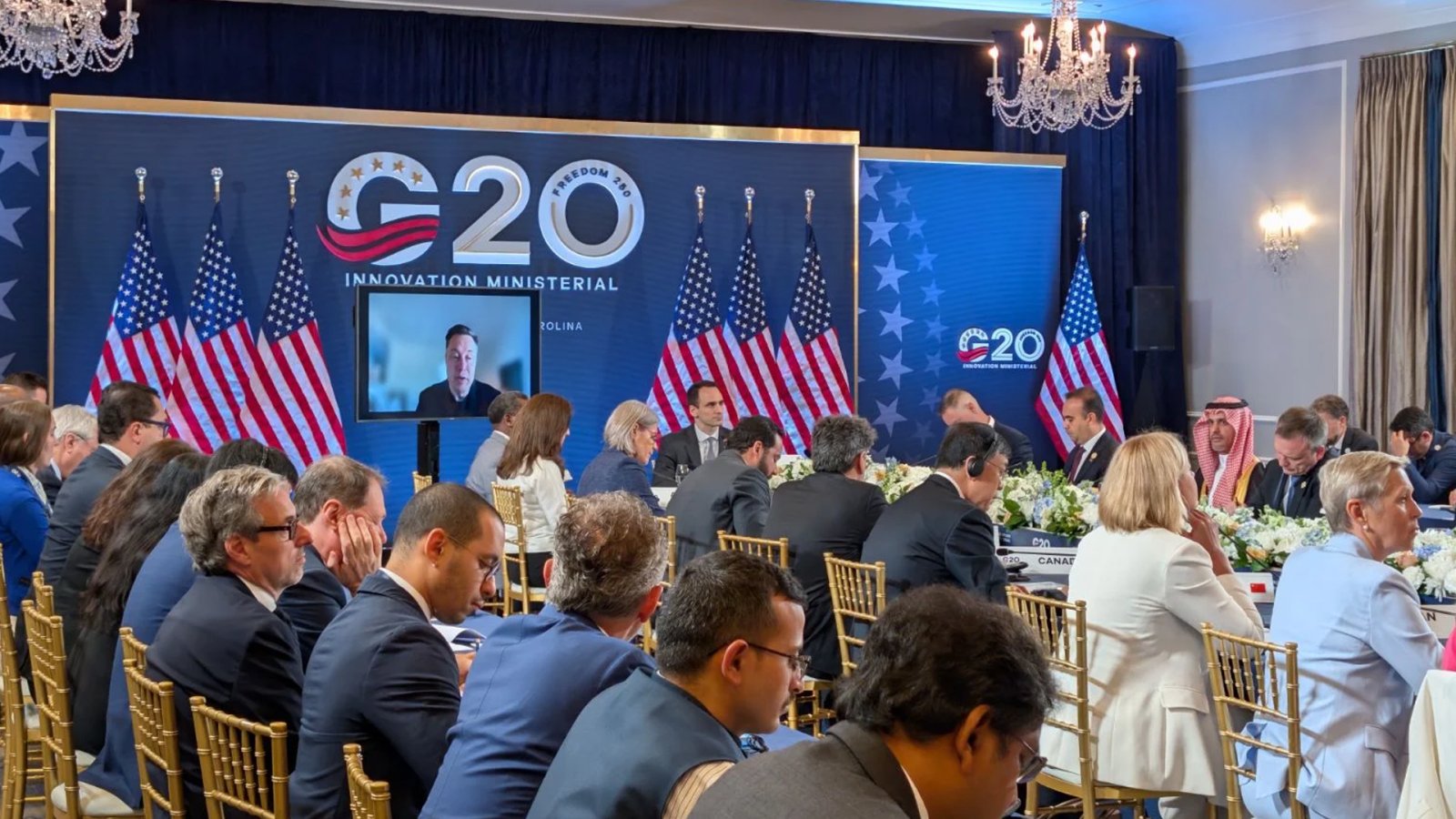
The US government’s message at the G20 Innovation Ministerial is clear: Nothing should slow down AI innovation – not regulation, not power shortages, not even serious safety concerns.
The forum, hosted this week in Chapel Hill, North Carolina, brings together government leaders from the G20 countries, including India, China, Russia and many European nations, to discuss technological advancements and subsequent policy challenges. The theme this year is, unsurprisingly, generative AI.
Michael Kratsios, director of the Trump administration’s Office of Science and Technology Policy, said in his opening remarks that “slow policy adaptation makes it harder to capture the full benefits of innovation.”
“Often, in the US and elsewhere, regulations built for a different technological era prove poor fits for rapidly evolving, generally applicable inventions, creating uncertainty for developers and policymakers alike,” Kratsios said. “That leaves development efforts abandoned, growth unrealized and nations falling behind, as innovation continues elsewhere.”
The US is pushing for a framework it’s calling the Carolina Principles, a “pro-innovation framework” that aims to bolster AI research, form pathways to commercialization and create industry-led standards for emerging technologies. Global leaders will hear from the biggest names in AI throughout their discussions.
At the end of the week, any policy agreements reached will feed into the broader agreement that the global community signs at the G20 Leaders Summit in Miami this December.
AI regulation is an increasingly important issue as AI models become more capable and autonomous. This week’s summit offers insight into how the global community is approaching the issue – and where it is drawing lines in the sand for Big Tech.
Trump AI adviser: No ‘DMV for AI’
It would be a “disaster” if the US adopted a version of the “FDA for AI,” said David Sacks, the Trump administration’s former AI czar and co-chair of the president’s council on science and technology, on Tuesday. “Any regulatory agency that has to approve AI product releases will become like a DMV for AI, where new models get stuck in a long queue waiting for approval.”
AI is “just too dynamic and fast-moving for that type of approach,” Sacks said in a virtual appearance. “And I don’t think we want to hamstring our innovation that way.”
Sacks argued against the idea of a regulatory agency for AI, one that would be similar to how the Food and Drug Administration authorizes new medicines or how the Federal Aviation Administration oversees airlines.
 Katelyn Chedraoui/CNET
It’s not the first time the idea of an AI-specific regulatory agency has been floated in the tech policy community, but Sacks’s remarks seem to take a direct swing at the only major AI company not in attendance at the event: Anthropic. Its CEO, Dario Amodei, advocated for such a government review process in a recent essay.
“Frontier AI models, like airplanes, should be required to go through technical testing and auditing, and their release should be blocked or reversed as a threat to public safety if they do not meet high standards of safety,” Amodei wrote. He added that because AI is being used in research, existing agencies like the FDA will have more proposals to evaluate, further taxing the regulators.
Sacks argued that there is already sufficient regulation around AI from existing laws, and existing regulatory agencies could deal with any AI threats.
This is far from the first time Anthropic and the US government have been at odds. After a deal between the Pentagon and Anthropic blew up, the AI company was declared a supply chain risk, though a judge blocked that order. Later, when Anthropic released its Fable 5 model, the US government ordered the company to prevent any foreign nationals from using it. To comply, Anthropic pulled the model, rereleasing it only after receiving an unofficial green light from the Trump administration.
Elon Musk and Mark Zuckerberg speak on AI
Elon Musk, CEO of SpaceX, which operates xAI, supported a hands-off regulatory approach in a virtual speech at the G20 Innovation Ministerial.
“What most countries tend to do is they tend to provide too much support to the large existing trees in the forest and not enough to the smallest saplings,” Musk said on Tuesday, comparing big corporations and startups to a forest. Musk said this should be flipped, and governments should adopt a philosophy where new inventions are “default legal as opposed to default illegal.”
Notably, Musk is CEO of one of the biggest tech companies in the world and the world’s richest person, aided by SpaceX’s recent IPO, which briefly made him the world’s first trillionaire. His businesses received $38 billion in government funding last year, according to a February report from The Washington Post.
But we’ve already seen how the US government is either unable or unwilling to address the worst, most abusive consequences of AI technology. When millions of AI-generated images of child sex abuse material flooded X months ago, US regulatory agencies did nothing to stop it.
By contrast, the European Union opened an investigation into X, countries like Malaysia and Indonesia banned the app, and many global leaders spoke out against the Musk-owned AI tool and platform.
Mark Zuckerberg, also speaking virtually, talked about how publicly available AI models help people create things, like learning to use new software or run small businesses.
“The ability to start new things is going to be immense, and that’s going to lead to this very dynamic period,” Zuckerberg said on Tuesday. “So I think it leads to wanting to have policies that make it easy to create things [and] easy to evolve and change the systems that we have today.”
The idea is that if AI is publicly available, like through an open-weights AI model, more people can use it. Tech policies that support open source AI fuel that creation. Zuckerberg’s open source approach to AI is unique in the industry, with Meta recently promising to publicly release its newest models. This came after it was rumored that the Trump administration was considering a ban on open-source models; many tech leaders said that would be harmful to global AI innovation and cybersecurity.
“Having the technology diffused … you can set up a system of checks and balances, rather than restricting it to only being available to a small number of people or companies or governments,” Zuckerberg said. (Zuckerberg, notably, would be one of the people with complete access.)
Over the past year, the Trump administration has flipped its previous hands-off approach to regulating AI. It seems to want to be involved, particularly as its tech and government leaders see generative AI technology as simultaneously a threat and a benefit to national security and cybersecurity.
Policy frameworks that emerge from forums like the G20 Innovation Ministerial could dramatically shape the limits on the power that Big Tech and AI companies have globally.

See full bio