dailynewsnblog
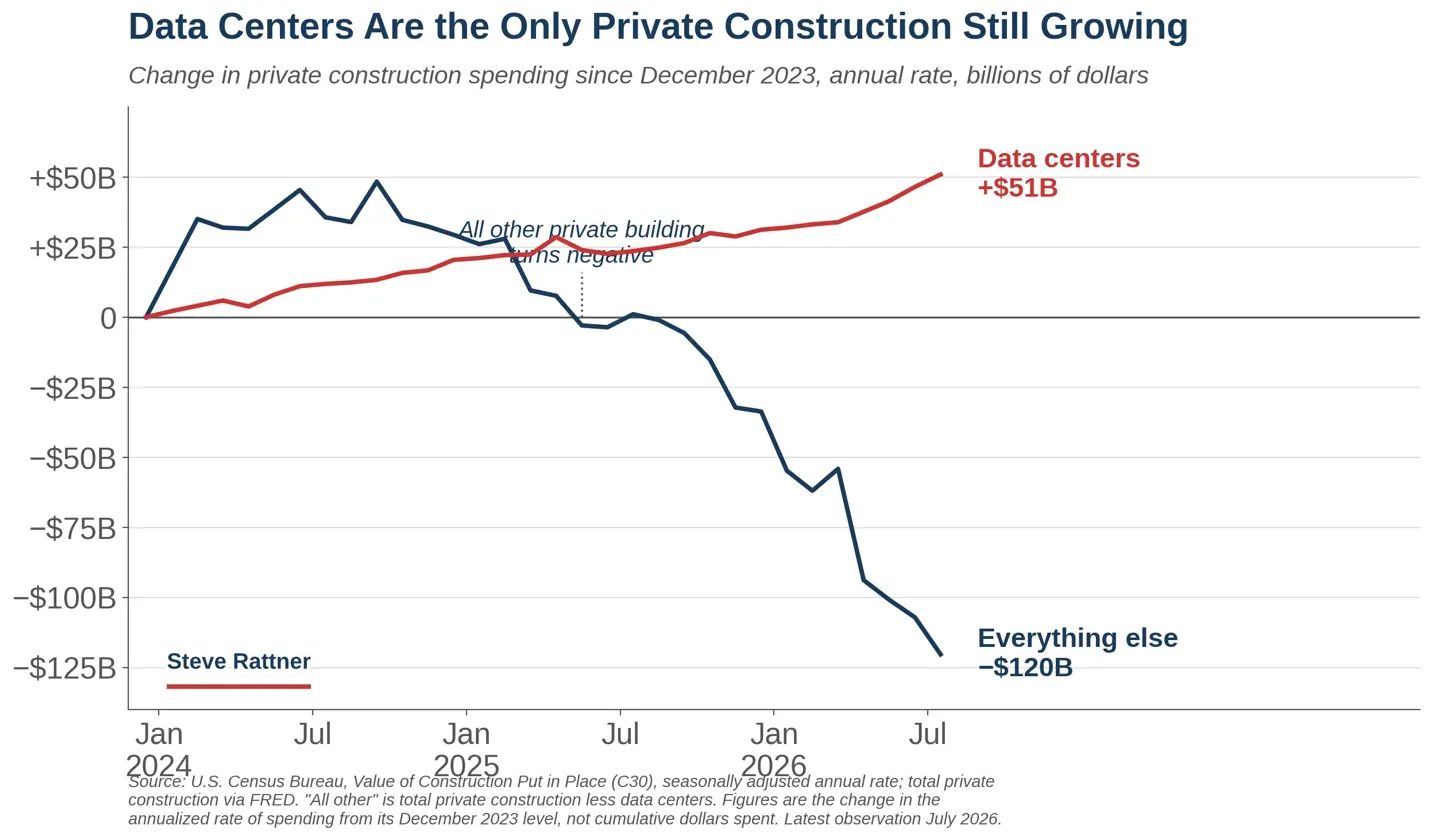
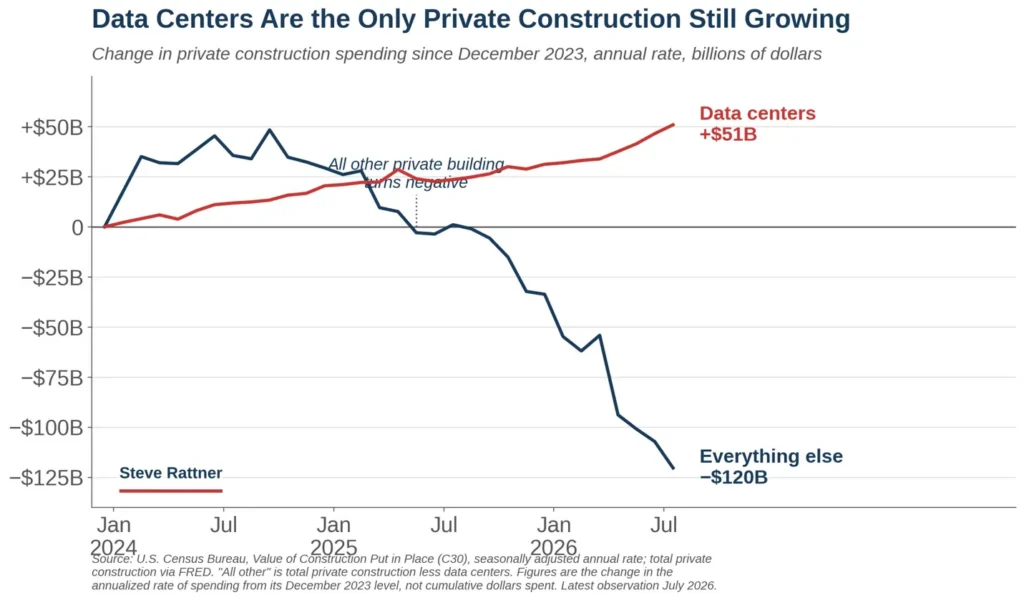 Based on charts like the one at right, Paul Krugman and many others are arguing that:
Massive spending on data centers is crowding out investment in everything else in the economy.
Not so fast. Can you see one immediate problem? How is $51b in data center construction spending crowding out $120b in everything else!
Indeed, crowding out in the standard loanable funds model is generically less than 1 to 1–that is, $51b of additional spending will crowd out less than $51b of other investment spending. The standard analysis is that increased investment demand/borrowing increases interest rates–the higher interest rate reduces investment demand elsewhere (that’s the crowding out) but the higher interest rate also increases savings so investment elsewhere falls by less than the increase in tech investment. Here’s the classic graph from our textbook, Modern Principles. In the graph, we explain crowding out in terms of government borrowing but formally the diagram is the same with tech borrowing substituting for government borrowing:
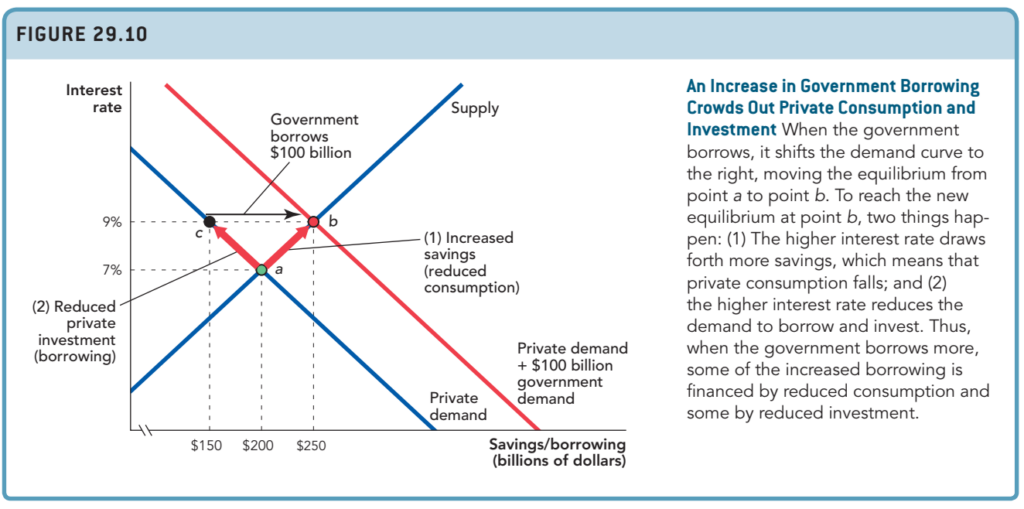
Although the diagram is formally identical with private borrowing or government borrowing the term crowding-out is usually reserved for the latter. Private borrowing faces the market test so “crowding out” in that context simply means funds flowing from lower value to higher valued uses–it’s a benefit. Government borrowing doesn’t face the same market test and so we need to remind people that it comes at a cost. Let’s put this point aside, however.
Krugman doesn’t point out the problem with Rattner’s graph but he does substitute with a graph of his own (shown below) which compares all “tech” investment with all other investment as a share of GDP. On the surface that seems to at least get the ratios in more plausible alignment but there are a few problems. First, the numbers are on a different order of magnitude. Rattner has annual datacenter investment rising by $51b over a more than two year period. Krugman has tech spending rising by ~$539b over a similar period–so far more than datacenters or AI as conventionally considered is being counted. That’s fine–but Krugman is relying here on datacenter discontent while actually discussing something different. But there is another problem.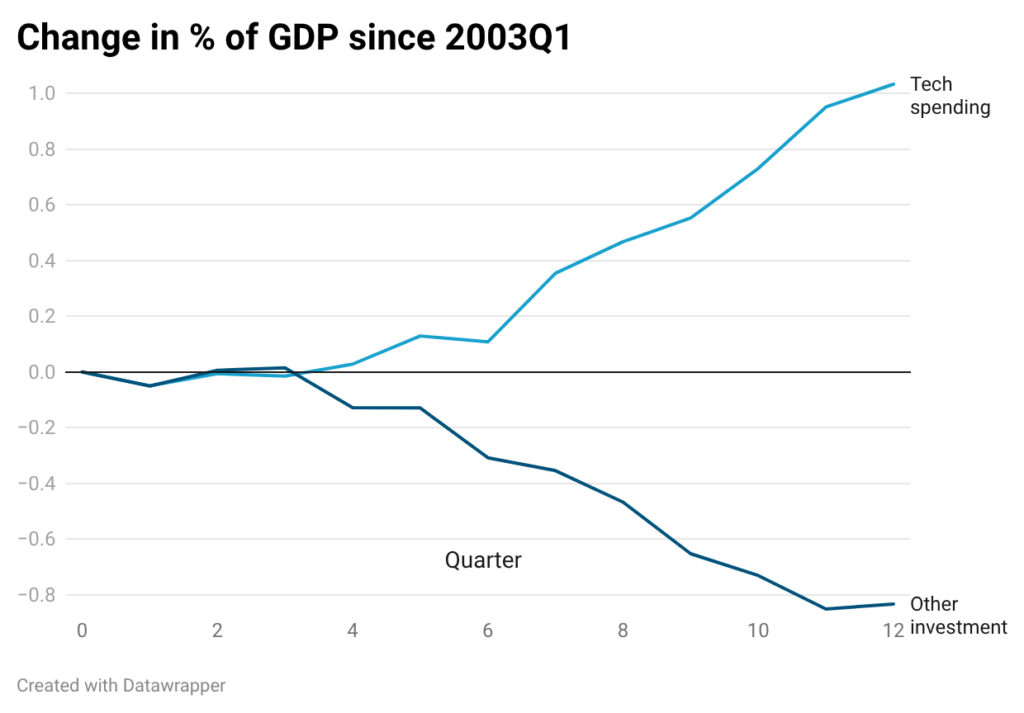
Krugman’s graph is in terms of shares of GDP and as one share is going up, another is going down which is meant to be suggestive of crowding out–except GDP is increasing. Let’s regraph the same data in dollars and in real terms: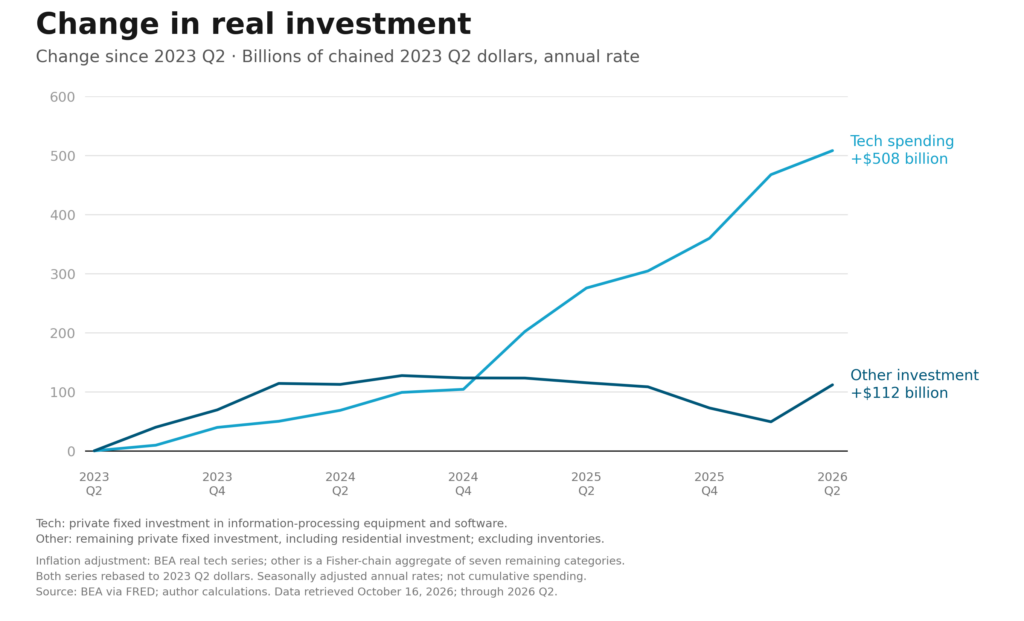
Now the picture looks different. From 2023 Q2 to 2026 Q2, real tech investment rose about 46%, while other real investment rose about 3%. Other investment has weakened since its 2024 peak, but it remains above its starting level. This does not rule out crowding out: other investment might have grown faster without the tech boom. But we have now gone from charts suggesting that crowding out was absolute to arguing that it was relative to GDP and relative to a counter-factual which cannot be identified with these graphs.
So what is really going on? Real interest rates are up since the pandemic but most of the increase happened before the AI investment boom. The average 10-year TIPS yield rose from −1.00% in late 2021 to 1.49% in late 2022. In comparison, the increase in rates over the Rattner/Krugman chart-periods are only .5 and 0.68 percentage points respectively, relatively small potatoes to hang a crowding out story.
Moreover, current real rates are ~2-3%, in line with historical averages and hardly prohibitive. If there are good projects they can be funded.
Why did real rates rise if not datacenter borrowing? There are many possible explanations: recovery from unusually low rates during the pandemic, Federal borrowing, maybe even a quite different tech story in which greater expectations of future wealth are reducing savings today (like the reputed AI workers who have taken up smoking because they expect a future cure for lung cancer). But note that real rates are up across advanced economies, not just here, even though most of the AI spending is here–this further weakens the case for crowding out of US investment, as the world saving base is much larger than the US base.
Bottom line is that I think a more plausible story is that two things are happening at once: tariffs, uncertainty, and other forces including the fading of Biden-era CHIPS and IRA subsidies have weakened investment outside AI-tech. The AI boom in contrast has supported overall investment. In other words, rather than datacenters and AI investment “crowding out” other investment, my interpretation is that AI investment is a bright spot in what would otherwise be a more negative economy.
Hat tip: Arpit Gupta.