dailynewsnblog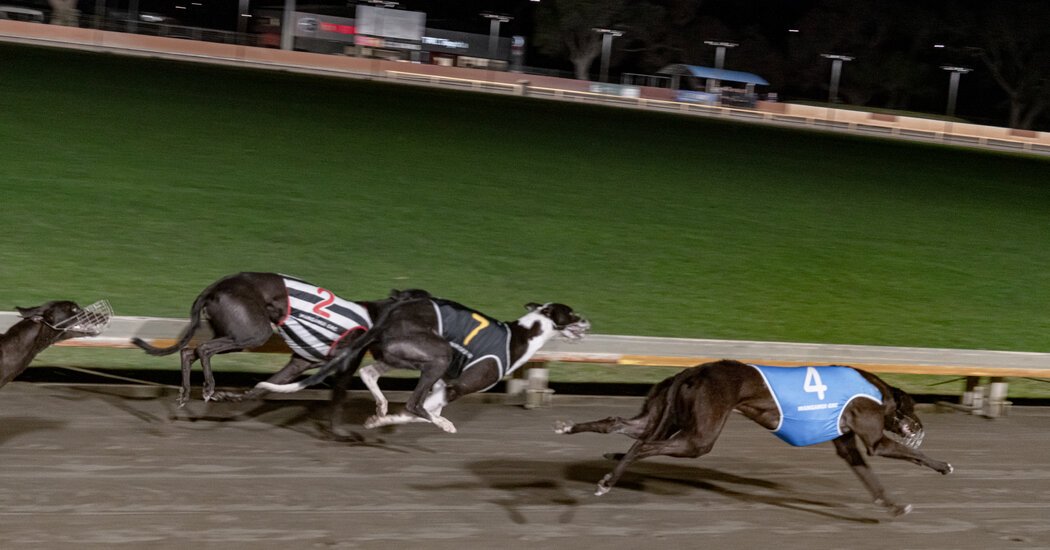
At a modest suburban track in the riverside city of Whanganui, hundreds gathered on Friday evening to witness the final night of one of New Zealand’s longest-running betting sports.
The occasion, held at the city’s Hatrick Raceway, marked the last commercial greyhound race in the country, ending a tradition that has roots stretching back over 150 years.
The setting was distinctly Kiwi: A field enclosed by the racing tracks doubles as a rugby pitch, its east edge fringed by Pōhutukawa trees, New Zealand’s native evergreen.
Intermittent downpours and gusts punctuated the proceedings, as did the slow revolutions of a small tractor, smoothing paw prints from the tracks between the night’s dozen scheduled races. Shortly before each sprint, the dogs were prepared for action, their sleek coats shining in the floodlights.
Martin Goodier, Whanganui local and trainer, summed up the mood. “The overriding feeling is of sadness and injustice,” he said, noting that betting on greyhound racing would continue legally in New Zealand but only on foreign races.
New Zealand is one of the last countries in the world to ban the greyhound racing industry, which remains legal in just four countries; the United States, United Kingdom, Ireland and Australia.
Yet last week’s closures did not end the matter. They represent a new phase of a wider national experiment, as the government must now find homes for the dogs, support the people whose livelihoods depended on racing, and manage the disappearance of a sport embedded in some communities for generations.
Industry representatives have protested the ban, arguing that welfare standards had improved and that countless livelihoods depended on the sport’s preservation. Its critics see the closure differently: a long-overdue step following years of calls for reform and continuing harm to dogs.
Dr. Arnja Dale of New Zealand’s Society for the Prevention of Cruelty to Animals (SPCA) said the ban followed multiple independent reviews over a decade. They found “persistent, systemic animal welfare issues on and off track, and these included really high rates of serious injuries and deaths, exposure to illegal and banned substances and prolonged confinement in barren kennels,” she said.
“Since the ban was actually announced on the 10th of December in 2024, 22 of those dogs have died or been euthanized due to race day injuries,” she continued.
About 1,000 New Zealanders, including trainers, kennel staff, breeders and officials, will be affected by the termination of the industry, according to the Greyhound Transition Agency (GTA), the government body responsible for overseeing the closure of the sport and its aftermath.
The New Zealand government has said it will offer retraining, mental health services, compensation and other forms of support to the communities affected by the shutdown.
The transition will cost up to 60 million New Zealand dollars ($35 million) over three years, according to government estimates, and will be funded by New Zealand’s state-regulated national betting agency. Much of that money will be spent on rehoming about 1,400 greyhounds, a GTA spokesperson said in a statement.
Despite these measures, those in the industry who spoke to The Times said that the impact on their lives would be severe, with some seeing no option but to leave the country to keep working in the sector.
“It’s going to be life-changing for all of us, there’s going to be a few people who are not going to recover from this,” said Craig Roberts, director of Greyhound Racing New Zealand and a lifelong trainer.
Mr. Roberts, who lives near Christchurch, in the South Island of New Zealand, told The New York Times he was relocating to Australia to continue working in greyhound racing.
“I had no intention of going there, but I have an opportunity I need to take. I’m leaving my close family contacts, especially with my grandkids,” he said.
At the track in Whanganui, the rain continued to come and go on Friday, buffeted by a bitter breeze. After four hours of occasional races, on the verge of the very final chase of the night, the mood shifted; some trainers were in tears as they completed the ritual of leading dogs around the ground toward their starting positions.
The last race concluded with ovations and supportive cheers from the crowd. Trainers then departed the course for the last time, before gathering in groups to huddle and commiserate.
As the sound of the crowd subsided, the last greyhound owners lingered in small groups, their words of consolation carried by the restless wind across the empty tracks.
Georgia Cole, a race manager from Palmerston North, said she was heartbroken by the termination of the industry and would also move to Australia.
“This is my whole life, I’m losing everything,” she said. “Some of the people here are like my family. I’m 28; I have grown up at the dog track.”