dailynewsnblog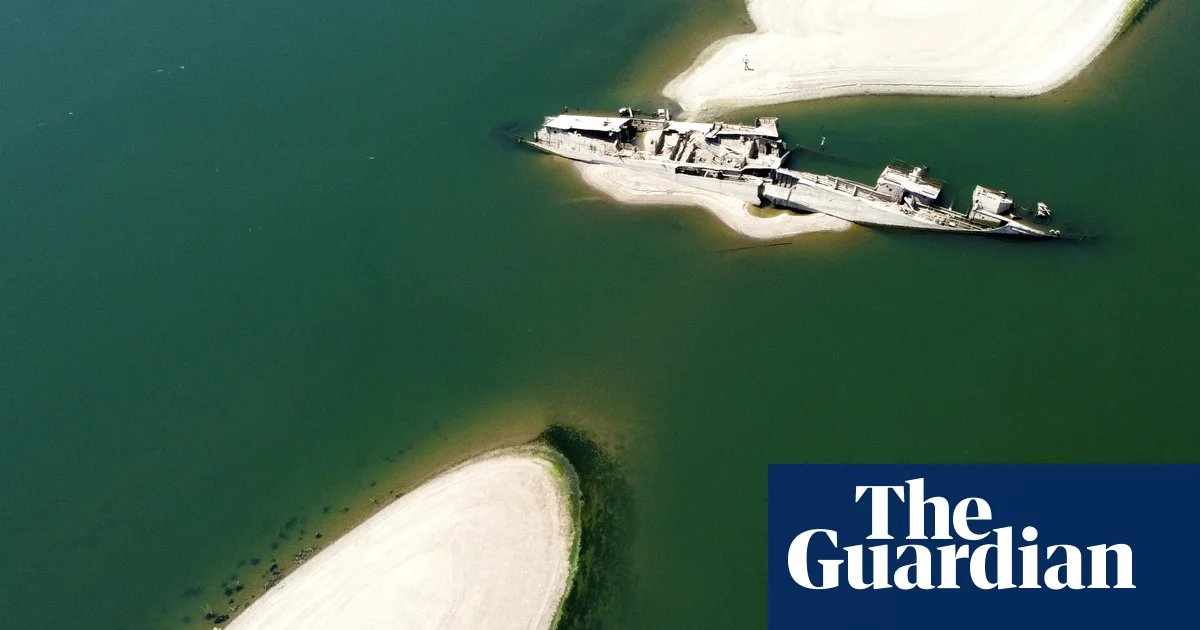
Record-low water levels in the Danube have exposed remnants of Europe’s Nazi past, with dozens of second world war warships emerging from the riverbed during an intense drought.
In the middle of the river on the Serbian and Romanian border, a broken-up hull was visible on a sandbank that is normally underwater. Other vessels were partly submerged, some still believed to be laden with weapons.
The ships were part of Adolf Hitler’s Black Sea fleet that the German military deliberately sank towards the end of the war to slow down the Soviet advance. Historians say up to 200 German warships were scuttled in this way in September 1944. But Nazi Germany did not surrender until the following year in May 1945.
The ships have been revealed during previous droughts only to disappear again as water levels rose along the second-longest river in Europe. The Serbian government has tried in the past to remove the wrecks, but most remain in place owing to the explosives they carried.
Other second world war remnants have been found in other parts of the river, including a German military motorcycle in Budapest, Hungary.
In Slovakia, police recovered an unexploded British 1,543lb (700kg) bomb. Police said authorities loaded it on to a “specially modified firefighter vehicle with a sand bed, which ensured its safe transport” and took it to a 5-metre deep pit to detonate it.
In 1944, Britain’s Royal Air Force mined the river to disrupt enemy troops.
The Danube, which flows through 10 countries, has become increasingly difficult to navigate as low water levels create dangerous conditions. Prolonged droughts have left major European rivers at significantly lower water levels than is typical for the time of year, creating an energy crisis as many power plants rely on their natural water supply for cooling.
after newsletter promotion
Intense summer heat and continuing drought conditions are being supercharged by the escalating human-caused climate crisis.
Temperature records have been broken in several countries across central and eastern Europe as the extreme weather that has caused wildfires and droughts across the continent continues.
Slovakia, Austria and Hungary registered record temperatures this week. On Thursday, the Slovakian hydrometeorological agency said a new national record of 42C (108F) had been reached in the village of Dolné Plachtince.
The Associated Press contributed to this report