dailynewsnblog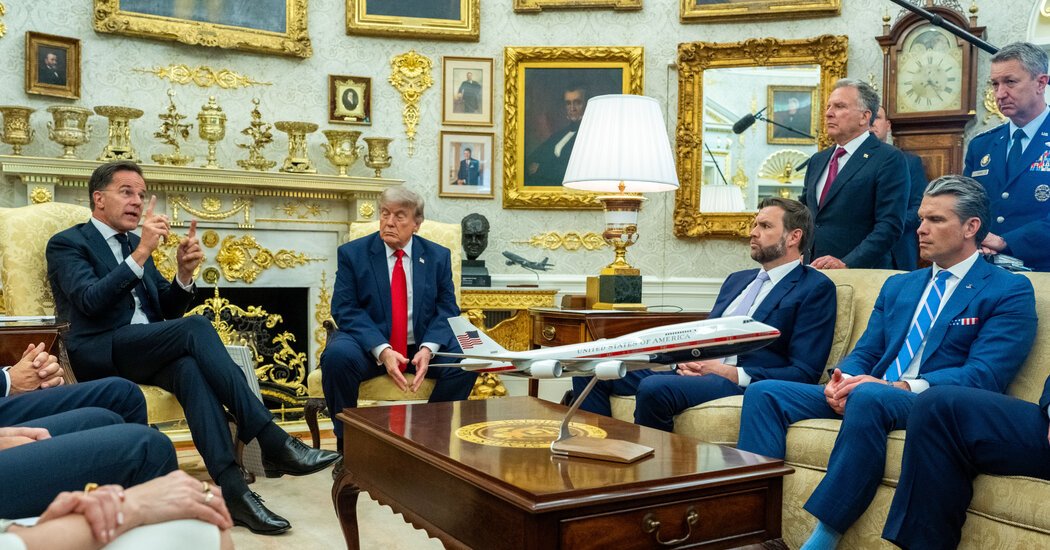
President Trump was launching into a litany of complaints about NATO allies on Wednesday afternoon in the Oval Office when the organization’s secretary general, Mark Rutte, interrupted to show him some charts.
Mr. Rutte, a former prime minister of the Netherlands who has gained a reputation as the European leader most skilled at managing Mr. Trump’s moods and critiques, had come prepared with props. Setting up posters in the Oval Office to “show you what this president was able to achieve,” his charts showed a surge in current and anticipated European defense spending.
“This chart is about the ‘Trump Trillion,’” Mr. Rutte said, moving around the Oval Office like a political science teacher laying out the basics of defense spending to a classroom that included Mr. Trump’s defense secretary, Pete Hegseth. He reached back to when Mr. Trump took office in 2017 to show “the total extra spent by the Europeans and the Canadians,” and homed in on the past two years, when NATO spending was “over $250 billion.”
“I can assure you this is because of Russia, because of the threat,” Mr. Rutte said, with the president’s initial anger at the allies appearing to subside as Mr. Rutte made his case directly to him. “But I am also absolutely convinced that you, being president of the United States,” made the difference, “pushing for something which, since Eisenhower, has not been achieved: which is the Europeans equalizing their defense spending with the United States.”
“This is your evidence,” he said, ending his lesson with a note about how many jobs the extra spending created in the United States.
President Dwight D. Eisenhower, of course, did not threaten to undermine NATO; instead, he built much of the alliance, drawing on his years as supreme allied commander. But Mr. Rutte recognized not only his target but also his goal: to keep the peace when Mr. Trump is set to arrive in Ankara, Turkey, for the NATO summit starting on July 7. As one European diplomat put it earlier in the week, the goal for that summit is modest — avoiding an explosion by Mr. Trump over the reluctance of NATO allies to contribute to the military operation against Iran, which many of them see as ill-considered and illegal.
Mr. Rutte was not entirely deferential in Wednesday’s Oval Office meeting. At one point he interrupted Mr. Trump’s complaints about European nations being too slow to invest in their own security and too reluctant to support operations with Iran. Mr. Rutte said he disagreed “slightly.” He added: “There have been isolated cases about which you are really disappointed, but generally speaking, your European allies have been there.”
Mr. Trump’s test was simple. “Just be loyal,” he said when asked what he wanted from America’s allies in Europe. “I just want their loyalty.” Earlier, he had singled out several countries for specific criticism, starting with Italy, Britain and Spain.
To Mr. Rutte’s critics, including several of the NATO allies, his approach to Mr. Trump is far too accommodating. But Mr. Rutte has made clear, both in public comments and private conversations, that he believes his success as the head of the alliance will be measured chiefly by his ability to keep the United States at the center of it. Another goal is to restore European leaders’ waning confidence that if Russian troops rolled even a few miles into NATO territory, the United States would be part of a unified response.
Mr. Trump seems unlikely to offer those assurances in any explicit way. During his first term, he declined to even mention Article 5 of the NATO treaty, which includes the promise of collective response to threats, in a speech at the alliance’s headquarters. In fact, he made it clear that he would not be attending the upcoming summit if it was not being hosted by Turkey’s president, Recep Tayyip Erdogan.
“I would have not gone for most people,” Mr. Trump said on Wednesday, “but he called me up. He said: ‘Please, I have it in Turkey. You got to be there. The United States has to be there.’ And so I’m going out of respect to President Erdogan.”
Mr. Trump also hinted that the United States was likely to permit Turkey to buy F-35 fighter jets, which Washington has long prohibited. Turkey was removed from the F-35 program in 2019, during the first Trump administration, after Mr. Erdogan purchased S-400 air defenses. U.S. officials feared that the Russians would be able to gather data on the F-35 program through Turkey.
Mr. Trump said nothing about that standoff when he indicated that he would likely lift the ban in coming weeks.