dailynewsnblog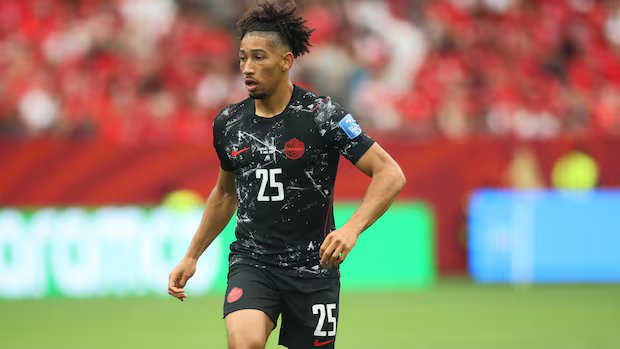

Listen to this article
Estimated 5 minutes
The audio version of this article is generated by AI-based technology. Mispronunciations can occur. We are working with our partners to continually review and improve the results.
Before Canada’s men began Sunday’s training session on another glorious day in Vancouver, head coach Jesse Marsch stood in the sun with his hands on Nathan Saliba’s shoulders. The World Cup makes it a little too easy to turn ordinary moments into dramatic ones, but the way Marsch spoke to his young midfielder, his hands might as well have been swords.
In the considerable absence of Ismaël Koné, Saliba has been anointed.
He is the obvious next man up, both logically and emotionally. After Koné’s horrific departure from last week’s otherwise spectacular 6-0 win over Qatar — after a stricken Saliba saw his childhood friend wheeled away on a stretcher with a shattered leg — he drew himself up and put in one of the great shifts of his emergent career.
Seven minutes after he stepped onto the emotion-soaked pitch, Canada was awarded a free kick a few yards outside Qatar’s crowded box.
Saliba stood beside the dead ball with his hands on his hips, surrounded by more celebrated teammates: all-time leading scorer Jonathan David, with two more goals already in his accounts; captain Stephen Eustáquio; hometown hero Ali Ahmed.

The four debated what they might do with the precious set piece. They were up 3-0 at the time, but if they converted the free kick, Canada would eclipse Group B rival Switzerland on goal difference and give itself a serious chance to enter the Round of 32 as a top seed, needing only a draw against the Swiss on Wednesday.
“I should take this,” Saliba said.
That was all his teammates needed to hear. Eustáquio tapped him on the head, and everyone else fell away.
He curled an inch-perfect free kick off the post and in. He didn’t celebrate, exactly. His thoughts immediately turned to Koné.
Saliba emerged from the clutches of his teammates and ran to the bench he’d just occupied, holding up Koné’s black No. 8 to the cheering crowd before he kissed it.
It was a gooseflesh moment, close to iconic. Saliba was asked after to explain the meaning of it for him and for his country.
“I think it speaks for itself,” he said in a whisper.
The 22-year-old is quiet, even reserved. But on the pitch, a season with Belgian side Anderlecht has seen him develop into a formidable midfield presence.

He’s still not Koné, a singular creative force who, outside of David, might have been the worst player Marsch could have lost for the tournament.
“From a talent and tactical perspective, it weakens us,” Marsch said. “But we built a squad over the last two years to be ready for these moments. I still think we’ll be strong in that position.”
Marsch has options beyond Saliba: Jonathan Osorio, Mathieu Choinière, and even Niko Sigur, who often plays midfield for Hajduk Split, his club side.
But Saliba might be the best fit. He doesn’t have Koné’s technical abilities, the same desire to take on opponents and drive the ball up the pitch. He is surprisingly physical, however, despite his relatively narrow frame. He’s mobile, a good passer, and a better defender than Koné.
He has his things that he does well. I also have my things that I do well.– Nathan Saliba on replacing injured Ismaël Koné
“He has his things that he does well,” Saliba said. “I also have my things that I do well.”
Saliba’s set of skills might, in fact, prove more useful against Switzerland. Marsch will no doubt employ his trademark press, but in a game in which a scoreless draw would be a fantastic result, Saliba’s more considered approach could be invaluable.
“Saliba is a top player, a top guy,” defender Derek Cornelius said Sunday. “He understands the game very well. He’s a very mature player, especially for his age. If it’s him that Jesse chooses to replace Koné, we’re all confident that he’ll do a great job.”
Nothing should inspire more confidence than what Saliba managed against Qatar, given the heat and salt of that searing experience. In one moment, he was sitting on the bench. In the next, he was crying for his friend. In the next, he was lining up a fate-changing free kick. In the next, he was putting it into the net.
He was asked how he was able to gather himself, to do what he went on to do.
“To be honest, I don’t think I was able to,” Saliba said. “I just had to do it.”
Jesse Marsch, at least, thinks he can do it again.