dailynewsnblog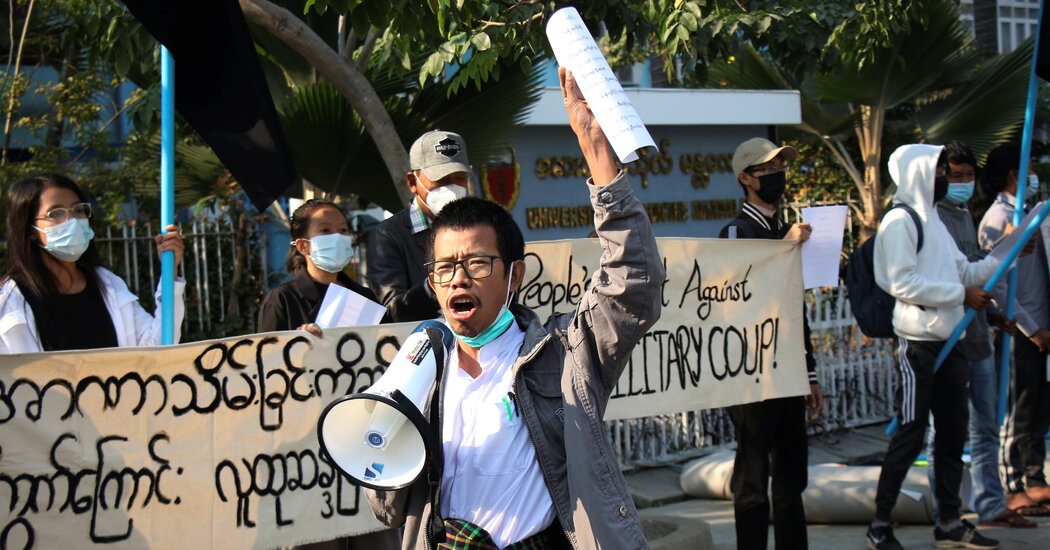
For the past five years, Tayzar San, one of Myanmar’s most prominent political dissidents, has been on the run from the junta, relying on equal parts luck and vigilance to evade capture. But at dawn on Dec. 3, he visited a popular market to protest the vote the military had planned for later that month.
It struck him as an obvious charade, and he was hardly alone. The main opposition party had been barred from participating, while ballots would only be cast in areas under the military’s control. As motorbikes threaded past him in the city of Mandalay, Mr. Tayzar San and other pro-democracy activists scattered leaflets urging residents not to vote in the upcoming ballot, which he denounced as a sham. “Looking at the country’s economy and political situation, what has improved? Nothing has improved,” he shouted.
Despite having had a bounty on his head since 2021, Mr. Tayzar San managed to escape before the authorities closed in. The others were not so lucky.
On Tuesday, some of his colleagues who had been arrested shortly after the peaceful protest were handed sentences of more than 20 years in prison, under an election law that the junta enacted in July 2025 to criminalize speech or political action deemed “disruptive.”
May Hnin, a spokeswoman for the Mandalay chapter of the Anti-Junta Forces Coordination Committee, said that eight of the activists who participated in the Dec. 3 protest — among them Htet Myat Aung, another key figure in the country’s pro-democracy movement — were sentenced to 37 years in prison, while a ninth was sentenced to 27 years. The activists will not appeal the sentences because they know that there is no chance of overturning them, she added.
At a time when the junta is casting itself as a peaceful and legitimate civilian government on the international stage, the verdicts are a sign that it has not eased its repression of civilians. On the contrary, according to some analysts, it has intensified its bombings of unarmed populations, while using its expanded surveillance capabilities to conduct increasingly targeted arrests.
“The military’s tactics in 2026 so far show merely shifting modalities of civilian repression rather than any reduction in its severity,” Armed Conflict Location and Event Data, a nonprofit that monitors global conflicts, said in a report this week.
There are still 14,600 political prisoners in detention in Myanmar, according to the Assistance Association for Political Prisoners. Among them are at least 21 people who have been sentenced under the election law.
Ms. May Hnin said the authorities had also detained people over online activities, including reacting to or sharing posts opposing the election. She added that, in the wake of the arrest of Mr. Tayzar San’s colleagues, military personnel had infiltrated protesters’ Zoom meetings in an apparent attempt to locate any other demonstrators.
“The military did not publicly announce their detention,” she said. “Instead, they used the detainees’ phones to impersonate them and contact other activists, attempting to obtain their locations and arrest them as well.”
After overthrowing Myanmar’s democratically elected government in a coup in 2021, the military regime faced an armed resistance that quickly grew into a grinding civil war. That conflict, coupled with international sanctions, have thrown the country’s economy into crisis.
In what has widely been seen as a bid to lend legitimacy to its rule and break out of diplomatic isolation, the junta held a parliamentary election in three stages in December and January. Unsurprisingly, it resulted in a landslide victory for the military-backed party. In April, the Parliament elevated Min Aung Hlaing, the military commander who has ruled the country since leading the coup in 2021, to president.
While most international monitors and Western governments considered the election illegitimate, it nonetheless paved the way for Mr. Min Aung Hlaing to make two high profile diplomatic visits as president, first to Prime Minister Narendra Modi of India in May, then President Xi Jinping of China in the following month.
And to further prop up the appearance of normalized civilian rule, the regime has sought to appear benevolent to the former civilian leader Daw Aung San Suu Kyi, who was arrested during the coup. In April, it said it had moved her to a house arrest of sorts.
But behind the scenes, rights groups and activists said, the junta’s campaign against critics of the election has only intensified.
“The authorities are not only arresting activists, they are also sealing off their homes and confiscating valuable belongings,” Mr. Tayzar San said in a telephone interview. “It’s meant to send the message that if one person opposes the dictatorship, the entire family will suffer the consequences.”
He said he feared that the authorities would torture his imprisoned colleagues to locate him, or that he might eventually find himself caught up in the military’s increasingly sophisticated surveillance system. Recalling how swiftly the authorities had rounded up even the drivers and spotters who had helped the protesters, he said: “I know that I, too, could be arrested at any time.”