dailynewsnblog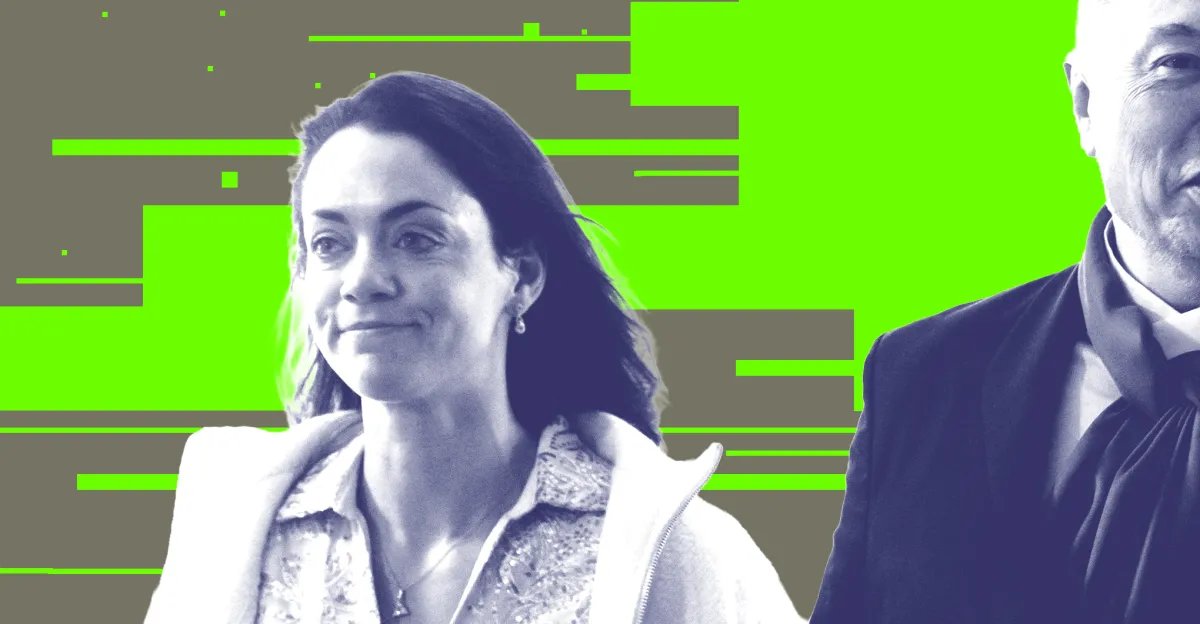
I sat down in the Musk v. Altman trial courtroom today, painfully aware that no one was going to ask Shivon Zilis the question on everyone’s minds: Girl, what the fuck are you doing?
Zilis, who testified under oath that she is the mother of four of Musk’s children, was… what’s the best way to characterize this? A Musk advisor? She denies she was a “chief of staff” but says she worked for Musk’s “entire AI portfolio: Tesla, Neuralink, and OpenAI” starting in 2017. The two met through OpenAI, and they had what she referred to as a “one off” before becoming “friends and colleagues.” The “one off,” she confirmed, was “romantic in nature.”
Her job under Musk was “to go find bottlenecks and solve them,” and she claims to have worked 80 to 100 hours a week doing that. “It was just bananas,” she said. Her first two children by Musk — twins — were born in 2021, while Zilis was serving on OpenAI’s board. She kept this a secret. She did not tell the board who the father was until Business Insider reported on court documents that listed Musk as the father.
“My first call was to my dad,” said Zilis, who testified that even her own family didn’t know the children’s paternity. “The call right after that was to Sam Altman.” Greg Brockman, OpenAI’s president, had testified he found out about Zillis’ children from news reports. When he talked to her about it, she claimed her relationship with Musk was “platonic” and that she’d had kids via IVF. This was reassurance enough for Brockman, who’d been friends with her since 2013. She remained on the board.
On the stand, Zilis spoke softly and quickly. She seemed mousy. A significant part of what made her testimony so bad for Musk was that she appeared to be the only person taking notes on what Brockman, Altman, Ilya Sutsekever, and Musk were discussing when the cofounders considered their options for creating a for-profit arm of OpenAI. She also was “aiding and facilitating communication between the principal parties.” Those notes are the trial’s most important evidence — more important, even, than Brockman’s diary.
The goal of the direct testimony seemed to be to take the sting out of what Zilis and the plaintiff’s lawyers had to know was coming. So she told the court that her role also meant telling Altman when Musk was “in a good headspace” for a conversation — perhaps inadvertently strengthening Brockman’s testimony yesterday that at one point he feared Musk would physically attack him —while vehemently denying that she funneled information to Musk.
Look, she and Musk testified they lived together and have a romantic relationship and four kids. She was originally a plaintiff in the suit. She kept her children’s paternity secret from her own father. All of those things would be reason enough to doubt her testimony about thinking OpenAI betrayed its mission during the chaos when Altman was fired by the board. She claimed that Microsoft CEO Satya Nadella said something to the effect of “we are above them, we are below them, we are around them” during that chaotic period as being “terrifying.” (The quote was “We are below them, above them, around them.”)
But the notes are really what did Musk’s case in. Try as she might, Zilis couldn’t explain them away.
There were a lot of ideas batted around in 2017 and 2018. We saw a lot of Zilis’ emails from that period. Notably in one, an option was “switch to for profit in next couple of weeks (woah fast!).” Another email noted that a “complete non-negotiable” for Altman, Brockman and Sutskever “is an ironclad agreement to not have Elon (or anyone) have absolutely [sic] control of AGI they create.” In another she wrote to Musk money manager Jared Birchall, “They say they will not move forward without a guarantee to switch away from him having control. You and I can argue that’s stupid all we want but they are holding firm on it.”
“If he hung around E perhaps it would force him to think about humanity more”
Zilis also knew about Musk halting donations before OpenAI did. On August 20, 2017, she wrote, “Funding freeze: OpenAI is likely to realize this week that their $5M in Q3 is, albeit correctly, on hold. Unsure how this will impact negotiations but wanted to flag it since it’s likely to have a big psychological impact on them if they find out.” Musk told Brockman and Sutskever over a week later, on September 1st, that he’d pulled funding.
There were other machinations:
- At one point, Musk seemed to have suggested that she, Sam Teller, and Birchall — two of Musk’s closest fixers — should all take seats on OpenAI’s board so that Musk would have control of the nonprofit. Zilis wrote to Teller that she didn’t share that with the OpenAI team.
- In November 2017, Musk was thinking of creating a “world-class AI lab” inside Tesla. To that end, Musk offered Altman a board seat at Tesla.
- Zilis wrote an email to Musk saying that to save him time she’d brainstormed some solutions for him. Three of them involved developing AGI at Tesla. One was making OpenAI a public benefit corporation subsidiary of Tesla. One was getting Altman as an “anchor” for TeslaAI.
- My favorite of those solutions was: “Find a way to get Demis. Seriously…. Demis really does fanboy hard and I don’t think he’s immoral… just amoral. If he hung around E perhaps it would force him to think about humanity more.”
- After hiring Andrej Karpathy, Musk asked for a list of top OpenAI people to poach.
We had already seen one of her text messages in the docket — the one where Musk leaves the board and she asks him whether she should remain “close and friendly” to continue funneling him information. In her direct testimony, she tried to put that in the context: “They were going through this weird half-breakup,” she said. But in the cross, we found out that she didn’t remember that in her deposition.
“Your long-lost memories have been recovered,” said Sarah Eddy, the OpenAI attorney, in one of the trial’s funnier moments. Sure, Musk’s team objected and the objection was sustained, but we all heard it. In fact, it was one of several times Zilis seemed to have recovered memories she didn’t have at her deposition, memories that — coincidentally I’m sure — happened to be good for Musk’s case.
To be fair, Zilis performed the best under cross examination of anyone we’ve seen so far, but she doesn’t exactly come across as truthful. And there was even more reason to be skeptical of her when we discovered how she left the board, which — according to her deposition — happened “because I picked up a call from Sam and he said, ‘I’ve heard Elon is starting a competitive venture’ and I said, ‘Well if that’s true, this is the time to resign.’”
Her primary allegiance was and is to Musk
Mysteriously, she had forgotten that call between the deposition and today. But she did seem to know that Musk was moving on AI when she texted a friend, who was in her phone as “Shahini Rubicon Fluffer.” (Incredible name. Thomas Pynchon will be so jealous.) “Have to resign OpenAI board btw,” she wrote. “E’s effort has become well-known.” Her friend didn’t seem surprised by the revelation. Zilis went on: “When the father of your babies starts a competitive effort and will recruit out of OpenAI there is nothing to be done.”
Zilis added that Musk “proactively apologized that he had pruned my friend network through this.”
Here’s what it added up to, as far as I am concerned: Her primary allegiance was and is to Musk. To believe she didn’t know about xAI, I would have to believe that despite their — at the time — three children and the time he spent with them every week, he never discussed it with her. I don’t believe that. Who would? There’s enough evidence in her meeting notes to suggest she routinely held back information from OpenAI on Musk’s behalf — xAI would be no different. I also don’t believe that she didn’t give Musk information about the Microsoft deals she approved while sitting on OpenAI’s board.
Musk didn’t have a problem converting the whole of OpenAI to a for-profit or kneecapping the charity by recruiting its strongest researchers. He didn’t mind the idea of subsuming it into Tesla in any of a variety of ways. The thing he did mind was not being in control of it. That’s what I took away from Zilis’ texts and emails.
Brockman and the OpenAI board were incredibly naive to allow Zilis to continue working there after learning of her twins’ paternity. But then, maybe no one expected someone so meek to be so devious. She was smart enough not to raise her voice or nitpick obvious questions during her cross-examination, so her bearing read as more trustworthy than anyone we’ve seen yet. It’s just that the overall takeaway from her written communications is that she’s put Musk first in her life. Everyone else — including, apparently, her own father — comes second. So on the stand, you might as well assume she’s saying what Musk wants to hear too.