dailynewsnblog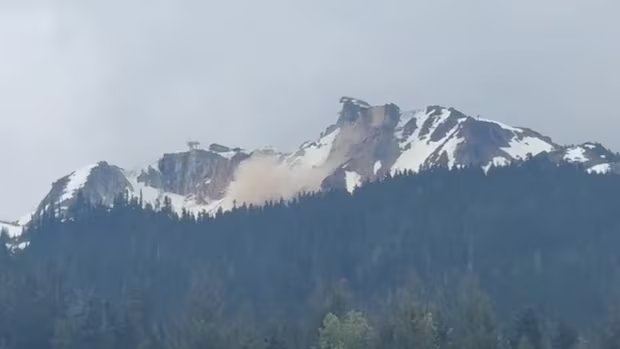

Listen to this article
Estimated 3 minutes
The audio version of this article is generated by AI-based technology. Mispronunciations can occur. We are working with our partners to continually review and improve the results.
A rockfall at Whistler Peak took place on Wednesday, marking the third time debris has fallen from the mountain this year.
Whistler resident Peter Higgins was at the Creekside gondola at 8 a.m. when he witnessed the rockfall.
“I heard it before I saw it,” Higgins said.
The area where the rockfall occurred, at Whistler Peak on Whistler Blackcomb, was closed and no one was injured.
“There is no risk to guests or staff,” said Vail Resorts spokesperson Dane Gergovich.

A suspension bridge and viewing platform foundations on Whistler Peak have not been impacted.
The Cloudraker Skybridge, which spans from Whistler Peak to the West Ridge, and Raven’s Eye, on Whistler Peak, do not open until June 13. Opening will be “conditions and safety dependent,” said Gergovich.
Rockslide in March
Back on March 12, a medium-sized rockslide occurred at Whistler Peak around 6:30 a.m. PT, closing a section of Whistler Blackcomb.
Whistler Peak and the Peak Express chairlift were closed until March 22 due to the rockslide, and a section around where the slide took place remained closed for the season.
Vail Resorts confirmed “rock movement” on May 28 near the slide site on Whistler Peak while the resort was closed.

“Preliminary assessment indicates the movement is likely ‘hangfire’, an unstable section of rock fractured during the March 12 rockslide, that did not initially release and is now shifting due to melting snow and rising temperatures,” Gergovich said.
The rockfall on Wednesday occurred in the same location as the previous rockfall.
“Additional movement, including today’s, was anticipated as part of this natural process,” Gergovich said.
A geotechnical assessment is underway at the rockslide location.
“Our operations team continues to work closely with geotechnical experts to monitor conditions and to finalize a detailed assessment,” Gergovich said.
Rockfalls were expected
Geologist and professor at Simon Fraser University (SFU), Brent Ward said debris falling is common after rockslides.

“It’s quite common to have some unstable rock on that slope that now is unsupported by the mass that left, and that can actually fail and roll down the slope,” Ward said.
The rockfall on Wednesday is likely small bits of the slope that are failing and rolling down, he said.
“The geotechnical assessment will probably be trying to evaluate if there’s the potential of a larger mass failing, and if that is a possibility,” Ward said.
Glyn Williams-Jones is also a professor at SFU and said there would be a benefit to installing seismo-acoustic monitoring systems in the area.

A similar system has been deployed at Mount Meager, northwest of Pemberton.
The system has sensors to measure the ground vibrations and air pressure change caused by rockfalls, landslides, snow avalanches and can even measure changes in river level due to atmospheric rivers, said Williams-Jones.
One B.C. researcher previously said the rockslide took place amid climate change-related warming, which causes deglaciation and permafrost degradation.
Vail Resorts said an assessment of the rockslide is still being done, and all three events are connected.