dailynewsnblog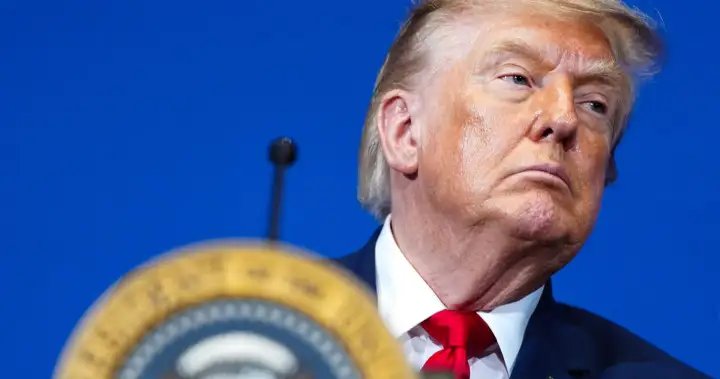
As U.S. President Donald Trump heads into the halfway point of his second term, a new poll suggests more Canadians hold a favourable view of China than they do of the United States.

Recent polling by the Pew Research Center shows that two in five (44 per cent) Canadian respondents held a favourable view of China, while just one in three (33 per cent) said the same about the U.S.
Last year, Canadians were found to be “equally” favourable toward both countries.
Canada has for years been part of an international effort to condemn China for human rights violations against Uyghur people, a largely Muslim minority group that has faced a long-term campaign of detention, and later incarceration, by China.
There are about 12 million Uyghurs living in Xinjiang, which is officially known as the Xinjiang Uyghur Autonomous Region (XUAR). The United Nations (UN) estimated in 2018 that as many as one million Uyghurs were being held in what resembles a “massive internment camp that is shrouded in secrecy.”
Canada imposed sanctions on four Chinese officials and one entity on March 22, 2021, with former prime minister Justin Trudeau saying a “gross and systematic human rights violations” was taking place.
China’s nearly three-year arbitrary detainment of Canadians Michael Spavor and Michael Kovrig also blew up diplomatic relations between the countries. At the time of their release, 115 Canadians remained in custody in Chinese prisons, Global Affairs Canada told Global News on Sept. 26, 2021.

China also executed four Canadian citizens in early 2025, with Beijing saying at the time all four were dual citizens and had been prosecuted on drug charges.

Get daily National news
Get daily Canada news delivered to your inbox so you’ll never miss the day’s top stories.
Abbotsford, B.C., native Robert Schellenberg has been on death row in China since 2019.
The federal government said at the time that it “strongly condemns” the executions, but Prime Minister Mark Carney has made repeated outreaches to Beijing to thaw relations and increase trade since coming into the role last year.
Canada not the only country to favour China over U.S.
The poll asked 1,020 Canadians via phone between Feb. 8 and May 13 about their views on both the U.S. and China, including the respondents’ foreign policy stances, rating respective presidents of each nation and respect for personal freedoms.
Surveyed Canadians were not the only ones who came to the conclusion of favouring China over the U.S., with the poll stating that “China is now seen more positively than the U.S. in most of 36 countries surveyed.”
“During the first two years of Trump’s second term, ratings of the U.S. president worsened significantly. While many people still lack confidence in [Chinese President] Xi [Jinping], positive views of him have become more widespread, and more overall now say they have confidence in Xi than in Trump,” the poll reads.
The U.S. is viewed more positively than China in just six countries, including four in the Asia-Pacific region: India, Japan, the Philippines and South Korea.

Tensions between the U.S. and Canada have been fraught since the American administration’s tariffs on Canada in early 2025 and repeated threats by Trump to make Canada the “51st state.”
A letter sent by U.S. Republicans to Carney on Wednesday regarding Canadian wildfire smoke blowing into the U.S. states that “sovereignty comes with responsibility, and the responsibility to prevent a foreseeable disaster from crossing into another country’s airspace has not been met.”
Carney visited China in January, meeting with Xi. Carney’s office had said his visit had a focus on “engagement on trade, energy, agriculture and international security.”
This marked the first visit by a Canadian prime minister to China in eight years.
As a result, Canada and China reached a preliminary trade deal in which Beijing agreed to lower or eliminate some tariffs on Canadian agricultural products and Canada agreed to reduce tariffs on some Chinese electric vehicles.
China’s foreign minister Wang Yi also conducted a three-day trip to Ottawa in June that included meeting with Carney.
The last time Wang was in Ottawa 10 years ago, he unleashed a tirade on a Canadian reporter who asked about human rights in China at a joint press conference with then-foreign affairs minister Stephane Dion.
During the visit in June, Foreign Affairs Minister Anita Anand said that the economic relationship between Canada and China is “significant.”
“We are committed to growing this relationship responsibly with a goal of increasing exports towards China by 50 per cent by 2030, while safeguarding Canada’s economic and national security interests and values,” she said at the time.
© 2026 Global News, a division of Corus Entertainment Inc.