dailynewsnblog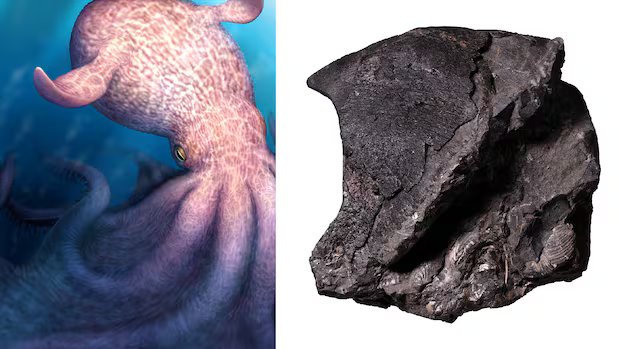

Listen to this article
Estimated 5 minutes
The audio version of this article is generated by AI-based technology. Mispronunciations can occur. We are working with our partners to continually review and improve the results.
Monstrous octopuses the size of modern whales prowled the seas during the Age of Dinosaurs, snatching prey with their huge tentacles and crunching them with powerful jaws, fossils from B.C. and Japan suggest.
Like mythical, tentacled sea monsters such as the Kraken, these creatures grew as large as 19 metres long — about the size of a sei whale, the third largest living whale — reports a new study published in the journal Science Thursday.
One of two species described, Nanaimotethis haggarti, “may even have been among the largest invertebrates in Earth’s history,” wrote Yasuhiro Iba, a professor at the University of Hokkaido and the senior author of the study, in an email.
The official record holder, the modern giant or colossal squid, tops out at around 12 metres.

Cameron Tsujita, a paleontology professor at Western University in London, Ont., said Nanaimotethis was “terrifyingly large,” even with a wide margin of error. Tsujita wasn’t involved in the study.
Not only were these octopuses huge, but they appeared capable of eating prey well protected with hard shells, based on the wear patterns on their fossilized beaks, Iba and his collaborators in Japan and Germany reported.
“Nanaimoteuthis likely used its large body and long arms to capture prey and its powerful jaws to crush hard structures such as shells and bones.”
At a time when huge, predatory marine reptiles such as mosasaurs and elasmosaurus were thought to have ruled the seas, this would have given smaller animals such as fish, sea turtles and octopus relatives such as ammonites something more to worry about.
Iba wrote, “Our study shows that giant invertebrates — octopuses — were also part of the top predator community.”
Tsujita said one observation from the study he found particularly intriguing was that the octopuses’ jaws or beaks were more worn on one side than the other, suggesting they had a preference for grabbing prey on one side — a level of “handedness” that’s associated with intelligence. (Modern octopuses are known to be highly intelligent.)

Underwater videographers John Roney and Chris Mullen tell The National about the moment they had their camera hijacked by a curious giant Pacific octopus off the coast of Vancouver Island.
How the fossils were ‘mined’
The fossils were beaks or jaws found in rock formations on Vancouver Island, B.C. (the species are named after the Nanaimo Group deposit) and in Hokkaido, Japan. Some of them are housed at the Courtenay and District Museum and Paleontological Centre in Courtenay, B.C.
Because fossilization usually happens to harder materials like bones and shells, soft-bodied octopuses rarely fossilize.
Only octopus beaks or jaws, made of the protein chitin (also found in lobster and beetle shells), which are harder for crushing prey, sometimes get fossilized.

But even chitin is hard to separate from rock, and traditional techniques often shave off part of the fossil, said Misha Whittingham, a paleontologist from Vancouver Island who has been studying fossil relatives of octopuses for more than a decade. Whittingham wasn’t involved in the new study.
To get more detailed “specimens,” Iba and his colleagues used a technique they called “digital fossil mining” (also known as “grinding tomography). They took rocks from areas where similar fossils were found without any visible fossils on the surface, and shaved them layer by layer, taking high-resolution images that were then analyzed and put back together into a 3D model using AI.
By comparing the detailed specimens to modern squids and octopuses, they were able to confirm that the two Nanaimotethis species weren’t vampire squids as previously thought, but finned octopuses. Modern finned octopuses, unlike coastal finless octopuses that people may be more familiar with, live mostly in the deep ocean.

The comparisons also allowed the researchers to estimate the octopuses’ size. From the detailed digital fossils, they analyzed of the wear patterns on the beaks of octopuses of different sizes and ages, suggesting that they ate very hard prey that wore their beaks down over time.
Oldest octopuses known
The octopuses in this study lived 100 million to 72 million years ago. That makes them at least five million years older than any other known octopus fossils.
Whittingham, now a postdoctoral researcher at the Open University in Milton Keynes, U.K., said that’s already interesting and important.
The way octopuses evolved is largely a mystery, since so few of their fossils are ever found.
The fact that Nanaimotethis were so different from modern octopuses raises questions about the origins of octopuses overall, Whittingham added.
“What happened? Why? Why are octopus now the way they are and not the way these octopus were?”