dailynewsnblog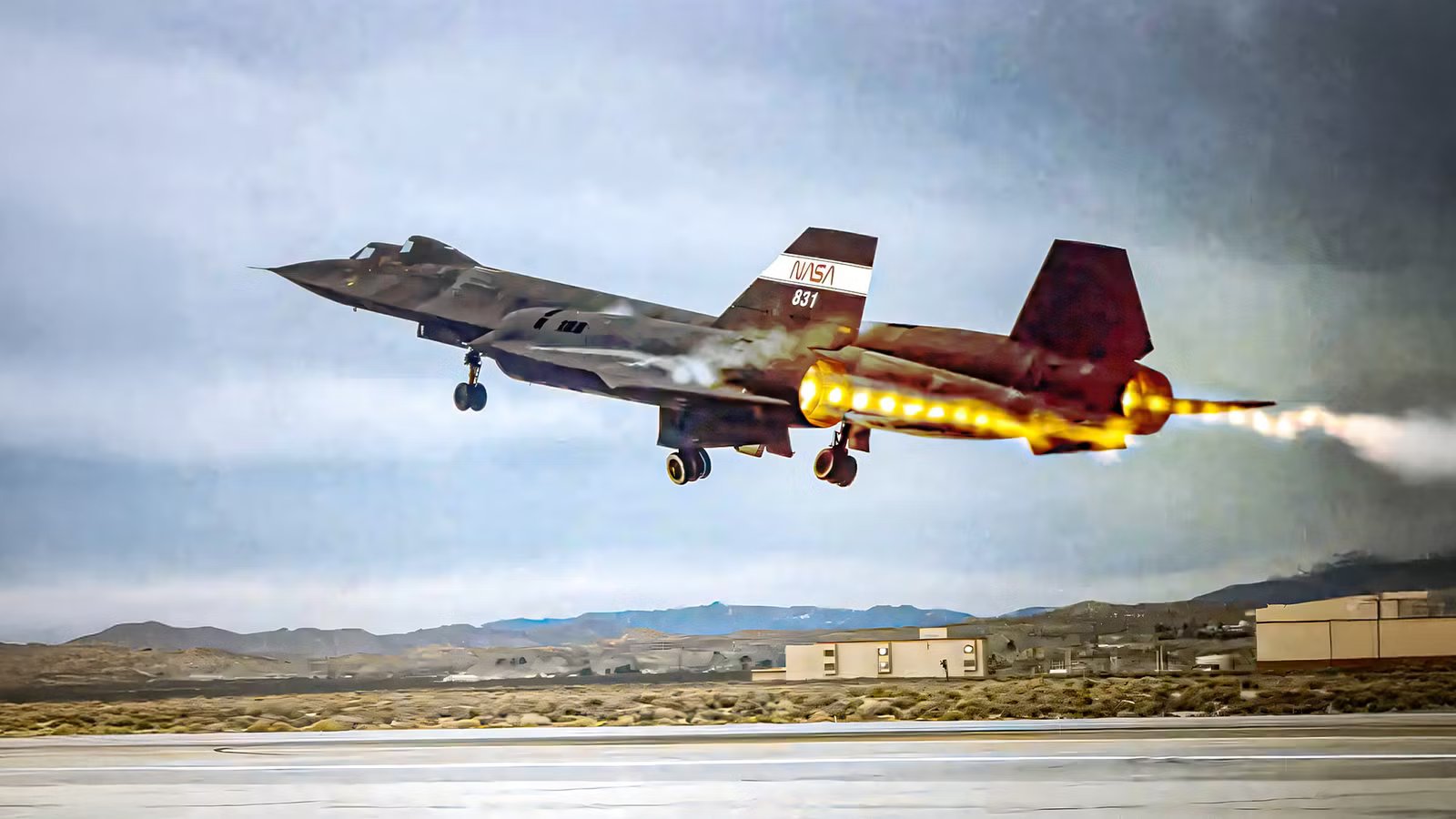
Some of the most interesting aspects of the engineering of the Lockheed SR-71 Blackbird supersonic spy aircraft were how it handled thermal expansion and the extreme temperatures of sustained high-Mach flight. The SR-71 belonged to an era when engineers tackled extreme aerodynamic heating largely through innovative materials and mechanical design rather than today’s extensive computer modeling and simulation.
Thermal expansion was one of the most important design factors of the SR-71, although it was not exactly unique. Thermal expansion was a dominant design factor in the North American X-15 rocket plane, which remains the only crewed winged aircraft to reach hypersonic (Mach 6.7) speeds. Thermal expansion was also very important to the design of the North American XB-70 bomber (built for cruising at Mach 3.0) and the Concorde supersonic passenger airliner built for sustained speeds of Mach 2.0.
The SR-71’s P&W J58 Turbojets

The Lockheed SR-71 Blackbird was a marvel of engineering of the 1950s and 1960s and is a testament to US engineers of the period. But it is also a design that is now over 60 years old, and some engineering aspects show its age. The SR-71 was powered by Pratt & Whitney J58 turbojet engines. These were built for the predecessor Lockheed A-12 and the YF-12. The engine was notable for having a unique compressor bleed to the afterburner, giving it a higher thrust when flying at higher speeds.
The aircraft was able to provide two modes of operation to enable it to power the aircraft both from a stationary position and at speeds of over Mach 3. The Air and Space Museum explains,
“When opened, bypass valves bled air from the fourth stage, and six ducts routed it around the compressor rear stages, combustor, and turbine. The bleed air re-entered the turbine exhaust around the front of the afterburner, where it was used for increased thrust and cooling.”
The J58 was developed in the late 1950s and was the first engine designed to operate for extended periods using its afterburner. It was also the first engine to be flight-qualified at Mach 3 for the US Air Force. The Anglo-French Concorde was built for sustained speeds at Mach 2. While it’s unclear how much its Rolls-Royce/Snecma Olympus 593 engines expanded, famously, Concorde’s fuselage length would increase by around 6–10 inches (15–25 cm).
Why The J58 Engines Expanded 6 Inches

A basic feature of many materials (such as metals) is that they expand when they are heated and contract when they are cooled. This is why engineers design bridges with the space to expand and contract with the temperature. When at cruise speeds of Mach 3.2+ at around 80,000 feet, the J58 engines would be subjected to intense aerodynamic heating. Compressor inlet temperatures could exceed 400°C (750°F).
The air entering the engine and nacelle could reach temperatures of over 300°C (570°F) in some areas. In these extreme conditions, the Blackbird’s engines were designed to expand in length by around six inches (15 cm), relative to when they were at cold conditions on the ground. Being able to expand was the engineer’s way to accommodate thermal expansion.
It wasn’t just the engines. The whole aircraft heated considerably, and so the whole aircraft had to be designed around thermal expansion. This even applied to the infused tires that enabled them to withstand high temperatures. This made them perform poorly at cool temperatures, with the weight of the stationary aircraft bearing down on them.
The Aircraft Lockheed Built That Was So Fast Even The Pilots Who Flew It Don’t Fully Understand How It Worked
A closer look at the black magic inside the SR-71.
The Problems Of 6-Inch Thermal Expansion

As stated, the engines could expand by six inches between the minimum and maximum temperatures they could be expected to endure. Because the engine would expand so much, Skunk Works was unable to just bolt it rigidly into the airframe. Instead, these engines were mounted with a complex set of rollers and swinging links, creating a floating mount.
The front of the engine was anchored tightly, but the rest of the engine was free to expand rearward into the exhaust ejector assembly. While the engineering was impressive, it was a compromise to accommodate thermal expansion, which caused some issues. The aircraft was designed with special titanium alloys due to the fact that aluminum would have softened too much. It also used heat-resistant nickel-iron alloys (like Hastelloy-X).
Pratt & Whitney J58 Turbojet | |
|---|---|
Weight | Approx. 6,000 lbs. |
Thrust | 32,500 lbs. with afterburner |
Maximum operating altitude | Above 80,000 feet (over 24,000 meters) |
Compressor | Nine-stage, axial flow, single speed |
Perhaps one of the most interesting features of the aircraft was that it was famously “designed to leak fuel” while stationary on the ground. It leaked fuel because its panels were designed with gaps for thermal expansion. These gaps would only be filled when the aircraft was heated up in flight, meaning that when the airframe was cool, it would leak. This may be a fun factoid, but it’s not an engineering ideal.
Why Modern Engines Don’t “Match” It

The extreme thermal expansion of the engines was a 1950s workaround to an engineering problem that faced engineers due to the requirements of the Air Force at that time. Since then, modern engines, such as the Pratt & Whitney F119 (F-22 Raptor) or F135 (F-35 Lightning II), are generations more advanced and are designed for different roles.
The SR-71 was developed in an era before widespread satellite usage and for sustained high-speed performance. Modern manned fighter jets like the F-22 Raptor are designed for efficiency, maneuverability, and prioritized stealth. The Blackbird was built with the concept that “you can’t hide, but you can run.” Today’s F-22 and F-35 stealthy aircraft are designed with an emphasis on the opposite: “you can’t run, but you can hide.”
Modern fighter jet engines are typically designed to propel the aircraft to between Mach 1.6 and Mach 2.5. They are only designed for short dashes with afterburners and sustained subsonic speeds. Even so, all modern fighter jet engines will expand as they get hotter, just less dramatically than aircraft engines designed for sustained high Mach flight.
Why The SR-71C ‘The Bastard’ Was The Only Blackbird Never Meant To Fly
The story of the Blackbird family’s black sheep.
Satellites Move Much Higher And Faster

The SR-71’s mission was absorbed by a range of platforms. It was retired in 1998 without a direct replacement. Parts of its missions were taken over by satellites, airborne assets, human intelligence, stealthy spy drones (e.g., RQ-170), signals intelligence, and more. While the SR-71 is remembered as being a high-Mach, high-altitude, and daring marvel of engineering, little thought is often given to satellites.
Catch what other flight trackers miss
Emergency squawks, holds, NOTAMs — live signals, no signup.
Open tracker
Catch what other flight trackers miss
Emergency squawks, holds, NOTAMs — live signals, no signup.
Open tracker
The SR-71 may have taken images from 80,000 feet (24,400 meters), but satellites take images from 100 to 1,240 miles (160 to 2,000 kilometers) in low earth orbit, 1,240 to 22,230 miles (2,000 to 35,780 kilometers) in medium earth orbit, or over 22,300 miles (35,786 kilometers) in geostationary earth orbit. While satellites can’t loiter over a point of interest (unlike a drone or crewed spy plane), they can give an image of almost anywhere within hours. It should be noted that the time for revisit is getting shorter. Historically, it could be days. Now it’s often hours or even minutes, with weather conditions complicating imagery.
Satellites also vastly exceed the SR-71 in terms of raw velocity. A typical low-Earth orbit satellite travels at roughly 7.8 km/s (about 28,000 km/h), completing an orbit of the Earth in around 90 minutes. Geostationary satellites orbit more slowly, at around 3.1 km/s, but remain fixed relative to the Earth’s surface. Low Earth orbit satellites typically move at Mach 22–23 using the reference as the sea-level speed of sound, and medium-level satellites move at Mach 9–12. This said, as they are in space, Mach is not physically meaningful in the way it is when passing through air as a medium.
How SR-71’s Uniqueness Worked Against It

The reason why no other engine matched the massive expansion of the J58 turbojet is that they don’t need to. The missions of the SR-71 have largely been absorbed by other platforms. The SR-71 hails from a pinnacle of engineering when the Air Force built a massive, mechanical shapeshifter to withstand the thermal environment. While the SR-71 is a beautiful piece of early Cold War engineering, its complex, unique, and expensive design was also its undoing.
As new platforms were built to take over much of its roles and as the geopolitical climate cooled following the end of the Cold War, the Air Force increasingly saw the SR-71 as an enormously expensive aircraft providing diminishing returns. In the end, the Air Force retired the aircraft (in 1989 and permanently in 1998) but kept the older, simpler, lower-flying, subsonic Lockheed U-2 Dragon Lady spy plane in service.
The Dragon Lady may have first been downed by a Soviet surface-to-air missile in 1960, while the Blackbird may have outrun 4,000 enemy interceptor missiles. And yet, by the 1990s, 2000s, 2010s, and 2020s, it was the Dragon Lady, with its lower operating costs and high loiter times, that was the more attractive ISR asset in low-threat environments. Today, the US Air Force is reluctant to send manned platforms on ISR missions deep into enemy territory. These can carry large political consequences. It is generally simpler to task a satellite or send a drone.