dailynewsnblog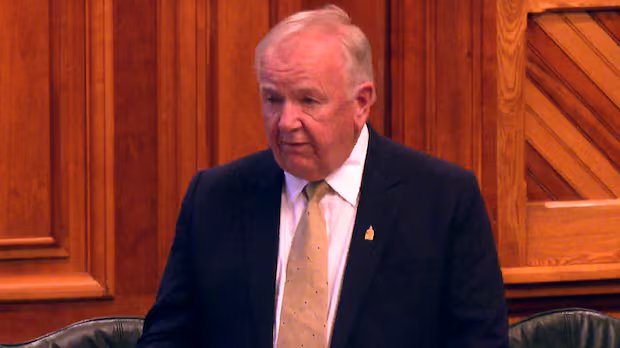
A Progressive Conservative MLA has confirmed he used artificial intelligence to prepare a speech he delivered — complete with AI prompts — to the New Brunswick Legislature.
A clip of the most obvious AI moments of the speech has been shared on Reddit, Instagram, and other social media platforms.
And Bill Oliver, the MLA for Kings Centre, says he’s learned a lesson.
“During the spring session of the legislature, I employed AI to help prepare speaking notes,”
Oliver said of the incident.
“When printing the final version of my speech AI prompts were not removed, which were spoken by me and has caused much concern of many individuals.”
Oliver gave the speech June 9 during a discussion about whether the province should create the position of energy advocate.

PC MLA Bill Oliver has admitted to reading from an AI-written speech at the legislature in June when talking about the creation of an energy advocate in the province.
In the text Oliver read, there were three instances where his AI use was obvious, including where he said: “Here’s a more natural-flowing version of that section that reads like legislative speech rather than a series of short points.”
A few minutes later, Oliver read out these words: “Here’s a more developed and flowing version of the same section.” And a few minutes after that he said, “This section adds roughly … excuse me.”
Despite the AI-generated words in the text, Oliver insists his thoughts were his own.
“AI has become a tool that is being used more often, in many areas, but should never replace our own ability to express our thoughts and convictions,” he said in a written statement to CBC News.
“The sentiment of my speech was certainly mine, and I have learned an important lesson from this experience.”
Parties react
Glen Savoie, the interim PC leader, said he’s satisfied with Oliver’s response to what happened.
“It’s been a learning experience, and certainly Bill has taken responsibility for it,” the Opposition leader said in an interview. “He’s put out a statement which I completely endorse and accept.”
“Look, we’re all human. He made a mistake. He recognizes the importance of making sure that it’s our voices that are heard on the floor of the legislature, and we’ll work towards ensuring that happens as we go forward.”

Savoie said the PC caucus is now working on creating an AI policy for its 16 members.
The Liberal caucus said in an email that it does not have a policy about members’ use of AI.
The Green caucus said it just created and adopted a policy on AI in March 2026. MLA Megan Mitton said she and the other Green MLA, David Coon, are both personally against using AI in the political sphere.
“We were not elected to come here and have generative AI, write 40-minute speeches for us,” Mitton said. “We’re here to represent people, use our own brains and thoughts.”

Mitton said she noticed the AI phrasing when Oliver initially read the AI-generated speech in the legislature, and both she and Coon called it out that same day.
“This spring, I noticed lots of instances where I thought generative AI had written MLAs’ speeches,” she said. “That was an example that was very clear, but I saw lots of examples.”
Not only does Mitton believe the AI speech was “boring” and hard to listen to, but she said the 40-minute speech prevented legislative work from getting done.
“Some of the bills that needed to be discussed, we didn’t even get to,” she said.
AI as a tool
The University of New Brunswick just launched its Responsible AI Research Lab this year. Mahtab Sarvmaili, the lab director, said, that because LLM, or large language model, platforms such as ChatGPT are trained on pre-existing data, their claims need to be verified.
“You cannot always 100 per cent say that the answer is accurate or it’s properly grounded in the existing resources,” Sarvmaili, an assistant professor of computer science at UNB, said in an interview.
“You have to go and double check. You need to be sure that the resources used are valid, it’s factual, and it’s correct.”
Sarvmaili said AI use always needs to be responsible, but this is even more important when it’s used by government.

“The domain of AI is changing really fast, but I 100 per cent support the placing of policies to make responsible adoption of AI,” she said. “Specifically if you’re talking about something that can affect the lives of so many people.”
Mario Levesque, a political science professor at Mount Allison University, said responsible use of AI by politicians certainly includes fact checking and source checking.
“I’m not saying don’t use AI,” he said “I’m saying that AI is a new tool that we have in our toolkit. We have many tools, and it can be used. But when you use it, you have to verify the facts.”
Levesque worries that by the time the government, or each individual party or caucus, implements policies surrounding AI, it will already have changed because AI is changing quickly,

Mitton agrees and would like to see policies implemented for all parties at the legislature, since AI use can undermine what little trust many people have in politicians.
“People don’t have a lot of trust in politicians,” she said. “And so I think it’s really important that we are expressing our own thoughts, that we are speaking for the people that we represent.
“I have a really big problem with it being used to replace the voice really, of someone who was elected to be a voice for people.”