dailynewsnblog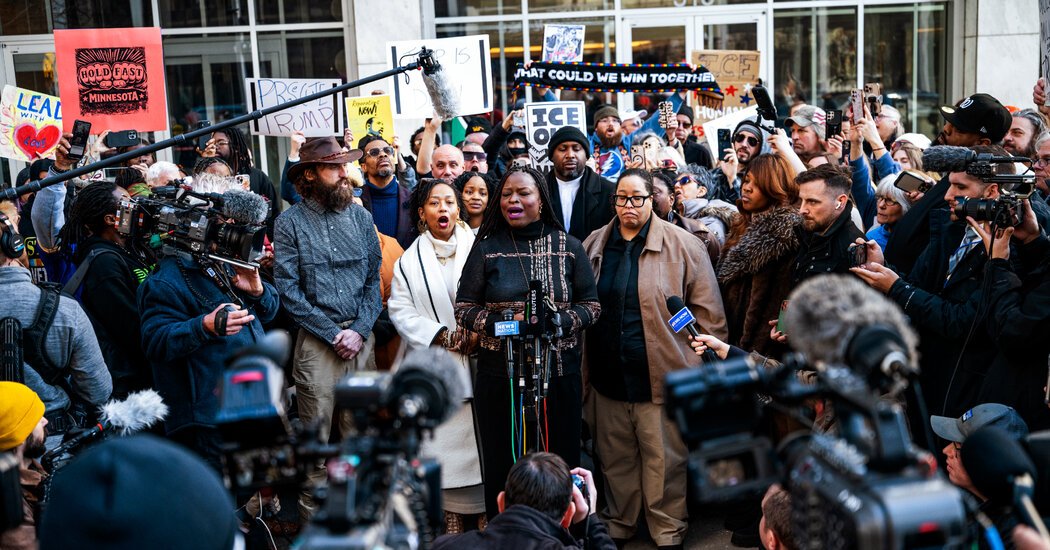
The Trump administration came out swinging in January after a group of activists in Minnesota, accompanied by camera-toting journalists, held a demonstration at a St. Paul church to protest President Trump’s aggressive immigration crackdown in the state.
Officials cast the incident as part of a larger narrative of left-wing protesters being out of control at a fraught political moment — just days after a Minneapolis woman, Renee Good, had been killed in her car by an immigration agent. The authorities moved swiftly, arresting several people who had been inside the church. Among them was Don Lemon, the former CNN anchor who had long run afoul of Mr. Trump.
Harmeet K. Dhillon, who runs the Justice Department’s civil rights division, which helped to bring the charges, set the tone for the administration’s moves by trumpeting the case with a brash remark. “We’re going to pursue this to the ends of the earth,” she said.
Six months later, however, the case, which is unfolding in Federal District Court in St. Paul, has been plagued by an array of prosecutorial missteps. Defense lawyers have accused the government of rushing to bring headline-grabbing charges, and the judges overseeing the proceeding have, from its outset, been voicing their concerns.
In May, for instance, it was revealed that one judge undertook the highly unusual step of rejecting a raft of search warrants after finding they would be unlikely to turn up evidence that crimes had been committed. Last week, another judge made an even more unusual move: He demanded to see some grand jury transcripts in an effort to determine whether prosecutors had acted improperly when securing the indictment.
At the same time, the defense has said investigators botched their efforts to search Mr. Lemon’s cellphone, issuing a warrant in Minnesota even though the phone was seized in California. Lawyers have also accused the prosecution of bypassing its problems with securing warrants by issuing administrative subpoenas typically used in customs enforcement cases, not criminal proceedings, to obtain information from some of the defendants.
All of this, the lawyers claim, has damaged the government’s case and had a broader impact, undermining the bonds of trust — known in legal circles as the presumption of regularity — that prosecutors have traditionally enjoyed in court.
“It is clear to me that in this case, the government in many respects, candidly, has gone off the rails,” Matthew Ebert, a defense lawyer who served as a federal prosecutor until late last year, told a judge last week.
“We’re talking about a growing confluence of conduct,” Mr. Ebert added, “which ultimately, Your Honor, I think goes to the fact that the presumption of regularity has eroded, if not evaporated.”
Prosecutors have adamantly denied such accusations, claiming that whatever errors they have made — and they have admitted making some — were purely accidental. A Justice Department official played down the troubles, saying that the case was moving forward in a normal way with the defendants challenging the charges.
Still, in a signal that prosecutors are somewhat concerned about bringing the case to trial, they have offered plea deals to 29 of the nearly 40 people facing indictment. Under the proposed agreement, defendants would plead guilty to a single misdemeanor charge and avoid any prison time, according to a draft shared with The New York Times.
So far, however, none of the defendants have agreed to take the deal, according to defense lawyers.
The U.S. attorney’s office declined to comment on the plea deals.
The case in St. Paul is only the latest prosecution arising from Mr. Trump’s nationwide immigration sweeps to face significant problems. Over and over, in cities like Chicago and Los Angeles, the Justice Department has followed the same pattern: It has loudly announced indictments, often tarring defendants as radicals or terrorists, then watched as cases have run aground because of a lack of evidence or prosecutorial errors.
An investigation by The Times found that hundreds of officer assault cases stemming from immigration raids have unraveled as juries have acquitted, judges have thrown out charges or prosecutors have themselves withdrawn indictments.
From the start, the case against Mr. Lemon and his co-defendants struggled to get off the ground, not least because of the uncomfortable way in which it lumped together activists engaged in political protest and journalists who covered them. Three sets of judges — including some on a federal appeals court — refused to go along with the government’s initial attempt to seek criminal complaints against Mr. Lemon and other journalists — including the reporter, Georgia Fort — after finding there was simply no evidence they had committed crimes.
Some career federal prosecutors in Minnesota were alarmed by the anomalous investigative steps that set the case in motion and by the pointed remarks administration officials made about the defendants. The protest happened days after several experienced prosecutors resigned over the Justice Department’s handling of Ms. Good’s shooting.
Lauren Roso, a career prosecutor assigned to work on the case in its early days, said it led her to quit what had been a dream job.
“The Cities Church protest case gave me significant pause,” Ms. Roso said, disclosing for the first time the reason she resigned. “I was uncomfortable with the pace and manner in which the case was proceeding, and those concerns played a role in my decision to leave the U.S. attorney’s office.”
In the end, prosecutors persuaded grand jurors in St. Paul to return an indictment charging the two journalists and seven other people with a conspiracy to violate the Face Act, a law that forbids using threats of force to intimidate or interfere with people seeking reproductive health services or trying to participate in a service at a house of worship. A subsequent indictment expanded the case to include another 30 people, most of them demonstrators who joined the protest at Cities Church on Jan. 18.
But the case ran into trouble almost immediately as the White House posted a digitally altered image of the lead defendant — Nekima Levy Armstrong, a local civil rights lawyer — appearing to sob as she was being arrested. Weeks later, prosecutors dropped the charges against one of the new defendants, Heather Danae Lewis, in what appeared to be a case of mistaken identity.
Overall, prosecutors have vigorously defended their indictment. In recent court papers, they said they intended to prove the charges by showing, among other things, that Mr. Lemon and Ms. Fort attended a meeting where activists organized the protest at the church where one of the pastors also works as a senior official with Immigration and Customs Enforcement.
The prosecutors also say that they have a large amount of video footage of the “disruptive protest operation” and that one churchgoer injured her elbow when she fled from the building. Moreover, another of the church’s pastors, Jonathan Parnell, has testified to the grand jury that he felt “threatened and crowded” by both the activists and the journalists.
Lawyers for Mr. Lemon and Ms. Fort have scoffed at such assertions, arguing that their clients, unlike the actual protesters, never shouted anti-ICE slogans during the demonstration and got close to Mr. Parnell and his congregants only to do their jobs.
At the court hearing last week, most of the discussion focused on Ms. Fort, a St. Paul native who has covered the extensive protests against ICE in Minnesota as well as the killings of Ms. Good and another demonstrator, Alex Pretti. The government has already acknowledged that in some of the rejected search warrants, investigators falsely claimed that Ms. Fort shouted things like “ICE Out!” during the church protest and used her camera as a “weapon to intimidate, threaten and scare the congregants.”
Her lawyer, Mr. Ebert, asked Magistrate Judge Douglas L. Micko to scrutinize the grand jury proceedings to be certain that the same false statements had not been used to secure the indictment against her. By the end of the hearing, Judge Micko agreed to do so, saying there was some evidence that prosecutors may have “misinstructed” the panel.
Typically, a case like this would be overseen by prosecutors from the U.S. attorney’s office in Minnesota, but as with other politically sensitive cases, the proceeding in St. Paul has largely been run by lawyers based in Washington. One of them was new enough to the case — and to Minnesota — that during last week’s hearing he mispronounced the name of a veteran judge in the district, Patrick J. Schiltz.
In a sign of local discomfort with the case, three defense lawyers formerly served in the office that is prosecuting the defendants. At the hearing, one of them, Mr. Ebert, immediately accused the prosecution of unfairly going after his client, Ms. Fort, and her co-defendants.
“We have a situation where the government unfortunately charged the case first and then tried to investigate it later,” he told Judge Micko. “And the consequences of that are playing out in unfortunate real time.”