dailynewsnblog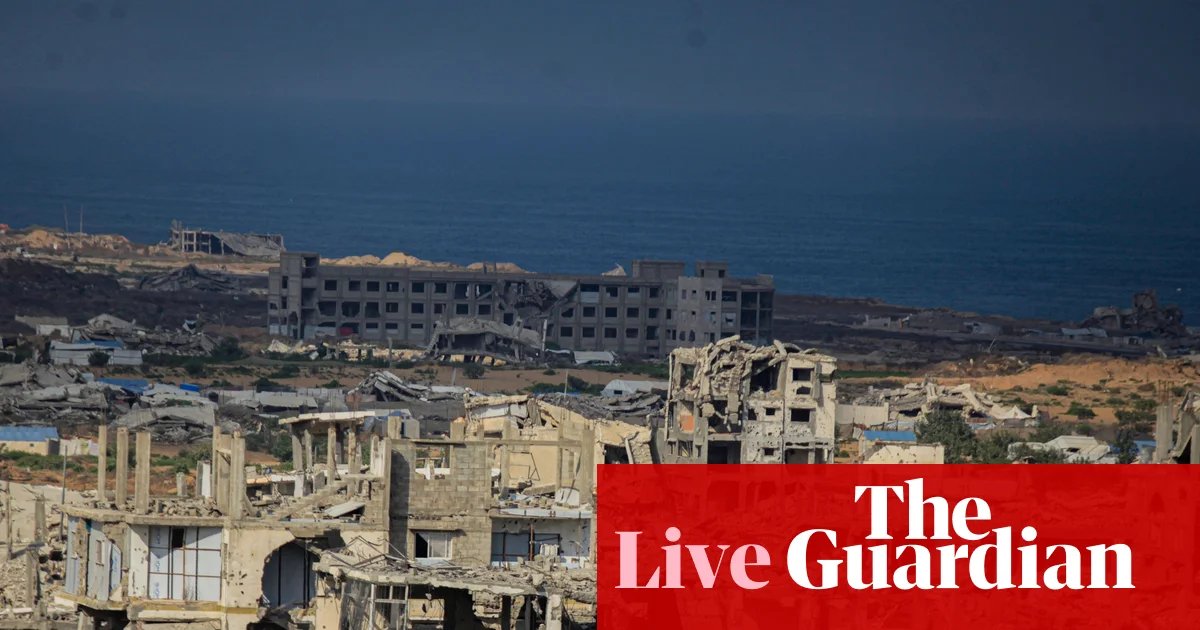
Netanyahu rejects US Gaza plan, vows no pullout until Hamas disarms
Israeli prime minister Benjamin Netanyahu has rejected a Gaza plan hailed by US president Donald Trump, vowing no military pullout of Gaza until Hamas is “genuinely” disarmed.
“Israel rejects the 15-point document,” Netanyahu said, referring to a plan endorsed in late July by Hamas.
The Israeli military “will not carry out any withdrawal until Hamas is genuinely disarmed and will continue to thwart threats against our forces and our citizens,” Netanyahu said at a cabinet meeting, Reuters reports.
The document, the latest stage in a US-led ceasefire announced in October that has reduced but not ended Israeli operations in Gaza, said Hamas would surrender weapons to a nascent Palestinian governing body.
The plan said Israel would begin pulling out forces in tandem with the disarmament, an idea adamantly rejected by Israel which also wants Hamas to destroy its weapons.
Netanyahu said that Israel was speaking with the US about its objections. “They have ideas; some of them are acceptable to us and some are not, and we know how to stand our ground on these matters,” he said.
Netanyahu said that Hamas must give up all of its weapons, a goal that Board of Peace members say is not realistically achievable. “We are talking about real disarmament, not fictitious disarmament,” Netanyahu said.
Key events
One major sticking point between the two sides over the Gaza plan is disagreement over timing commitments.
Israel has said that Israeli troops in Gaza would not move before Hamas disarms, while Hamas has insisted that Israel halt attacks before it begins implementing the part of the agreement dealing with its arms.
Hamas said it agreed to the plan in order to spare the people in Gaza a possible resumption of war, but it added that the implementation of the deal would depend on Israel first meeting its own commitments, including withdrawal.
Hamas avoids the use of the term “disarmament” and said the group agreed to hand over weapons to be stored by the US-backed National Committee for the Administration of Gaza under the supervision of Trump’s Board of Peace.
Israeli prime minister Benjamin Netanyahu’s rejection of the plan and vow not to withdraw until Hamas disarms was met with praise by far-right finance minister Bezalel Smotrich.
“We went to war with a central goal: the destruction of Hamas,” he said in a statement. “The (military) cannot withdraw even a milimetre from the Gaza Strip. The Gaza Strip cannot begin any process of reconstruction before the complete dismantling and demobilization of Hamas and the Gaza Strip.“
The US plan that would see Hamas disarmed and Israeli withdrawal from Gaza was announced at the end of July. Here’s a recap of the details of that plan from when it was announced:
Announcing the agreement in a social media post, Trump said it involved the “complete disarmament” of Hamas and other armed groups in Gaza and was “a monumental step toward ending the fighting”.
Israel has pointed to Hamas’s failure to disarm as justification for its continued strikes and refusal to allow any reconstruction in Gaza, and for Israeli forces’ steady edging forward from the demarcation line agreed in October.
The 14-point plan, posted by the Board of Peace (BoP) on X, urges Israel, Hamas and other Palestinian factions to halt all military operations, and calls for an international verification committee (IVC) to be set up. It outlines a 14-day period after all parties have accepted the roadmap, with a timetable and implementation mechanisms to be worked out.
Control of Gaza would then be handed to a National Committee for the Administration of Gaza, a panel of Palestinian professionals and experts set up by the BoP in January who have been waiting in Cairo since then to take over. The NCAG would take over all administrative functions, backed by the new police force and the ISF. That would enable a “process to decommission and store heavy weapons, military production sites, depots of weapons, and tunnels”.
The disarming of Hamas and other groups would be “gradual, sequential and time-bound” and would be “linked to an Israeli withdrawal, in phases, from the areas under its control in Gaza”. The ISF would operate between NCAG and Israeli-controlled areas of the territory, while internal security would be the responsibility of the NCAG and its police force.
You can read Julian Borger’s full report at the link below:
US must pressure Israel to accept Gaza plan, Hamas official says
The US must pressure Israel to accept the next phase of the Gaza plan, a Hamas official told AFP, after Israeli prime minister Benjamin Netanyahu said he rejected the US-backed agreement.
“We expect the mediators and the American guarantor to pressure Netanyahu and his government to adhere to the roadmap and not obstruct the process for internal political and electoral reasons,” Hamas political bureau member Bassem Naim told AFP.
Iranian president Masoud Pezeshkian met the country’s supreme leader Mojtaba Khamenei around the start of the president’s third year in office in late July, state media said on Sunday, and a paramilitary leader promised footage of Khamenei in the future, Reuters reports.
Pezeshkian has given differing accounts in recent weeks about his access to Khamenei, who has not been seen in public since he succeeded his father in the role in March.
On 21 July, the president said interactions with the supreme leader were “increasing day by day”, but in early August he said communicating with Khamenei was “very difficult”.
The late July meeting covered military affairs and the economy, including securing resources, managing foreign exchange and energy use, as well as economic ties with foreign partners, according to state media.
Khamenei was reportedly seriously injured in the February strike that killed his father and predecessor, Ali Khamenei on the first day of the US-Israeli war on Iran. The promise to release footage of the leader by paramilitary Basij Organisation deputy Qasem Qoraishi appeared to be aimed at quashing speculation about his health. Senior Iranian sources have said he suffered facial disfigurement and other injuries in the strike.
Attacks by Iran-backed Houthi rebels in Yemen killed at least four troops from the internationally-recognised government forces and injured 20 more personnel, two military sources told AFP.
The initial toll came from strikes on the Yemeni city of Mokha and surrounding areas, as well as Khokha, south of the port city of Hodeida, the sources said on condition of anonymity, after the Houthis announced they had targeted military forces and equipment on the Red Sea coast.
Netanyahu rejects US Gaza plan, vows no pullout until Hamas disarms
Israeli prime minister Benjamin Netanyahu has rejected a Gaza plan hailed by US president Donald Trump, vowing no military pullout of Gaza until Hamas is “genuinely” disarmed.
“Israel rejects the 15-point document,” Netanyahu said, referring to a plan endorsed in late July by Hamas.
The Israeli military “will not carry out any withdrawal until Hamas is genuinely disarmed and will continue to thwart threats against our forces and our citizens,” Netanyahu said at a cabinet meeting, Reuters reports.
The document, the latest stage in a US-led ceasefire announced in October that has reduced but not ended Israeli operations in Gaza, said Hamas would surrender weapons to a nascent Palestinian governing body.
The plan said Israel would begin pulling out forces in tandem with the disarmament, an idea adamantly rejected by Israel which also wants Hamas to destroy its weapons.
Netanyahu said that Israel was speaking with the US about its objections. “They have ideas; some of them are acceptable to us and some are not, and we know how to stand our ground on these matters,” he said.
Netanyahu said that Hamas must give up all of its weapons, a goal that Board of Peace members say is not realistically achievable. “We are talking about real disarmament, not fictitious disarmament,” Netanyahu said.
Opening summary: Hormuz will stay closed until US meets all our conditions, say Iran’s Revolutionary Guards
Iran’s Revolutionary Guards Corp said they will not reopen the Strait of Hormuz until the United States meets Tehran’s conditions, including compensation for war damages.
The IRGC said their strategy was to maintain the closure “until the enemy accepts all our conditions … the strait is now actually a theatre of war for us and not just a waterway”.
Iran’s security chief Mohammad Bagher Zolghadr on Saturday laid out a list of demands for reopening the strait, including an end to the “war and aggression against Iran and its allies in Lebanon, Palestine, Yemen and Iraq”.
He also demanded the lifting of a US counterblockade of Iranian ports, the end of sanctions, the release of frozen assets and compensation for wartime damage, according to remarks reported by the Tasnim news agency.
Iran has imposed an effective blockade of the strait since the US and Israel attacked in late February, and wants to charge tolls for passage, striking ships it accuses of attempting to circumvent its preferred route.
Iranian foreign minister Abbas Araghchi said discussions with Oman over transit and management of the strait were “approaching the final stages”, but added that the reopening of Hormuz “is subject to other conditions and compensation for the violation” of an interim June agreement with the US.
Iran’s president Masoud Pezeshkian has said he believes now is the best time for an agreement with the US. “There is cohesion, strength, and unity in the country, and as far as I know, Iran is considered victorious and powerful in this war,” Iranian news agencies quoted him as saying.
Oman condemned what it described as repeated attacks on vessels while transiting the strait, without assigning blame, and said that negotiations with Iran on arrangements for shipping through Hormuz were “positive and constructive”.
The UAE said on Saturday that Iran had attacked a carrier affiliated with the UAE’s state oil company with a missile as it transited the strait of Hormuz. No injuries were reported. The UK maritime trade monitor UKMTO said a vessel had caught fire after being hit by an unknown projectile but the fire was put out and there was no reported environmental impact. There was no immediate comment from Iranian authorities.
US Central Command said on Saturday it had allowed more than 30 ships through for humanitarian aid since the current blockade started. US forces have turned away 53 ships, disabled two vessels and boarded two others, Central Command said in a statement on social media.