dailynewsnblog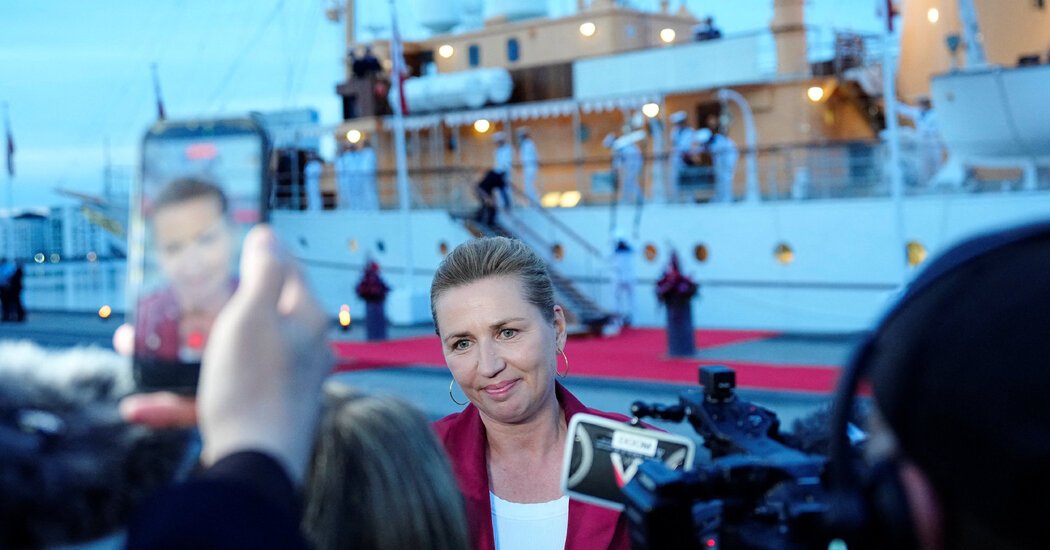
Mette Frederiksen has done it again.
After a bruising post-election period in which negotiations dragged on for longer than ever before, Ms. Frederiksen, Denmark’s veteran prime minister, formed a new government on Monday night. That put her on a path to be Denmark’s longest-serving leader since World War II.
Ms. Frederiksen presented the news to King Frederik X, who was waiting for her on the deck of the royal yacht. The king then announced, shortly after sunset, that under her leadership a new left-of-center government would come into office, supported by a majority in Parliament.
“This had to succeed,” Ms. Frederiksen told reporters who had gathered on the dock. “We live in the best country in the world.”
Ms. Frederiksen has become a well-recognized figure on the world stage by standing up to President Trump’s threats to seize Greenland, which has been part of the Danish kingdom for more than 300 years.
But at home, she has struggled. In the most recent elections, which were held in March, her center-left party, the Social Democrats, delivered its worst performance in a century, winning only 22 percent of the vote. Her personal popularity is clearly sinking. Many voters have said they’re getting tired of her and find her arrogant.
“Mette Frederiksen is not becoming prime minister because voters are enthusiastic about her, nor is it because of any grand political project,” said Niels Thulesen Dahl, a political analyst at the Danish newspaper Jyllands-Posten. “She is becoming prime minister because of a fragmented and directionless opposition.”
More than a dozen parties won seats in the elections, leading to an impasse in forming a new government that lasted for more than two months. It was only after thorny negotiations between Ms. Frederiksen’s party, other left-leaning parties and moderates that a viable government emerged on Monday night.
The whole thing then turned rather glamorous.
As soon as negotiations finished, Ms. Frederiksen rushed to Odense, Denmark’s third-largest city, to deliver the news to the king. He and Queen Mary were docked in Odense’s harbor aboard the Royal Yacht Dannebrog, the elegant, 260-feet-long floating residence of Denmark’s royal family when they are on summer cruises.
“I know how much the Danish people cherish the royal couple and these summer voyages,” Ms. Frederiksen said. “So I thought: I would not want to interrupt that in any way whatsoever.”
Ms. Frederiksen, 48, first swept into office in 2019 as Denmark’s youngest prime minister. If she completes this term, her third, she will etch herself into Danish history as one of the most powerful stalwarts of contemporary Scandinavian politics.
“In many ways, she is the only option,” said Jon Rahbek-Clemmensen, the head of strategy and great power competition at the Royal Danish Defense College in Copenhagen.
Since she was a teenager, Ms. Frederiksen has been an active member of the Social Democrats, following in the footsteps of her father, a union leader. He said in an interview with The New York Times that she was a strident, opinionated child and that he always kind of knew she was headed for high office.
She has followed the script of many Western European governments, supporting high taxes, a strong social safety net and a commitment to combating climate change. But she has been especially hawkish on defense.
During her tenure, Denmark became an important player in the NATO alliance against Russia, playing an outsize role in supplying weapons to Ukraine. The population of Denmark is only six million.
But Denmark holds a critical piece of territory: Greenland. Mr. Trump has repeatedly said the United States needs to take over the giant Arctic island for U.S. national security.
Though he has backed down a little, the United States is pushing for a major long-term role in Greenland, according to officials with knowledge of confidential negotiations unfolding in Washington.
Ms. Frederiksen has continually frustrated Mr. Trump’s ambitions, resisting efforts to hand over the island. Experts expect her to stay tough.
“I don’t see why she would change a policy that appears to be working,” said Mikkel Runge Olesen, a researcher at the Danish Institute for International Studies in Copenhagen. “It played a big part in her party not losing more votes than they did.”
Analysts said they could imagine Denmark taking a bigger role in global climate policy with a more left-leaning government. The government will likely to be more environmentally vigilant, which could be a worrying sign for Denmark’s enormous pork industry, which has been blamed for polluting farmland and ground water.
Ms. Frederiksen signaled as much on Monday, saying that the new government will be “good for the people living in Denmark, for future generations and also for animals.”
Several analysts said she was likely to use this term to set herself up for her next job — perhaps outside Denmark, maybe even a lead role at NATO.
As Dr. Olesen put it, “She has a high star in European politics.”