dailynewsnblog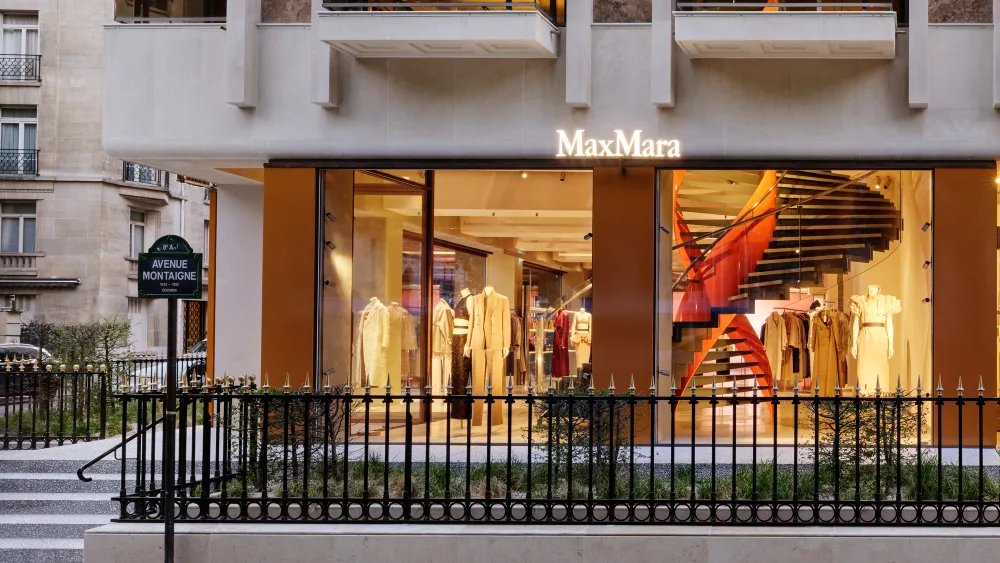
PARIS — After a year and a half of construction, Max Mara on Wednesday will reopen its Avenue Montaigne flagship, unveiling a redesigned retail space that blends Brutalist architectural austerity with bold color and design intended to set off an “Italian firework” on one of Paris’ most prestigious luxury shopping streets.
Marking the Italian brand’s 75th anniversary, the two-story, 8,100-square-foot boutique has been reimagined by British architect Sophie Hicks, whose concept plays on the house’s signature camel tones while introducing a striking orange staircase that spirals through the center of the store.
The double-helix structure contrasts with the otherwise pared-back interior of exposed concrete, terrazzo floors and softly lit marmorino surfaces.
The design is rooted in Max Mara’s product DNA. Hicks approached the project by considering “the coat as a design piece,” drawing on the brand’s long-standing emphasis on form, function and materiality. References to the company’s origins in Reggio Emilia are embedded throughout, including nods to the Brutalist architecture of its original headquarters, now home to the Collezione Maramotti contemporary art museum.

Max Mara Avenue Montaigne
Courtesy of Max Mara
For Max Mara, the collaboration also reflects a broader philosophy around design partnerships, said Maria Giulia Prezioso Maramotti. The granddaughter of founder Achille Maramotti, she now serves as director of omnichannel distribution for the group, as well as global brand ambassador.
She said that Hicks’ process mirrored the way the company approaches design — beginning with a clear understanding of the brand and its history, then translating it into something timeless. Hicks’ perspective as “a woman who wears the product” brought an added layer of authenticity to the project, Maramotti said.
The flagship is located at 31 Avenue Montaigne, a street that holds an outsized position in the global luxury landscape.
“It’s not just an address, it is a symbol of experiencing fashion in Paris, the fashion capital,” Maramotti said. “For us, personally, there is a strong element of pride in being there as a family-owned Italian brand. There is definitely a sense of pride in that.”
Beyond aesthetics, the reopening signals Max Mara’s continued emphasis on physical retail at a time when much of the industry is recalibrating its omnichannel strategies. While digital sales are “very strong” and growing “steadily,” Maramotti said that physical retail remains central to its business. It’s where clients can engage directly with the product — touching fabrics, trying on garments and building a more tangible connection with the brand.
This approach is closely tied to Max Mara’s positioning as family-owned luxury house. “We are a brand [that] values the quality and the substance of the product,” Maramotti said, adding that the company has long prioritized durability and design integrity over price-led increases to drive its business. The flagship has been designed with this philosophy top of mind, with clean lines and minimal visual distraction intended to place the product firmly at the center.
At the same time, the store is intended to serve as both a commercial and community gathering space. The second floor will host a program of talks and cultural events, as well as presentations of the collections that debut in Milan. Personalized appointments, private spaces and concierge services are also integrated for VICs.
While that strategy reflects a broader shift toward experiential retail, Maramotti is careful to note that the flagship does not want to cultivate an idea exclusivity, such as engineering scarcity through velvet ropes and lines down the block. She wants the store to be a welcoming stop.

Max Mara Avenue Montaigne
Courtesy of Max Mara
That balance extends into Max Mara’s omnichannel approach, which is integrated to support and not replace personal service. While the company has invested in digital infrastructure to support payments, customer service and post-purchase engagement, it draws a clear line around the role of technology in the retail experience.
“When we started brainstorming about the about the store, we were very careful. There is an overall overload of technology, and therefore, to make a retail experience something personal, the human element is something very relevant for us,” she said. “[Tech] is certainly a help with understanding what the trends are in terms of macro categories and traffic. But we don’t like the idea of every choice that we make being an algorithm-driven choice.”
Customer behavior is also shaping that strategy. While younger shoppers often first encounter the brand online, many ultimately complete their purchases in-store, particularly when investing in key wardrobe pieces such as a first luxury coat or tailored suit. These moments, Maramotti said, are critical for building long-term relationships and fostering emotional attachment to products.
That emphasis on longevity stands in contrast to the accelerated pace of trend cycles driven by social media. Gen Z and Alpha have grown up “viewing clothing as a commodity,” she said, but Maramotti believes that this mindset is shifting as consumers seek more meaningful connections with what they buy. Physical retail, in this context, becomes a space not only for purchase but for memory-making.
The Avenue Montaigne design itself has been conceived as a one-off project rather than a template for other stores to reflect both the uniqueness of the location and the depth of the collaboration with Hicks.

Max Mara Avenue Montaigne
Courtesy of Max Mara
The flagship reopening also comes at a time of broader uncertainty in the luxury sector, as brands navigate fluctuating demand, evolving consumer expectations and grapple with geopolitical and economic headwinds.
Maramotti said the brand cannot ignore current global conditions, particularly as a consumer-facing company, but noted that after 75 years in business, it has weathered many periods of uncertainty. She emphasized that Max Mara has remained focused on consistency and durability rather than a trend-led approach, which helps maintain relevance in volatile times and resonates with how consumers think today.
“We are a very pragmatic brand,” she said, adding that there is still a growth story for bricks-and-mortar. The group is continuing to invest in its retail network, with a new flagship in Germany and another Paris location slated for later this year.
“Especially at this time, you need to look ahead, of course, with a sense of reality. But we still have projects [moving forward],” she said, reflecting on the brand’s seven-decade journey. “That’s the way we’ve always operated — no panic.”