dailynewsnblog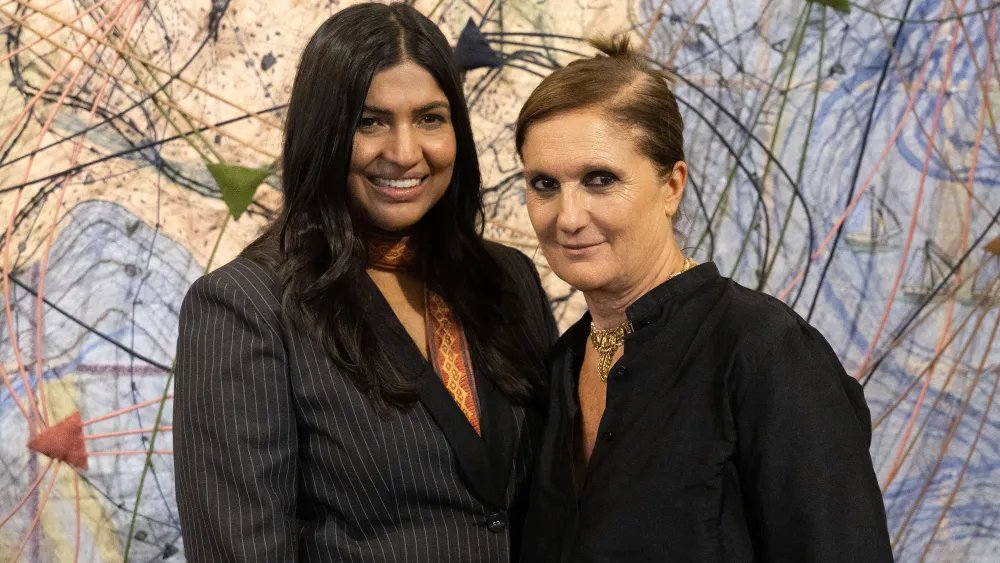
MUMBAI — When Maria Grazia Chiuri first walked into the Chanakya ateliers three decades ago, there was no formal design brief, just an obsession with embroidery and a belief that craft could be a language of its own.
“I have been very lucky in my life, because with my job I can do this incredible journey around the world, to know other places, to know so many different people,” Chiuri said. “To be connected with another country and culture gives me new energy, and especially in India. I feel that this is an extension of me.”
What began there has become one of fashion’s most influential cross-cultural collaborations. Chanakya has spent four decades as one of the key textile and embroidery partners Europe’s luxury players rely upon yet rarely name.
Chanakya works with more than 50 international houses. This week, marking the anniversary, it put itself on public view with three exhibitions that opened across the city and run through October.
At the center of them is Karishma Swali, Chanakya’s creative director, who grew up in the business her father, Vinod Shah, founded in 1986. She and Chiuri are sharing the latest chapter of “En Route,” an exhibition they created together that makes the case that craft is not a decorative afterthought to art and fashion, but central to both.
The two sat down with WWD at the atelier headquarters just ahead of the opening celebration, and proof of how far back the relationship goes was sitting on the table: Swali’s vintage Indian embroidered Baguette, the original, from 1997, which she has kept for nearly 30 years. Chiuri was then a key member of the accessories team that co-designed it under Silvia Venturini Fendi. And since taking the helm of the house she brought the style back, loaded with the embellishment and embroidery that made her name.
“I have now the opportunity to put in the light what I really love from the beginning of my career,” Chiuri said. “And so I want to celebrate it.”
Bringing “En Route” Home
“En Route,” on display at Mumbai’s Dr. Bhau Daji Lad Museum, was originally shown last year at the Vatican’s Apostolic Library, a exibition created at the invitation of the Vatican. Through their research in the library’s rarely opened archives, Chiuri and Swali discovered the untold stories of 19th-century women travelers and recreated them as embroidered maps. For the exhibition in India, they added new work charting Mumbai’s own history.

En Route is in India for the first time, joined by new work charting Mumbai’s own history in thread.
“We always dreamt of bringing it back to the school and the foundation and sharing it where it was done,” Swali says. “That public program is so important to craft in India.”
India as a Creative Engine
Luxury brands now speak fluently about Indian craftsmanship. They did not always. “Although India is even today the largest artisanal base in the world, I don’t think it was a known thing in the ’70s and ’80s,” Swali recalls. “As we grew, this idea of creating a new language using that foundation of craft is now being understood.”
Chanakya maintains an archive of 10,000 historical textiles and 150,000 material studies, along with a conservation lab she established in 2004 to research why techniques disappeared and how to revive them. One is Chaand Jaal, a Mughal-era silver lace so heavy it had become impractical, remade lighter but in pure silver. “You hold the essence, but you look at the relevance of today,” Swali explained.

Chanakya works to keep dying craft traditions alive and relevant
Hashim Badani
Chiuri and Swali’s research for “En Route” produced a globe mapping 88 embroidery techniques worldwide, showing that supposedly local stitches recur across continents.
“We often hear about cultural appropriation, which does have its place sometimes,” Chiuri muses. “But people also travel around the world, and with them their ideas. I found techniques in South Italy that are also in Mexico. The expertise is the same. It’s only the name that’s different.”
Rethinking Authorship and the “Minor Arts”
“En Route” is also a statement about who gets credit in fashion. Chiuri, long a champion of collective authorship, ties the problem to a Western art hierarchy that privileged sculpture and painting over textiles, jewelry and fashion, much of which was women’s work.
“In Italy, in the books of art there are only men,” she noted. “Michelangelo, Caravaggio, and that’s it. Silver, jewelry, fashion, we call them ‘arti minori’, minor arts. Everybody thinks Italy is famous for fashion, and we don’t have a museum of fashion. (Art) is very patriarchal.”
Swali is trying to tackle those hierarchies structurally in India. In 2016, she crated the Chanakya School of Craft where tuition and materials are free. More than 1,400 women have graduated and the ambition is to reach 14,000 in the next decade.

Women artisans being trained at Chanakya’s School of Craft
Hashim Badani
“I don’t think these distinctions between artisan and artist lend to the future,” Swali says. “We try to create a language that allows shared authorship to shine, which is still unfortunately not understood.”
The Long View of Luxury
Chiuri returned to the bag on the table, emblematic of a slower idea of luxury. “The Baguette was not a simple bag. It was something more,” she said. “Our maximum ambition was to create pieces you really want to give to the next generation, and they can use again. Not something you like because it’s cool and use one time, but part of your personal story.”
Asked about the next decade, Swali says it’s not a traditional growth trajectory.

The Garden of Gestures exhibit invites the public into the Chanakya Atelier for the first time
Ryan Martis
“I don’t think about it through scale,” she said. “I think about it more through creating experiences where craft can be understood, where future generations can know what the history was and why it’s important. I would like to think of our roles as incubating a curiosity for the future.”
Vinod Shah founded the atelier out of admiration for the subcontinent’s craft traditions, working alongside artisans from multi-generational lineages to build a place where techniques could be explored and taken into new territory. Forty years on, he directs the credit to them.
“Chanakya began with a belief that traditional craftsmanship is a living, limitless language,” Shah said in a statement marking the anniversary. “I wanted to give our master artisans a home where their knowledge could be shared, evolved and carried forward. Any recognition Chanakya has received belongs first to them and to the traditions they keep alive.”