dailynewsnblog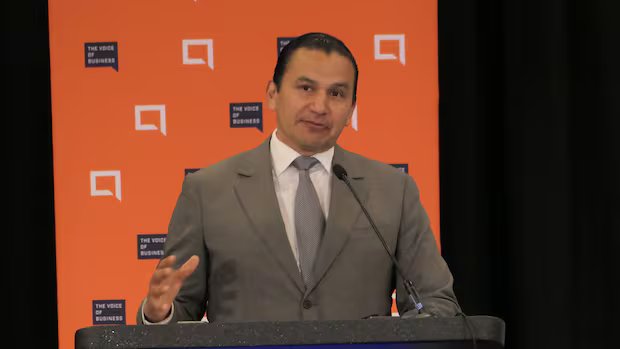
Manitoba’s government spoke last fall with U.S. energy advisers about developing a hyperscale AI data centre near Winnipeg and using private capital to build an $18-billion hydroelectric generating station on the Nelson River, documents obtained by CBC News show.
Premier Wab Kinew says a massive data centre is no longer on the table but he remains interested in reviving the Conawapa dam project on the Nelson River, which was shelved in 2014 due to rising costs.
According to emails, meeting notes and a pitch document obtained by CBC News, the highest-ranking bureaucrat in Manitoba’s NDP government and three deputy ministers had discussions in October and November 2025 with officials from Rothschild & Co., an international financial services and advisory group.
The purpose of the talks was twofold, emails and meeting notes from the same time period show.
On the data centre front, Manitoba officials wanted to see whether Rothschild & Co. advisers in New York City and Washington, D.C., could help the province quickly develop an artificial intelligence data centre that would require 250 to 300 megawatts from Manitoba Hydro’s electrical grid.
That’s enough electricity to power about 150,000 homes. Any data centre that requires more than 100 megawatts is considered a hyperscale facility.
Manitoba, the meeting notes stated, had a unique opportunity to develop a hyperscale data centre because of “immediate power availability,” the clean nature of hydro power, lower cooling costs and the “potential for fast-track permitting.”
The province planned to “actively attract hyperscale operators and major players,” the meeting notes state.
The notes also say the “premier wants accelerated timelines” and that the province was advised to “move quickly to capitalize on current AI/data centre boom” because “market interest may decline in 12-24 months.”
Kinew soured on AI data centres
On Oct. 27, between the first and second round of talks between provincial officials and Rothschild & Co. advisers, Kinew was asked by reporters about a meeting he had earlier that month with Bell Canada’s CEO.
That meeting was about “AI in Manitoba,” Manitoba’s lobbyist registry shows.
That day, the premier said he had no news but suggested reporters check out his forthcoming state of the province speech.
Three days later in Toronto, Kinew hinted further at talks about a data centre and an energy megaproject in an appearance before the Empire Club of Canada in Toronto.
“Any tech play at a large scale is basically an energy play, and so we have a lot of low-carbon electricity in Manitoba, and I think that’s going to be one of our competitive advantages,” Kinew said during the Oct. 30 appearance.
On Dec. 9, Kinew’s state of the province speech came and went without any announcement about a Bell Canada data centre in Manitoba. Bell Canada then announced plans for a 300-megawatt data centre near Regina in March.

Kinew announced last week Manitoba is no longer interested in hyperscale data centres because he said they consume too much electricity and provide dubious economic long-term benefits.
He said the province came to this conclusion after engaging in a “deep dive” into the AI data centre market.
“Part of that was looking at what would it look like with the proponents who are pitching setting up shop here,” Kinew said Tuesday at a scrum after a speech in downtown Winnipeg.
“What would it look like if we went to the broader market and made, like, maybe a call for proposals? What would it look like if we were the proponent?”
Kinew said the province learned “there is a huge amount of money flooding into the space” and decided against devoting scarce megawatts to data centres.
“I think we owe it to Manitobans to hold ideas up to the light and say, ‘OK, what would it look like if we put out a call for proposals on AI data centres?’ And in the end, we said, ‘No, that doesn’t make sense.'”

Anne Pasek, a Trent University professor who studies data centres and serves as the Canada Research Chair in media, culture and the environment, said she is not surprised to see Manitoba’s premier lose interest in AI data centres.
“People a year ago were taking for granted that this future was a certain thing and an AI data centre investment was a solid investment because there was a near-infinite need for more compute,” Pasek said last week in an interview.
“I do think it likely that we’re going to see, euphemistically, a market readjustment — or more colloquially, the bubble’s going to pop, and the market’s going to bleed.”
Manitoba considered private Hydro dam funding
The Rothschild & Co. meeting notes reveal that last fall, the province revived the idea of building a dam and generating station on the Nelson River at Conawapa. This project would be located downstream from existing Manitoba Hydro generating facilities and would cost a projected $18 billion to $20 billion.
Greg Selinger’s NDP government put Conawapa on hold in 2014 when the projected cost of the 1,485-megawatt undertaking approached $10 billion and the Public Utilities Board determined there was no strong business case for another dam while the smaller Keeyask project was still under construction further upstream.
Today, Manitoba Hydro faces a looming energy crunch but is saddled with $25 billion in net debt, partly due to the cost of building both Keeyask and the Bipole III transmission line. Manitoba’s net debt, meanwhile, is expected to climb to nearly $40 billion this coming year.
In a pitch document, Rothschild & Co. offered to help Manitoba build an $18-billion hydro dam in spite of the financial challenges.
“Due to the scale of the project and the province’s existing financial commitments, the key challenge for the government is to develop a funding model which leverages third-party private capital and does not adversely impact the provincial balance sheet,” the document states.
“As a result, the government is actively considering different funding models and other support mechanisms which would see these projects successfully realized.”
One of the suggested mechanisms to build the new hydro station was a partnership with Canadian pension funds such as CPP Investments, La Caisse and the Ontario Teachers’ Pension Plan, which are investing more capital in infrastructure, the document noted.
Other mechanisms included offering equity in the project or provincial land to private partners.
Manitoba Hydro spokesperson Scott Powell said in a statement the Crown corporation is “unable to respond” to requests about Conawapa at this time.
Kinew reverses flow on dam
Kinew was not enthusiastic about the idea of building a new hydro dam throughout the first two years of his NDP government.
“The days of Hydro being this utility that’s exclusively focused on building massive dams are over,” Kinew told reporters in October 2023, weeks after he became premier.
“I love the folks at Hydro, and I’m sure if you ask them, you know, ‘What do you think of Katy Perry landing from space? What do you think of the Jets winning the Presidents’ Trophy? What do you think of the premier’s press conference today?’ I’m sure their answer is going to be to build a new dam,” he said at a scrum in April 2025.
The province’s position changed by last October, when provincial officials and Rothschild & Co. advisers were in talks.
Kinew said Tuesday that Conawapa returned to the table because Manitoba will eventually require more power.
He said it was worthwhile to consider all funding options, including private partners, considering the scale of the hydro project.

“Any time you get to the scale of billions or tens of billions, I think it’s important for us, and in the best interests of Manitoba and our economy, to look at the best of the best and to look at everything that’s on the table in terms of financing, in terms of projects, in terms of potential partners,” Kinew said.
“The way I approach things is, I want to see where the evidence takes you. I want to see what’s in the best interest of the province in all cases. I don’t want to be bound by ideology.
“Of course, I’m influenced by ideology, but at the end of the day, if something makes sense, it makes sense. Something doesn’t make sense, it doesn’t make sense.”
Kinew has repeatedly accused Progressive Conservatives of trying to privatize Manitoba Hydro since he became NDP leader in 2017.
“They have been secretly privatizing our Crown utility piece by piece behind closed doors,” he said in an NDP news release in December 2022.
Kinew said Tuesday his comments were validated by the former PC government’s sale of Hydro subsidiary Teshmont in 2020.
Tory Leader Obby Khan said the premier needs to explain why his government was considering a private partner on a hydro dam behind the scenes when Kinew has always claimed to be against privatization.
“What is that deal? How did that fall apart? Where does that leave Manitoba Hydro?” Khan said outside the Manitoba Legislative Building on Tuesday.
Mark Winfield, a York University professor of environmental and urban change who studies energy and climate change policy, said the province would run the risk of losing control over a hydroelectric dam station with a private partner.
He also questioned the wisdom of reviving Conawapa given the immense cost.
“We already had determined that Conawapa was not economical, and the Keeyask project didn’t go very well either in terms of the economics,” Winfield said in an interview from Toronto. “So, there’s a large risk there.”
‘A lot of meetings with a lot of different people’
Kinew said he is not aware Manitoba ever formally engaged Rothschild & Co. and said the province sought advice from other financial advisers as well.
“I meet with a variety of people, all sorts of people,” he said, adding he was invited to a Toronto dinner by Jamie Dimon, the CEO of U.S. multinational bank JPMorgan Chase, but did not take the billionaire up on his offer.
“We take a lot of meetings with a lot of different people,” Kinew said. “We have a ton of business with the capital markets around the world, right? Like, we do billions and billions of dollars worth of activity in the capital markets.”
In its pitch document, Rothschild & Co. proposed the province sign a non-disclosure agreement and then proceed toward a request for proposals to build both the AI data centre and hydro station.
The meeting notes from last fall stated Manitoba Hydro had 11 pending applications for power, all of which were “AI-focused data centres.”
“Rothschild & Co. asked for the list of companies that are soliciting power from Hydro so they can engage with them,” the notes stated.
Rothschild & Co. also “emphasized the need for their own independent technical experts, not relying solely on Manitoba Hydro’s internal resources,” the notes say.
According to emails obtained by CBC News, three Rothschild & Co. advisers were listed as taking part in the talks with Manitoba. One declined to comment, and two didn’t respond to requests for comment.
CBC News requested comment from the four provincial officials copied on emails with Rothschild & Co. The provincial public service’s communications office deferred comment to Kinew and his cabinet.