dailynewsnblog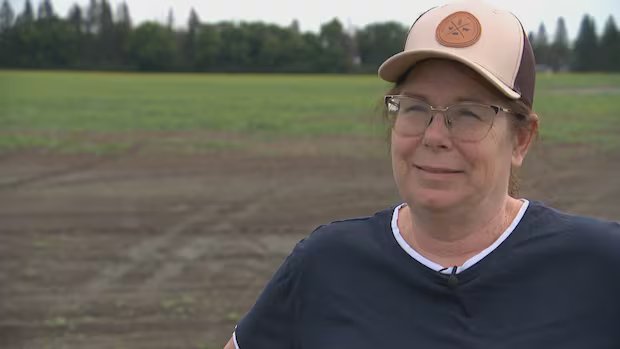
Farmers in Manitoba may face big losses this year after an extremely wet spring and stormy early summer, the head of the province’s largest agriculture lobby group says.
The soggy conditions have kept many producers off their fields, while those who were able to get on earlier in the year likely have submerged seeds or plants pummelled by hail.
“Anywhere where we’ve had excess moisture, the crop really has suffered, hasn’t come up,” said Jill Verwey, president of Keystone Agricultural Producers, looking over her farm near Portage la Prairie, about 85 kilometres west of Winnipeg, on Tuesday.
Her field is a patchwork of some green and dark, wet soil.
“You can see there’s no or little crop coming up,” she said, but added she considers herself lucky.
“We’re not hearing and seeing the devastation [here] that we’re seeing right across Manitoba — real impacts of excess moisture and rain and hail, more recently, on the weekend.”
Parts of the province, especially in the Parklands region to the west and the Stonewall area, north of Winnipeg, have been drowned by torrential rains and repeated storms.

“[They face] huge devastation in crops, where they’re just going to have to wait and see and recover what is left,” Verwey said.
Even in places that aren’t actually flooded, the ground is saturated, and farmers can’t get fungicide applications done to address critical weed control.
“What hasn’t been damaged is now susceptible, because you can’t really get out there and work the field,” Verwey said.
Margins for farmers are tight even when the conditions are right, and many have some crops they’re counting on to make up the difference for others.
“It doesn’t leave anything for risk, which is what we’re having here today,” said Verwey.
“It certainly doesn’t allow for any of that additional money that you want to reinvest into your farm,” with much of that investment “just being put on the back burner for producers today,” she said.
Manitoba has “excellent” crop insurance programs and hail insurance, which will cover some direct costs for farmers, said Verwey. But there are significant investment costs just to get a crop into the ground in the first place — dollars that aren’t covered.
A lot of producers have already spent more than usual because the late, cool spring meant they had to pivot and change their plans, Verwey said.
“You kind of have to roll with the changes … Mother Nature hands you, and this year it seems like every week it’s something different.”
At this stage of the season, a stretch of sun is desperately needed, Verwey said.
Swath of berry farm ‘wrecked for the season’
Danielle Boonstra, who co-owns Boonstra U-pick berry farm east of Stonewall, said her land was inundated with about 280 millimetres of rain during an overnight storm on June 9–10.
That was followed up by a run of hail.
“We’ve never seen rain like this ever in the 20 years that I’ve been on this farm,” Boonstra said.
“We think it’s about 60 per cent of our farm that’s been affected, and that has been wrecked for the season — and the season’s so short. It only lasts for three weeks.”

Only about five hectares (12 acres) on her farm are available for U-pick, instead of the usual 10 or 11 hectares, she said.
“That has just been wiped out for the year. We can’t put customers in this field,” she said, noting each acre produces about 25 kilograms of berries.
There is no overland flooding insurance for strawberry farms — just hail damage coverage, Boonstra said.
“All of our fields were damaged by the rain, but there’s no funding for that. We did apply for the emergency funding. However, we haven’t heard anything back, [so] we’re not sure if we’re going to get anything from that,” she said.
The business also offers a petting zoo, hayrides, a chip truck and an ice cream shack, all of which are open.
“So there is lots of other stuff to do on the farm,” Boonstra said, but “we won’t have as much berries as normal.”
In the meantime, she’s already looking ahead to 2027. In her business, the plants are put in the ground a year ahead.
“We planted 70,000 plants that have been affected, but we won’t know the damage of that until actually next year,” she said.
“You can see in spots where they’re not growing, where they haven’t produced. We’re just praying that that’ll come back next year. We just gotta keep thinking positive.“