dailynewsnblog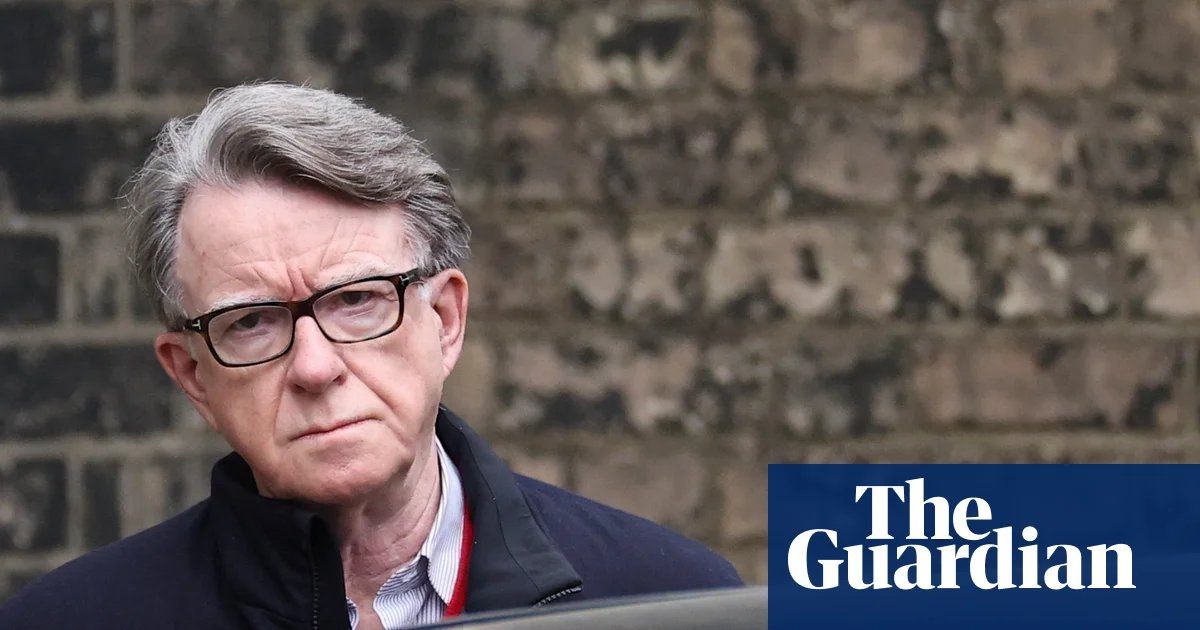
A trove of government documents about Peter Mandelson contains no record of any measures taken to mitigate serious security concerns over his appointment as Washington ambassador, the Guardian has learned.
Multiple sources who have seen or been briefed on the files, which will be published on Monday, say there is no detail about any steps put in place to deal with flags raised about his associations with senior figures in foreign states.
The Guardian also understands Mandelson was not asked to take any steps himself to allay such concerns. The omissions cast doubt on assurances provided by senior Whitehall officials to MPs on the foreign affairs select committee.
A fuller picture will emerge on Monday when the government publishes more than 1,000 pages of information relating to Mandelson’s appointment, which has proved to be one of the most momentous decisions by Keir Starmer in his time as prime minister.
One source who has been briefed on the contents of the documents said: “The big question I would be asking is why there is no written record of what mitigations were put in place. We’ve been told they were there, but why is there no document showing he accepted them?”
Multiple sources said that while Mandelson had been asked to provide assurances over potential commercial conflicts of interest, there was no record indicating that the same was true about matters of national security.
The Guardian revealed last week that the former peer’s associations with senior figures in China, Russia and Israel were among the red flags raised by the UK’s vetting agency when it concluded he should be denied clearance.
The document release on Monday sets up another difficult week for Starmer, after Tony Blair’s coruscating essay last Tuesday, arguing the government had abandoned the centre ground and was putting Labour’s future at risk.
It forms the next stage in the government’s response to a “humble address” passed by parliament, forcing ministers to publish documents that otherwise would have remained highly confidential.
Ministers are braced for the release of a series of embarrassing exchanges with Mandelson from his time in Washington, including criticism of Keir Starmer, which could further undermine the prime minister’s authority as many of his MPs are calling openly for his resignation.
Senior government insiders said they expected awkward WhatsApp messages from ministers “trying to impress” Mandelson to be published, but that they did not anticipate any resignations from government as a result.
There could also be group message exchanges involving Wes Streeting, the former health secretary who quit the government over Starmer’s leadership, and who released his direct messages with Mandelson in February in an effort to draw a line under their friendship.
Sources suggested there were also exchanges revealing that the former ambassador, who was twice sacked from cabinet in the previous Labour government, gave unsolicited advice to ministers on policy areas outside his diplomatic brief.
A government spokesperson said: “The second tranche of documents will be among the largest publications ever laid in parliament. That reflects the transparent and thorough process we have followed, in line with established precedent for humble addresses.”
Mandelson declined to comment.
Starmer sacked Mandelson after documents published in the US laid bare the depth of his friendship with the disgraced financier and convicted sex offender Jeffrey Epstein.
Since then, questions over the appointment have led to the departure of Starmer’s chief of staff, Morgan McSweeney, and the top official at the Foreign Office, Olly Robbins.
The papers being published this week will go into further detail about the security assessments undertaken before Mandelson’s appointment, as well as his contacts with senior government ministers.
Some documents are being withheld because they could be used by the Metropolitan police in a future prosecution, while the government has redacted others for security and data privacy reasons.
The documents to be released are understood not to include a nine-page summary document compiled by UK Security Vetting (UKSV), after Scotland Yard confirmed it had requested that some documents not be made public.
However, the lack of any record of security mitigations is likely to raise some of the biggest questions, especially among MPs on the foreign affairs select committee, who were given explicit assurances that such measures had been taken.
Robbins gave evidence to the committee in April in which he said clearance could be approved if the “risks identified as of highest concern by UKSV could be managed and/or mitigated”.
Such mitigations were meant to have been noted in an email from Ian Collard, the Foreign Office’s head of security, noting the decision to grant Mandelson clearance. According to Robbins, that email recorded “the ways in which we would manage” his clearance and “the mitigations”.
Robbins’ claim was supported by the top official in charge of gathering the humble address material, Cat Little. She told MPs that she had seen an email which “sets out the decision to grant DV and some mitigations”.
Collard, through a letter sent on his behalf by the Foreign Office, told MPs he had sent an email “recording the fact of the decision (but not any of the underlying discussions or reasons for doing so) and mitigations”.
Multiple sources, however, said that whatever emails had been sent, none had included any formal agreement with Mandelson, suggesting that if security mitigations were put in place, they were agreed to informally by the former peer and security officials.
The breadth of risks identified by UKSV, which as the Guardian revealed on Wednesday included Mandelson’s associations with senior figures in China, Russia, and Israel, would have made security mitigations “totally impossible”, according to one former head of MI6.
However, some steps appear to have been taken to address commercial conflicts of interest caused by Mandelson’s stake in Global Counsel, the lobbying firm he co-founded.
These management actions, separate to security mitigations, were not “strictly speaking a national security issue”, Robbins told MPs.
Instead, they were “more about protecting, I suppose, Mandelson’s reputation, and potentially the government and the Foreign Office’s reputation, against any perception that he was advantaging Global Counsel or its clients,” Robbins said.