dailynewsnblog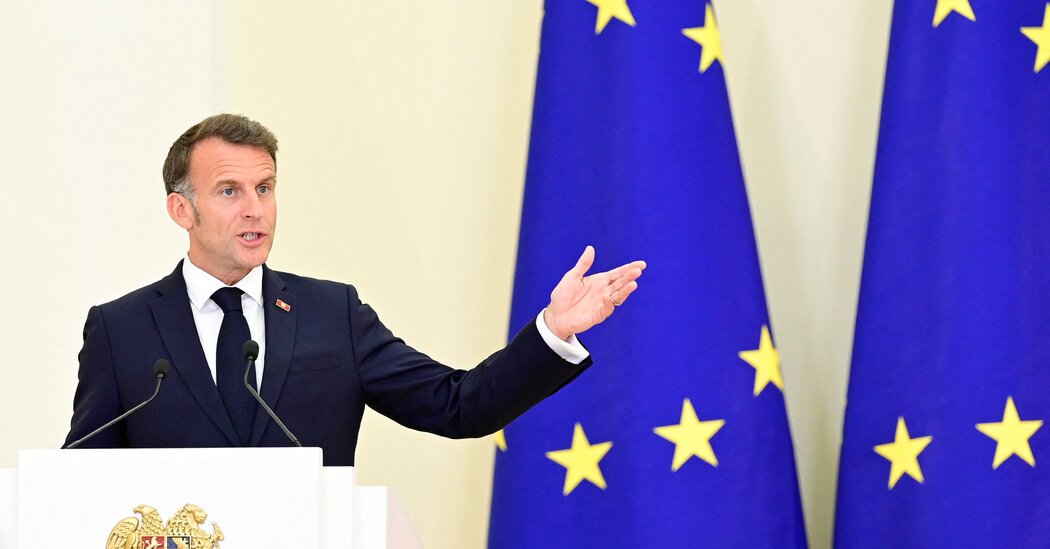
Seeking to break a deadlock over the Strait of Hormuz, President Emmanuel Macron of France on Wednesday called for the United States and Iran to reopen the contested waterway even before they agree on a truce to end the two-month war.
“All parties must lift the blockade of the Strait immediately and unconditionally,” Mr. Macron posted on social media. “We must return permanently to the regime of full freedom of navigation that prevailed before the conflict.”
Mr. Macron hopes to persuade the two sides to remove the status of the strait from broader negotiations over Iran’s nuclear program, ballistic missiles and support for militia groups in the region, two senior French officials said. They spoke on the condition of anonymity to discuss a sensitive diplomatic matter.
Such a compromise, these officials said, could allow a multinational force that France is marshaling, along with Britain and other European countries, to begin escorting commercial ships through the strait relatively quickly, restoring a semblance of normalcy to a gravely disrupted global economy.
Iran is likely to balk at such a proposal because it would remove much of its leverage in the broader negotiations with the United States.
It’s also unclear where Mr. Macron’s proposal would fit within the overall state of negotiations between Washington and Tehran. Iran has said it was reviewing a U.S. proposal, the contents of which were unclear, but had also earlier dismissed a proposal as a “list of American wishes.”
Mr. Macron said he spoke on Wednesday with Iran’s president, Masoud Pezeshkian, noting that during the call, he condemned Iran’s “unjustified strikes against Emirati civilian infrastructure and several ships.” Mr. Macron said he planned to discuss the proposal with President Trump soon.
The French military said it had deployed an aircraft carrier, the Charles de Gaulle, to the Red Sea on Wednesday to prepare for the peacekeeping mission “as soon as circumstances permit.” The French officials said the carrier, which is sailing with escort ships, would send a signal that the multinational force was ready and capable of securing the strait, which was first closed by Iran and later blockaded by the U.S. Navy.
Mr. Trump on Tuesday paused a U.S. military operation to escort commercial ships through the strait, citing “great progress” in negotiations to end the war. But there was little public sign of diplomatic achievements, and by Wednesday, both sides were back to playing down the prospect for peace.
Mr. Trump warned that if Iran did not agree to unspecified concessions, “the bombing starts.”
Mr. Macron’s intervention reflected the mounting frustration of leaders in Europe and Asia about the economic costs of a blocked strait. France and Britain have led efforts to assemble a force to escort ships and carry out de-mining operations. But they have said the operation would begin only once the security situation stabilized.
The continuing hostility between Iran and the United States has left the Europeans on the sidelines, even as the interruption of shipping is hurting their economies and threatening their security.
On Tuesday, a container ship owned by the French company CMA CGM was struck by fire while transiting the strait. The incident damaged the vessel and injured several crew members, according to the company.