dailynewsnblog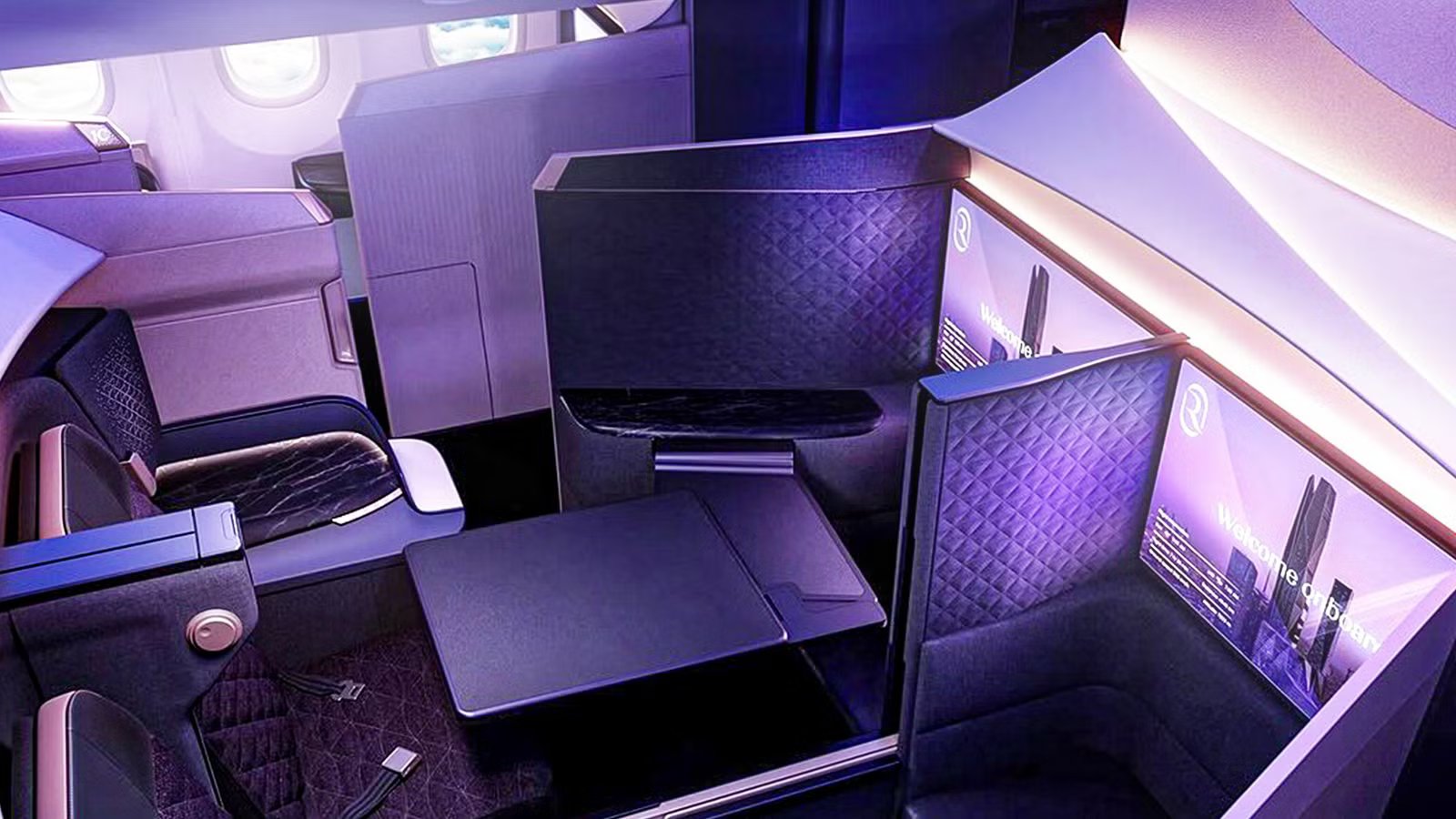
 Riyadh Air thinks it can skip first class entirely and still out-premium
  Emirates and
  Qatar Airways by engineering a business class suite that delivers first-class specs at a business-class price point. As the airline prepares for its commercial debut, the revelation of its Boeing 787-9 interior has sent a clear message to the industry. Today, luxury is no longer defined by the label on the cabin door, but by the technical sophistication of the seat itself. This guide provides an in-depth look at how a start-up is using smart industrial design and cutting-edge audio technology to disrupt the established hierarchy of long-haul travel.
The introduction of this cabin configuration is a centerpiece of the Saudi Vision 2030 plan, which aims to transform the Kingdom into a global aviation hub and triple annual passenger traffic. Opting for a two-class-plus layout on its first fleet of 787-9s, Riyadh Air is prioritizing strategic yield over legacy prestige.
Fresh On The Scene

Riyadh Air is entering the most competitive aviation market on the planet, using cabin density and high-margin seating to come onto the scene with force. Unlike established neighbors that often maintain legacy first class cabins on their flagship aircraft, the Saudi start-up has designed its Boeing 787-9 with a strictly two-class-plus layout. This decision is not a move toward the mid-market, but rather a highly focused approach to yield management that prioritizes the high-demand business segment while maximizing the physical footprint of the airframe.
Eliminating the massive footprint required for traditional first class suites, the airline can dedicate more square footage to a business-plus experience that rival carriers often reserve for their most elite passengers. CEO Tony Douglas has described this philosophy as offering a “Maybach” compared to the standard “S-Class” found in current business class cabins. It allows the airline to maintain a premium brand image while avoiding the empty suite syndrome that often plagues first class on routes where a $15,000 price point is difficult to sustain consistently.
The strategic logic is backed by the economic reality of the 787-9 airframe, which is optimized for efficiency and medium-to-long-haul range. Every square inch of the cabin must generate maximum revenue to support the goals of the Saudi Vision 2030 plan, and by using the Safran Unity platform, it creates a business class that delivers the privacy and amenities of a traditional first class. Riyadh Air is yield hunting with this plan, securing the high-margin corporate traveler while ensuring the aircraft remains capable of carrying a larger total volume of passengers than a traditional three-class jet.
Excelling In Design

The core of the premium experience on the Boeing 787-9 consists of 24 standard business class suites arranged in a 1-2-1 configuration. These suites are built on the award-winning Safran Unity platform, which has been extensively customized to meet the airline’s specific aesthetic and functional requirements. Each passenger is enclosed within 52-inch (132 cm) high walls, providing a level of seclusion that is increasingly becoming the benchmark for new wide-body aircraft deliveries in the 2020s.
A standout technical feature of these suites is the integration of the canopy twist architectural motif, a design element developed by the industrial design firm PriestmanGoode. This sculptural form is inspired by the geometric patterns found in the King Abdullah Financial District in Riyadh, where modern architecture blends with traditional influences. The canopy twist is physically integrated into the seat shells and cabin monuments, creating a cohesive visual language that guides the eye through the interior and reinforces the sense of a bespoke environment. Riyadh Air has really got the design language spot on overall.
While many new airline products are rushing to include wireless charging pads, Riyadh Air has made the technical decision to omit this feature in favor of high-performance wired connectivity. Most travelers find current wireless charging speeds insufficient to meet the power demands of modern devices, leading them to prioritize high-wattage charging instead. Consequently, each suite is equipped with two USB-C ports and one USB-A port, aligning with the Saudi Arabian mandate for universal USB-C charging standards for mobile devices by 2025. Focusing on future-proof wired power ensures that passengers can charge laptops and tablets at maximum speeds without the inconsistency of inductive charging pads.
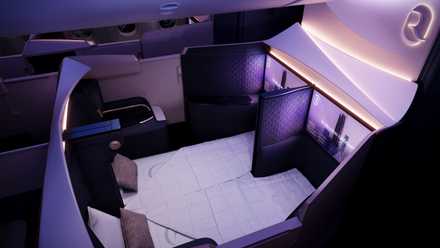
Stunning: Riyadh Air’s CEO Shows Off Its New Boeing 787 Cabin
Riyadh Air’s CEO claims that the front row of business class will be better than some other airlines’ first class offering!
Time To Be Social

The standard suites are very impressive, but Riyadh Air has reserved the most innovative space for the very first row of the Boeing 787-9. Occupying the front row are four specialized business elite suites, which utilize the extra space typically found at the front of a cabin to deliver a business plus product that functions as a bridge between high-end business travel and true first class. The hallmark of these suites is the 32-inch 4K OLED monitor, a massive display that matches the screen size found in Emirates’ legendary first class, yet sits within a business-efficient footprint.
The defining characteristic of the business elite experience is the ability for passengers to travel together in a shared social space. The two center suites feature an electrically controlled central privacy divider that can be fully retracted. When combined with the oversized ottoman and specialized seat toppers, these center units convert into a double bed, the only such offering on the airline’s Dreamliner fleet. The configuration allows couples to enjoy a shared sleeping and dining environment that is usually only found on much larger apartment-style first class suites on the Airbus A380.
|
Feature |
Standard Business Suite |
Business Elite Suite |
|
Quantity |
24 suites |
Four suites |
|
IFE Screen Size |
22-inch 4K OLED |
32-inch 4K OLED |
|
Bed Conversion |
Single flat bed |
Double bed (Center pairs) |
|
Stowage |
Standard cubby |
Enhanced backlit storage |
|
Seat Platform |
Safran Unity |
Safran Unity Elite |
With this highly useful layout, the suite transforms from a mere seat into a private dining room. Branding this as business elite rather than first class, Riyadh Air avoids the high-tax and rigid corporate travel policies that often prevent executives from booking first class, while still delivering an environment that justifies a premium over the standard business fare. It takes plenty of inspiration from the success of Qsuite, where Qatar Airways has definitively proven that a high-quality business class can totally outweigh a first class product.
Bringing The Best Of Tech

A primary technical differentiator for Riyadh Air is the debut of the Euphony audio system, developed in partnership with the French acoustic engineering firm Devialet. This system integrates high-fidelity speakers directly into the seat headrests, allowing passengers to enjoy movies and music in a personal sound bubble without the need for physical headphones. For the frequent traveler, this eliminates the discomfort often associated with wearing noise-canceling headsets for a long-haul flight.
The technology behind Euphony relies on three proprietary pillars. These are SAM (Speaker Active Matching), AVL (Adaptive Volume Level), and CNC (Cabin Noise Compensation). As SAM ensures the audio remains crisp within the confines of the headrest, the CNC technology is the most revolutionary for aviation. It uses integrated microphones to monitor the low-frequency hum of the 787’s GEnx-1B engines and actively neutralizes that noise within the passenger’s immediate ear space, providing a digital layer of quiet that was previously only possible with over-ear active noise-canceling technology.
|
Technology Component |
Feature |
Passenger Benefit |
|
Devialet Euphony |
Headrest-integrated speakers |
Headphone-free spatial audio |
|
CNC Tech |
Cabin Noise Compensation |
Active engine noise neutralization |
|
Panasonic Astrova |
4K OLED Displays |
Cinema-grade contrast and color |
|
Viasat Connectivity |
Gate-to-Gate WiFi |
Seamless streaming for loyalty members |
The visual experience is powered by the Panasonic Astrova system, which is also adopted by plenty of other carriers. In the business elite cabin, the 32-inch screen provides a pixel density and color depth that rival high-end home theater setups. Combined with free gate-to-gate Viasat WiFi, the tech stack ensures that the aircraft functions as a flying office or a private cinema. Here is a massive level of integration that shows the airline is treating technology not as a secondary amenity, but as a core structural component of the passenger experience.
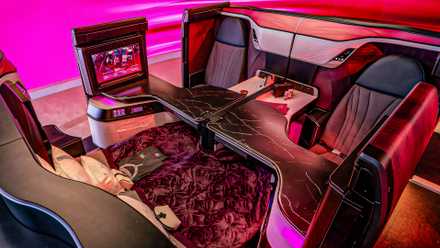
How Qatar Airways’ Qsuite Next Gen Stacks Up Against Every Rival Business Class Suite In 2026
Qatar Airways unveils Qsuite Next Gen, a business class suite designed to silence doubters and maintain its position at the top of luxury travel.
Upping The Economy Standards

The interior design of the Boeing 787-9 is deeply rooted in culture, with the representation of the desert’s transformation into fields of blooming lavender. The cabin palette transitions from deep indigos and mochas in the premium sections to softer lavender tones in the rear. This is intended to create a sense of calm and growth, moving away from the sterile whites and greys common in older fleet configurations. The color scheme is a direct nod to the Saudi landscape, reinforcing the airline’s identity as a national carrier.
Moving toward the rear of the aircraft, the premium economy cabin features 39 Recaro PL3530 seats in a 2-3-2 configuration. Each seat offers a 38-inch (96.5 cm) pitch and a width of 19.2 inches (48.7 cm), providing a significant upgrade over standard seating for travelers who want more space without the full business class price. These seats also feature 15.6-inch 4K monitors, ensuring a consistent high-definition visual experience throughout the aircraft.
The economy cabin, consisting of 223 Recaro R3 seats, maintains the premium feel through the use of high-quality textiles and the canopy twist design motif. Despite the 3-3-3 layout, each passenger has access to a 13.4-inch screen, a size that was considered industry-leading for business class only a decade ago. Maintaining a high baseline of technology and design across all 290 seats, Riyadh Air makes certain that the “Lavender Spring” aesthetic feels like a cohesive brand experience rather than a tiered service.
The New Saudi Vision

Riyadh Air’s arrival is a critical component of the broader Saudi Vision 2030 strategy, which aims to diversify the national economy and establish the Kingdom as a global hub. The Boeing 787-9 configuration we see today is just the beginning of a massive fleet rollout, and as delivery delays have pushed the first commercial flights toward late 2025 or 2026, the airline is already using invite-only demonstration flights to refine its service standards. These demonstrator flights are crucial for testing the Euphony audio system and the Business Elite service flow in a live environment.
The 787-9 is the sole type of the initial launch, but the airline is already looking toward the future Airbus A350-1000 orders. CEO Tony Douglas has hinted that while the Dreamliner skips first class to yield efficiency, the larger Airbus airframes might eventually house a game-changing first class product. This suggests that Riyadh Air is using a tiered fleet strategy: the 787-9 for high-frequency, high-yield business routes, and potentially the A350 for ultra-long-haul halo routes where a physical first class cabin is still a competitive necessity.
Ultimately, the goal is to connect Riyadh to over 100 destinations worldwide by the end of the decade. Launching with a business class that challenges the first class standards of its rivals, the airline is skipping the typical growth pains of a start-up. The new standard for luxury in the 2030s will be defined by technological integration and thoughtful, culturally relevant design.