dailynewsnblog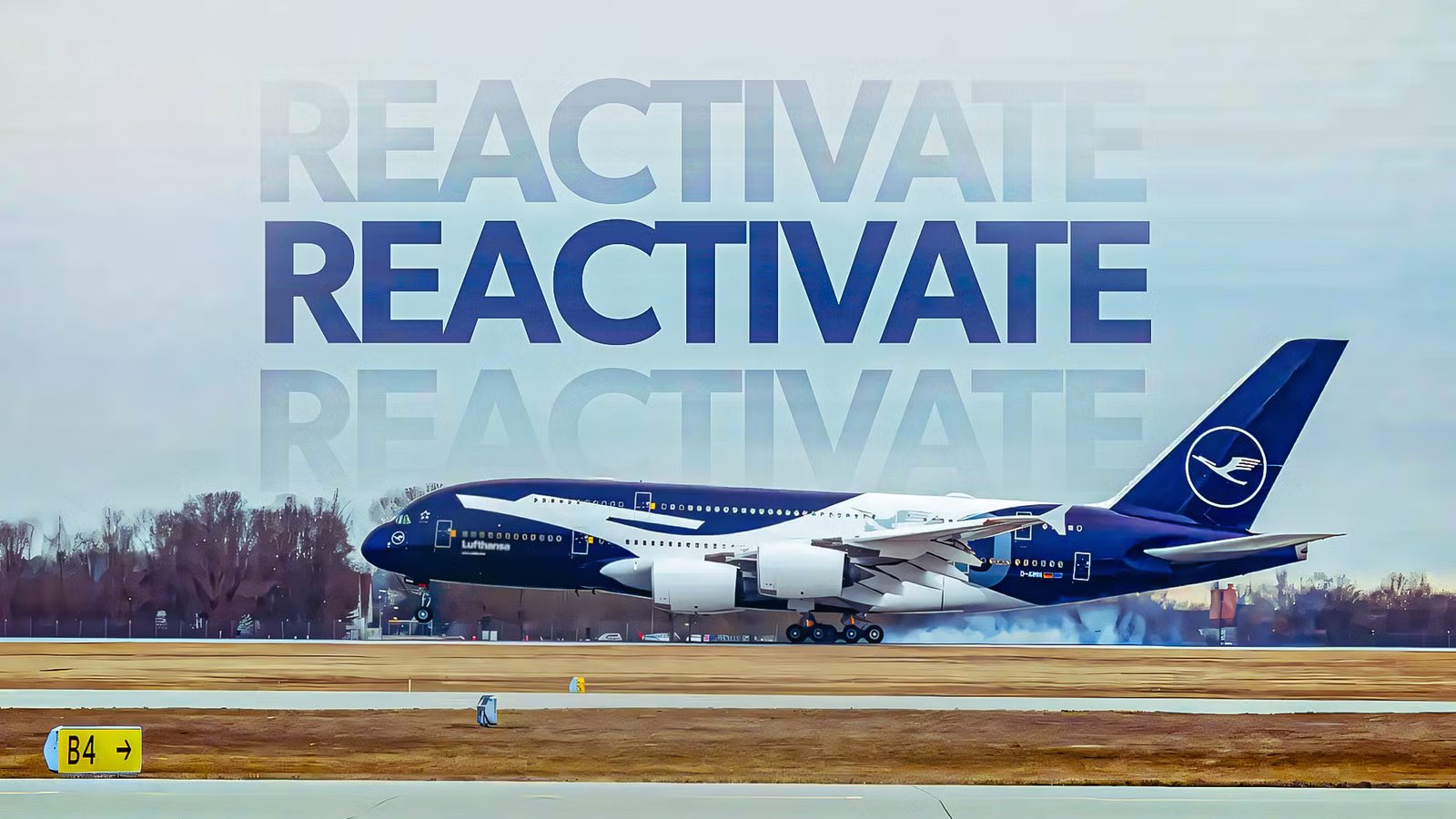
 Lufthansa has bought its Airbus A380 fleet back from the brink in recent years. Having placed the Superjumbos in long-term storage back in the midst of the pandemic, the prospect of an A380 ever flying in the German flag carrier’s colors again might have seemed distant. But news came last year that all eight of Lufthansa’s remaining models were back in operation, and the airline was finally reaping the rewards of not simply scrapping them when the situation seemed dire.
With news of their return, though, keen spotters may have noticed that Lufthansa’s A380 fleet no longer graces the skies around Frankfurt Airport (FRA). Rather, Lufthansa has housed the entire reactivated fleet at Munich International Airport (MUC). So, why the shift?
Lufthansa’s A380 Gamble

The truth is, Lufthansa had begun to move Superjumbos from Germany’s largest to second-largest airport before the pandemic struck and raised questions over whether massive aircraft like the A380 would ever be needed again. As such, the shift was not so much a decision made in haste as the planes returned, but a longer-term plan interrupted by Covid-19.
In 2019, Lufthansa had 14 A380s in its fleet. Nine of these called Frankfurt home at the time, with the remainder already based at Munich. Over the coming year, a further two would be sent south to Munich to leave an equal split operating from each of the major hubs. As we know, however, the pandemic brought with it widespread groundings soon after as demand plummeted. For Lufthansa, this ensuing chaos left the conundrum of whether to retire the aircraft permanently or place them in long-term storage and hope for the best.
Lufthansa opted for a mixture of the two, ultimately returning six models to manufacturer Airbus and placing the remaining eight in deep storage at the Tarmac Aerosave facility in Teruel, Spain. As it turned out, a rebound in demand as travel restrictions eased meant the gamble of keeping some A380s had paid off for Lufthansa. As chief executive Carsten Spohr put it last year: “I very much remember the day we took that decision. We took a bet, and we bet the right way.”
Reactivated A380s Invaluable

As of the first quarter of 2025, all eight of the A380s still in Lufthansa’s fleet had been reintroduced to service after the announcement indicating the move came in mid-2022. Notably, none of these ever returned to Frankfurt. Whether the plan was always to move the entire fleet to Munich and the pandemic simply sped this up is tough to say. What is clear, though, is that the Superjumbos have a large part to play at the airline despite once having been on the verge of full retirement.
Per Lufthansa’s 2025 annual report, the reasons for the A380s reactivations were twofold. One was “to expand its capacity,” naturally, while the other was “in view of persistent delays in the delivery of new long-haul aircraft”. This most likely referred to variants of the Airbus A350 and Boeing 777, of which Lufthansa had firm orders for 37 and 20, respectively, as of late 2025.
Lufthansa Group totals orders as of 2025-end:
Aircraft | Fixed orders | Delivery period | Options |
Long-haul fleet | |||
Airbus A350-1000 | 15 | 2026 to 2030 | 25 |
Airbus A350-900 | 22 | 2026 to 2031 | |
Boeing 787-9 | 27 | 2026 to 2028 | 13 |
Boeing 777-9 | 20 | 2026 to 2029 | 24 |
Boeing 777-8F | 7 | 2028 to 2030 | |
Short-haul fleet | |||
Airbus A220-300 | 40 | 2026 to 2031 | 20 |
Airbus A320neo | 30 | 2026 to 2029 | 40 |
Airbus A321neo | 18 | 2026 to 2028 | |
Boeing 737-8 | 40 | 2028 to 2032 | 60 |
Total aircraft | 219 | 2026 to 2032 | 182 |
Both have been ordered en masse by Lufthansa under the “largest fleet modernization” in its history, with options also being held for a further 25 and 24 of each. However, sluggish output of A350s from Airbus and a seven-year delay in rolling out the 777 at Boeing have forced Lufthansa and the rest of the long-haul industry to improvise against a backdrop of growing passenger demand since the pandemic.
It’s 2025, But Why Do Some Airlines Still Love The Airbus A380?
Popular with passengers but airlines have gradually phased them out.
Why Munich For The A380s?

So Lufthansa has effectively been left having to do its best with the planes it has for the time being. This offers a clue as to why the returning A380s have been posted to Munich as opposed to Frankfurt.
According to Flightrader24, all of Lufthansa’s Boeing 747-8 and soon-to-be-retired Boeing 747-400 aircraft were based at Frankfurt as of April this year. This meant that in the region of 20 Jumbo jets were serving the airport under Lufthansa colors. As such, there has likely been little need for Lufthansa to consider adding comparable, huge aircraft at the base.
Catch what other flight trackers miss
Emergency squawks, holds, NOTAMs — live signals, no signup.
Open tracker
Catch what other flight trackers miss
Emergency squawks, holds, NOTAMs — live signals, no signup.
Open tracker
Aside from the two 747 variants, Lufthansa’s 15 Boeing 787-9 Dreamliners were also all operating from Frankfurt as of April, per the aviation tracker. Those flying from Munich in the meantime would have been able to spot Lufthansa-branded Airbus A350-900s, alongside the reactivated Airbus A380-800s, among those that serve its intercontinental network from the Bavarian city. Note, Lufthansa does appear to chop and change its scheduling, though, having disclosed in 2025’s report that six A350-900s were transferred from Munich to Frankfurt over the year.
Lufthansa’s Wider Expansion

All this goes to say, Lufthansa and the rest of the industry are constantly in the midst of a huge juggling act in terms of placing aircraft where demand is. For Lufthansa specifically, the reintroduction of its A380s comes as the airline is phasing out the likes of its 747-400s and Airbus A340-600 fleet, but still awaits the modern jets to replace them. Perhaps more importantly, it comes at a time when it is looking to grow its presence at Munich, alongside Frankfurt.
As Lufthansa wrote itself in the annual report: “In order to consistently exploit opportunities in the leisure travel market, the range of short-, medium- and long-haul routes from the hubs in Frankfurt and Munich targeting leisure travelers is being expanded.” Not only does this apply to international services, served largely by Lufthansa’s core airline, but also connecting flights between the two themselves, and to and from other nearby airports. Based on Flightrader24 data, Lufthansa operated the world’s shortest regular 787 route as of April, flying 12 times a week between Frankfurt and Munich, for instance. Such efforts to create simple links between airports allow what Lufthansa ultimately calls its “multi-hub strategy”.
Lufthansa Airbus A380-800 technical data:
Seats | 509 (8 First, 78 Business, 52 Premium Economy, 371 Economy) |
Length | 238.62 feet (72.73 meters) |
Wingspan | 261.81 feet (79.80 meters) |
Height | 79.07 feet (24.10 meters) |
Maximum takeoff weight | 1,234,589 lb (560 t) |
Maximum cruising speed | 563.6 mph (907 km/h) |
Maximum cruising altitude | 42,980 feet (13,100 meters) |
Range | 7,705 miles (12,400 km) |
Engines | Four Rolls-Royce Trent 970 |
In terms of Munich itself, Lufthansa has become closely involved with the airport in recent decades and years. Munich’s Terminal 2 was born in 2003 out of a joint venture between the duo. Such was its success that a satellite terminal was then added in 2016, with its latest expansion currently underway to allow for further traffic growth at the airport in the coming years. Per Lufthansa’s first-quarter results, the “planned expansion of its long-haul fleet in Munich will play an important role here.”
Explored In Depth: The Current & Past Airbus A380 Airline Operations
So far, only four airlines have retired all of their Airbus A380 aircraft: Air France, China Southern, Malaysia Airlines, and THAI.
Lufthansa A380 Routes From Munich

So in many ways, Lufthansa had the benefit of being able to pick from the dormant A380 fleet as it sought options to continue growing its presence at Munich. On top of this, the airline had the luxury of being able to send the Superjumbos to the airport without having to wait for any infrastructure upgrades, since these had already been completed prior to the pandemic.
Both factors meant Lufthansa had the option of quickly getting them back in service relatively soon after the decision was taken to reactivate them. The first of these arrived at Munich ready for flights in mid-April 2023 as a result, following around 30 days of checks and maintenance.
Regular Lufthansa A380 routes to and from Munich:
Country | City | Flights | Aircraft |
India | Delhi (DEL) | Seven weekly | Airbus A380-800 |
United States | Boston (BOS) | Seven weekly | Airbus A380-800 |
Los Angeles (LAX) | Seven weekly | Airbus A380-800 | |
San Francisco (SFO) | Three weekly | Airbus A380-800 | |
Washington D.C. (IAD) | Seven weekly | Airbus A380-800 |
Come last April, the eight Lufthansa A380s were regularly making the transatlantic crossing, as well as flying to India. Figures from Flightrader24 showed seven weekly flights between Munich and Boston, Los Angeles, Washington, and Delhi. A further three then made their way to San Francisco and back in the meantime.
A380s Set To Stay For The Time Being

Lufthansa may well have bought its A380s back into service, in part, due to delays in the delivery of new aircraft, but that does not mean they will simply be used to bridge a gap over the short term. It would appear the airline is instead intending to keep the Superjumbos around for several years yet. As of the first quarter of this year, Lufthansa noted the process of refurbishing business-class cabins in all eight of its A380s had begun.
This, it said, would “be completed step-by-step” over the coming year. Given the time and effort in getting the aging fleet up to standard, Lufthansa appears just as set on boosting its capacity for the foreseeable future, alongside simply filling a hole left by delays. So who knows how long these aircraft will continue to serve passengers from Munich after having been so close to permanent retirement just a couple of years ago.