dailynewsnblog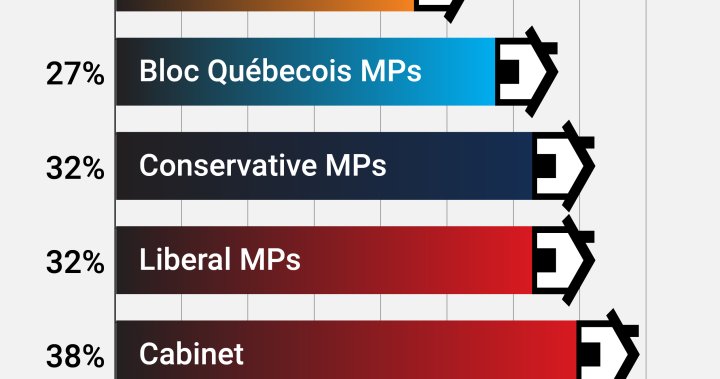
When Prime Minister Mark Carney looks around his cabinet table, he sees nothing but homeowners and plenty of landlords.

A Global News analysis of the financial disclosures of all MPs as well as a series of follow-up questions to a select number of politicians has determined that every single person in Carney’s 38-person ministry — ministers plus secretaries of state — are homeowners. None of them rent their principal residence.
Not only are none of them renters — except, perhaps, of their secondary residence while in Ottawa — 38 per cent of Carney’s ministers are landlords, earning rental income or as investors in property management businesses or real estate investment trusts.
There is, for example, the immigration minister — Nova Scotia MP Lena Metlege Diab — who owns or co-owns 14 rental units in Halifax. Carney’s finance minister, Quebec MP François-Philippe Champagne, owns or co-owns a pair of rental properties in London, England. And the Secretary of State for International Development, B.C.’s Randeep Sarai, owns a half-dozen rental units in Burnaby and Surrey.
Carney’s assets are in a blind trust and so his status as a landlord is unknown even to him, but among the dozens of companies he used to own that are part of his disclosed conflict-of-interest screen, there are plenty that earn their income by extracting rent from commercial or residential tenants.
Meanwhile, in the House of Commons there are even more landlords: 103 MPs or their spouses have disclosed rental income, owning rental properties, or owning a business involved in renting or managing investment properties.
The landlord list in the House includes the Opposition Leader Pierre Poilievre and 44 other Conservative MPs, 52 Liberal MPs (including those in cabinet), six Bloc Québecois MPs and one New Democrat: Alexandre Boulerice who reports on his disclosure form that his spouse earns rental income.
And at least 295 MPs own their principal residence while only a handful rent their principal residence in their riding.
The overwhelming weight in our national legislature of homeowners and landlords is not lost on those who advocate on behalf of the 30 per cent of Canadian households who are not homeowners and who pay rent every month to a landlord.
“I do find that those statistics are very helpful in calling attention to the power and politics of housing,” said Ricardo Trajan, who studies housing policy for the Canadian Centre for Policy Alternatives and is the author of the 2023 book The Tenant Class.
“These stats cause us to pay attention to the simple political facts that tenants are underrepresented in city halls and in provincial legislatures, and in the Canadian Parliament, and that obviously it’s going to be harder to make the case for their policies if they’re not there.“
Indeed, during committee hearings this spring on the Carney government’s signature housing bill, C-20: The Build Canada Homes Act, several advocates for tenants and renters asked the government to amend the bill to include more support for tenants and renters — things like vacancy control, security of tenure for renters, and a tenants’ bill of rights. Not a single amendment recommended by tenants advocates was adopted.

Get breaking National news
Get breaking Canada news delivered to your inbox as it happens so you won’t miss a trending story.
“It’s hugely disappointing, of course,” said Julieta Perucca, co-founder of the human rights group The Shift, which was one of the advocacy groups that submitted a brief to the House of Commons committee that studied C0-20.
“It shows that there is a bit of an institutional bias to keep the housing system working exactly as it is right now because it is the most profitable business in Canada — unfortunately for the rest of us, the tenants, the people who are trying to access home ownership and most acutely for those living in homelessness or housing precarity.”
The Global News analysis of MPs’ real estate assets and investments is drawn from financial disclosures every office holder must file with Parliament’s Conflict of Interest and Ethics Commissioner. The commissioner’s office then publishes a summary of those disclosures. As of June 23, the disclosures for every cabinet minister and all but 11 of 343 MPs have been published.
The summary does not include the value of any asset or liability but does disclose, for example, the name of the stocks each one might own and what kind of outside income they or their spouse expect to earn in the next 12 months. Dozens of MPs listed shares or units in real estate investment trusts (REITs), investment vehicles set up precisely to earn profits on rents.
“Politicians themselves are homeowners or landlords and the interests of the tenants are not represented directly in their conversation,” Trajan said.
Are MPs, then, thinking about their investment portfolios when it comes to policies which would put more power in the hands of tenants at the expense of landlords?
“I think it’s possible, yes,” said Perucca. “I think there would be a lot of different ideas proposed, but even if we’re not quite there yet, what about if our MPs didn’t have money tied up in real estate investment trusts and weren’t dependent on those strong returns from those real estate and investment trusts? Could that then maybe support how they legislate to change the status quo of these corporate landlords? I mean, we could ask ourselves that question. ”
So what did renters advocates want the government to do?
The DisAbled Women’s Network (DAWN) of Canada submitted a brief to the House of Commons committee that studied C-20 recommending, among other things, that the government should create a national “Renter Bill of Rights”. This initiative would shield tenants—particularly those with disabilities—from exploitation and “secondary victimization” by housing authorities or landlords.
The Trudeau government, in its 2024 budget, did, in fact, try to do this.
“This is a really important document that talks about ensuring that tenants have rights they can vindicate, including in front of tribunals and, potentially, courts of law,” then-justice minister Arif Virani told the House of Commons on April 18, 2024. But the Trudeau government’s tenants’ bill of rights needed provinces to sign on. They did not and the initiative died.
Sources in the Carney government say current Housing and Infrastructure Minister Gregor Robertson is working on a successor to the Trudeau-era tenants’ bill of rights.
But the committee studying C-20 considered — and rejected — other suggestions. To address the immediate threat of homelessness, Samuel Watts of the Welcome Hall Mission and Tim Ross of the Co-operative Housing Federation of Canada urged the government to implement a targeted rental protection fund designed to keep current tenants in their homes and prevent evictions.
Another group, the Front d’action populaire en réaménagement urbain (FRAPRU), asked MPs on the C-20 committee to shift the definition of “affordable housing” away from market rent benchmarks and instead towards a tenants’ ability to pay. The suggestion was ignored.
Perucca’s group, The Shift, argued that security of tenure should be a mandatory legal condition for any developer receiving financial assistance through the newly created Build Canada Homes agency. Liberal MPs on the committee, who have the majority, declined to recommend such an amendment.