dailynewsnblog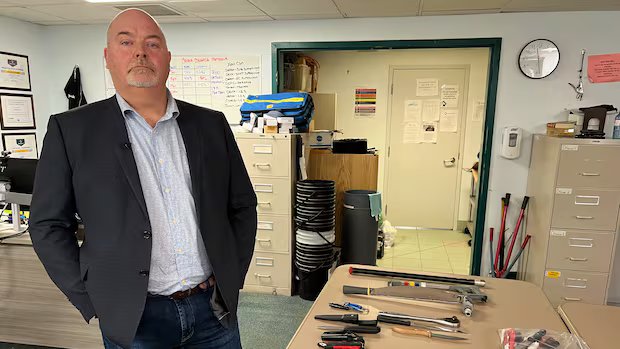

Listen to this article
Estimated 5 minutes
The audio version of this article is generated by AI-based technology. Mispronunciations can occur. We are working with our partners to continually review and improve the results.
In a security office at the Halifax Infirmary, Dean Stienburg stands beside a table filled with items that include knives, box cutters and a hacksaw. Then he picks up what he calls an improvised weapon.
In a former life, the item was actually the arm of a paper cutter. But the combination of a sharp blade, handle and a weighted end makes it dangerous.
There’s even an item that looks like a green leaf keychain, but when opened down the middle, it reveals a blade that could be used to slash someone.
These are just some of the examples of items discovered through screening at the hospital after security measures were beefed up last year following an incident that saw two staff members stabbed and a third injured.
“We’re not looking to put barriers up for people to get in here,” said Stienburg, Nova Scotia Health’s director of security. “We’re just looking to make sure that we’re identifying dangerous things and keeping them out of the hospital.”

The hospital initially installed metal detectors to identify weapons or things that could be used as a weapon, but they were noisy and would be set off by items like cellphones and belt buckles, which caused lineups, said Stienburg.
In December, the hospital installed devices that use artificial intelligence and are better equipped to differentiate potentially dangerous items from everyday things that people carry, said Stienburg.

If the machines notice an item of concern, the location of where it is on the individual is displayed on a screen, allowing security guards to do a more precise check and speed up the screening process.
“What’s neat about the AI is it’s constantly learning,” said Stienburg. “There’s no personal data ever transmitted, but the machines do store the data of what it finds. And then they compare that with their machines all over North America and they learn what different things are, so it’s constantly teaching itself.”
Nova Scotia Health has the AI detectors at four hospitals, and one at the emergency room at the Cape Breton Regional Hospital in Sydney. Plans are in the works to add the units at seven other hospitals this fall.
Around 75,000 people go through the doors of the Halifax Infirmary each month.

Statistics released through a freedom of information request show that roughly one weapon is detected for every 100 people who go through the detectors.
“If you wouldn’t take it into the airport with you, probably don’t bring it into the hospital,” said Stienburg.
He said in most cases, people don’t have a nefarious intent with the item. But he said some people have said they carry the items for self-defence.
People who have an item of concern are given the option to return it to their vehicle before re-entering. There are also free temporary lockers people can use, but if they’re all in use, the item can be handed over to security staff and they will be given a ticket, like a coat check service.
And if people decide they no longer want the item, they can just hand it over to security for disposal.
Stienburg said about 10 per cent of the devices stored in the lockers or handed over to security staff go unclaimed, which is how they end up in the security office.
One of those items is a socket wrench. Might it belong to a tradesperson?

“If this was something I used every day in my job and I needed, I would come back and I would get this at the end of the day,” said Stienburg.
Data provided through the freedom of information request shows that of the roughly 2,300 weapons that were stored or rejected between Dec. 13, 2025, and March 1, 2026, about three-quarters were knives. Other items included scissors and a small quantity of chemical sprays, such as pepper spray or mace.
More than 200,000 people were screened during that period.
Stienburg said staff feel safer as a result of the security measures.
“It’s not a cure-all, it’s not going to make the hospitals absolutely, completely safe, but it’s a huge step in the right direction,” he said.

Stienburg said that as familiarity with the measures has increased, fewer items of concern are being flagged.
The Nova Scotia Government and General Employees Union represents nurses at the Halifax Infirmary, as well as some other staff members in administrative and support care positions.
“They’re dealing with the patients who are coming in with high needs and never knowing what’s in that backpack or in someone’s pocket,” said union president Sandra Mullen. “So the ability to have these folks go through these scanners, eliminate some potential sources of injury, all the members in there have a sense of relief that that is being eliminated at the source.”
MORE TOP STORIES