dailynewsnblog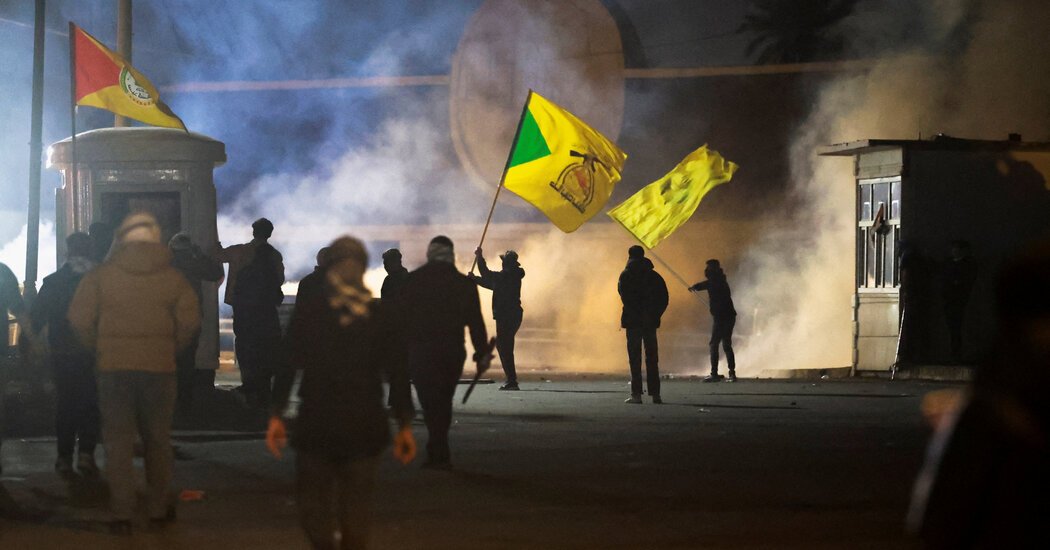
A commander of Kataib Hezbollah, an Iraqi militia that is a proxy for Iran’s Islamic Revolutionary Guards Corps, has been charged with plotting to attack Jewish sites in the United States, according to a criminal complaint unsealed on Friday.
The complaint, filed in the Federal District Court in Manhattan, accuses the commander, Mohammad Baqer Saad Dawood al-Saadi, of planning at least 20 attacks against U.S. and Israeli interests in Europe and Canada since late February. It has cast a spotlight on the militia, one of the most hard-line and powerful Iranian proxies in Iraq.
The group’s reach beyond the Middle East is not clear. It does not have a history of organizing attacks outside the region, and experts say the plots to attack the U.S. mainland cited in the complaint would be a significant departure for the militia.
Rocket and Drone Attacks
The militia was founded after the 2003 U.S. invasion of Iraq, which spurred an effort by Iran’s theocratic regime to recruit, train and arm Iraqi Shiite militias to attack American troops on Iraqi soil.
With Iran’s backing, the militia has continued to exert power. Amid the American military campaign in Iran this spring, Kataib Hezbollah launched near-daily drone and rocket attacks on U.S. targets in Iraq and neighboring countries like Jordan and Kuwait.
The group has also claimed responsibility for high-profile abductions. This year, the group kidnapped Shelly Kittleson, a U.S. journalist in Baghdad, freeing her after a week. The militia is perhaps best known for its 2023 abduction of Elizabeth Tsurkov, an Israeli Russian doctoral student. It held her hostage and tortured her for more than two years.
From its inception, Kataib Hezbollah has been closely tied to Iran’s Quds Force, the overseas arm of Iran’s powerful Revolutionary Guards. Its repeated attacks on U.S. posts in Iraq and Syria over the years have contributed to Washington’s 2009 designation of the group as a foreign terrorist organization.
Ties to a Shadowy New Group
The complaint tied Mr. al-Saadi, 32, to a shadowy new group called Harakat Ashab al-Yamin al-Islamiyya, also known as HAYI, which announced its presence online in March.
Not much is known about the new group’s capabilities, but in Friday’s complaint, the U.S. authorities said it was a front for Kataib Hezbollah. The complaint cited similarities between both groups’ logos and the use of common Shiite militant channels to broadcast propaganda as evidence.
The new group has become a concern in recent months for European authorities, who have warned of potential Iranian retaliation amid the war. Since then, HAYI has claimed attacks in Britain, Belgium and the Netherlands . The authorities have said they were investigating whether the group had ties to Iran.
Fighting ISIS and the Iraqi Government
In 2014, Kataib Hezbollah joined with other mostly Shiite militias to fill the vacuum left by Iraq’s faltering military and take on the battle against the Islamic State, or ISIS.
Loosely organized under a coalition called the Popular Mobilization Forces, or P.M.F., those militias helped wrest back territory and, after years of fighting, demolished ISIS’s self-declared caliphate.
Eventually, the P.M.F. came under the formal supervision of Iraq’s national security forces. But factions like Kataib Hezbollah continued to operate with significant independence from the government and remained under Iran’s influence.
Iran has long supported Kataib Hezbollah by providing weapons and other aid. The militant group is also partly financed by the Iraqi government, with thousands of its members drawing salaries from the state.
Deadly Attack Leads to U.S. Retaliation
No Iranian proxy force has ever successfully carried out a terrorist attack on U.S. soil, although there have been myriad arrests and convictions in connection with plots, surveillance, raising money and weapons transfers.
But Iranian proxy forces have been linked to numerous attacks over the years, including the bombing of a Jewish community center in Argentina in 1994 that killed 85 people and a truck bomb on U.S. Air Force barracks in Dhahran, Saudi Arabia, in 1996, that killed 19 servicemen and wounded hundreds of others.
In 2019, Kataib Hezbollah was accused of an attack on an Iraqi air base that killed an American contractor. That contributed to the U.S. decision to kill Maj. Gen. Qassim Suleimani, the leader of Iran’s Quds Force, while he was visiting Iraq.
This year, an Iranian intelligence agent was convicted of organizing a plot to assassinate U.S. politicians and government officials, including President Trump. The attacks were meant to avenge the death of General Suleimani.