dailynewsnblog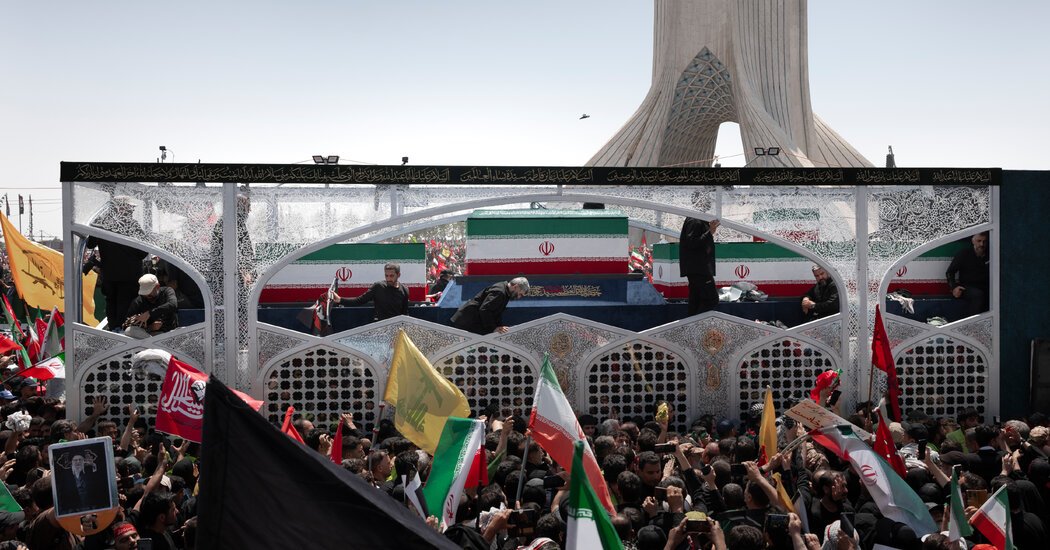
They arrived from every direction, flowing toward the heart of Tehran in streams that gradually turned into rivers and then something larger — a human current of mourners with enough collective force that individual will seemed to dissolve into movement itself.
I joined them on Monday morning as millions gathered to bid farewell to the late supreme leader, Ayatollah Ali Khamenei, who was killed at the onset of the U.S.-Israeli war on Iran in late February.
After two days of public mourning ceremonies in the Iranian capital, this was the final day to pay respects before his body was transported onward. Next it would go to Qom, Iran’s center of religious learning; then to neighboring Iraq, which, like Iran, has a majority Shiite Muslim population. Finally, his body will be taken to his hometown Mashhad for burial on Thursday.
As the procession moved through Tehran for the last time, it converged at the city’s symbolic core, Azadi Square.
There, a tower rises like an arch between eras, its white ribs carrying echoes of kings, revolutions, triumphs and grief. Commissioned by Iran’s last monarch, Mohammed Reza Pahlavi, and previously known as “Memorial of the Shah,” it was renamed Azadi, or “freedom” after the 1979 Islamic Revolution.
That layered history helps explain why the procession came here.
The New York Times was granted access to the ceremonies by the Iranian government, which determined the events we could attend, and assigned us a translator and guide to accompany us everywhere.
Around Azadi Square, the crowd was a cross-section of Iranian life. Parents lifted children onto their shoulders or pushed them in strollers. Young women chanted and filmed continuously, sweeping their phones in slow arcs across banners and moving crowds. Older men carried portraits of the slain ayatollah. Groups of women walked together beneath a giant Iranian flag, chanting “Death to Israel” and “Down with Trump.” At least one sign, vowing revenge in Hebrew, was visible among the crowds.
And then there were the sounds, many layered until they seemed to merge into something indivisible.
The mournful music and elegies never stopped. The verses from the Quran blasted from huge loudspeakers. Every few minutes, chants would erupt somewhere, first as a distant rumble indistinguishable from the general noise, then passing from one section to another like a wave.
We pushed through it all, sometimes wondering whether the sheer density of people had become untenable. Looking ahead revealed only more bodies dissolving into heat and haze. At times, there was no visible beginning and no visible end, only the sensation of moving through a landscape made almost entirely of people.
After three hours, we finally broke into the square.
We asked a man operating a water truck if we could climb onto it. He agreed immediately. From that height, the scale of the gathering became clearer, though no less overwhelming.
Soon after, we saw it: A mobile stage truck moving slowly through the square in a wide circuit. As the crowd recognized it, their energy shifted. Voices rose into chants. People threw whatever they had — turbans, scarves, pieces of clothing — toward the platform, hoping they would reach the coffin and be blessed. Some succeeded, their items caught and returned by the men on top. Others fell short.
It was the closest many had come in days to the presence of the body itself.
The man on the water truck began to cry. A flag-bearer beside me waved his flag more vigorously. Others nearby fell silent, as if trying to hold the moment in place.
For many around me, this felt like the end of an era, a farewell to a man revered by supporters, but whose rule had also left behind deep divisions and suffering for others. Standing there, it felt almost unreal, chaotic, overwhelming and faintly absurd that I was witnessing it at all.
On Monday evening, I returned to Azadi Square. The crowds had dispersed. Cleaners moved across the pavement. Life had resumed its ordinary rhythm with disarming speed.
When I expressed my surprise, someone remarked, almost casually, in Farsi, “It is as if no king came or no king left.”
Just like that, history had moved on.