dailynewsnblog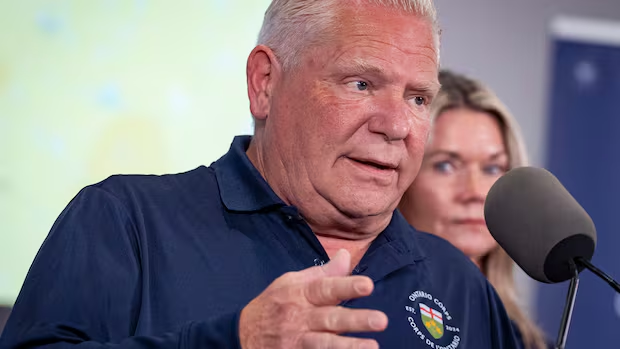
Premier Doug Ford told reporters Monday morning that the nearly 200 wildfires burning across northern Ontario, many of which are out of control, are covering more and more of the province.
Fires have now burned across 735,000 hectares of the province, Ford said, up from 650,000 the province reported last week.
“It’s moving quickly,” Ford said at a news conference in Toronto alongside Jill Dunlop, Minister of Emergency Preparedness and Response, and Mike Harris, Minister of Natural Resources.
Recent rain helped to temper fire activity over the weekend, but officials warned the hazard remained high as another First Nation reported widespread destruction. Chief Pauline Drake of Whitewater Lake First Nation said Sunday that a wildfire had destroyed much of the remote community about 250 kilometres north of Thunder Bay.
The majority of the fires are burning in the northwest region, where 51 are considered out of control, provincial authorities said Sunday. For the latest information on wildfires in the province, and where they’re burning, click here.
But even for those living hundreds of miles away, the wildfires have become impossible to ignore.
Last week, smoke from the north covered other parts of the province, including Toronto, where skies turned orange and the air quality was briefly ranked the worst of any city in the world.
Smoky skies weren’t limited to Ontario or Canada, though. U.S. President Donald Trump and other Republican legislators blamed Canada last week for polluting American air by improperly managing the country’s forests.
On Monday, Ford again urged U.S. politicians to stop complaining and instead send help, as Canada has done during U.S. natural disasters.

Ontario Premier Doug Ford rejected Donald Trump’s criticism of Canada’s northern wildfire response, suggesting the U.S. should send support instead.
Fires in the north have forced over two dozen communities and areas to evacuate in recent days, including 10 First Nations communities across northern Ontario.
Around 1,800 people have fled, Ford said Monday, evacuating to host cities across the province, including Thunder Bay, Toronto, Sudbury and Niagara Falls.
First Nations leaders, including from Nishnawbe Aski Nation (NAN) and Anishinabek Nation, have criticized the province for not responding to the wildfire situation quickly enough.
Namaygoosisagagun First Nation (Collins First Nation) completely burned to the ground last week and leaders say they weren’t warned of the wildfire in advance.
The Ministry of Natural Resources said in a statement Friday that the safety of the public and firefighting personnel is its top priority, and it is providing the resources necessary to respond to active wild land fires and protect communities and critical infrastructure.
Ontario accused of low-balling wildfire budget
Ford’s government has also been questioned over how it has budgeted money to respond to wildfires. Ontario has set aside $150 million this fiscal year for emergency firefighting, despite spending nearly twice as much last year on a difficult wildfire season.
Ford has said the province will spend whatever is needed this year to fight wildfires, regardless of the budget, announcing last week the province is buying 11 aircraft to respond to the wildfires.
But Ontario’s wildfire season has been getting worse for years due to the climate crisis, and a lack of money upfront to deal with it makes it harder to manage, says Noah Freedman, a veteran forest fire crew leader in the province.
“What we should be doing is proactively preparing for these situations, and acquiring these aircraft before we need them,” he told CBC Radio’s Metro Morning Monday, saying the current approach delays resources and makes it harder to plan.
“We’ve been aware of these issues for a long time and have been working to get ahead of them, although we haven’t exactly gotten there yet,” he said.
Ford acknowledged Monday that, “We seem to be going through this every single year,” saying it may be time for a national wildfire strategy.
Prime Minister Mark Carney said last week that his government is in close communication with provinces and municipalities and will provide additional assistance as needed.

As Ontario asks Ottawa for help with evacuations, Premier Doug Ford is rebutting criticisms his government hasn’t properly budgeted for this year’s wildfire season. CBC’s Lane Harrison breaks down the numbers.
Although Ford has continued to vow the province will spare no expense, Freedman said that’s just the government playing politics, and its emergency firefighting budget is being mismanaged.
He said he has tried to raise concerns with the province, but has been met with a “blackout curtain.” Last year, Minister Dunlop showed up at his fire base unannounced for a tour of the facility and equipment, Freedman said, but she did not speak with the firefighters about the resources they need.
“No meaningful conversation, no interest in actually talking about the issues. Just a photo op with a helicopter at a firebase,” he said.
Dunlop’s office declined to comment on Freedman’s remarks.