dailynewsnblog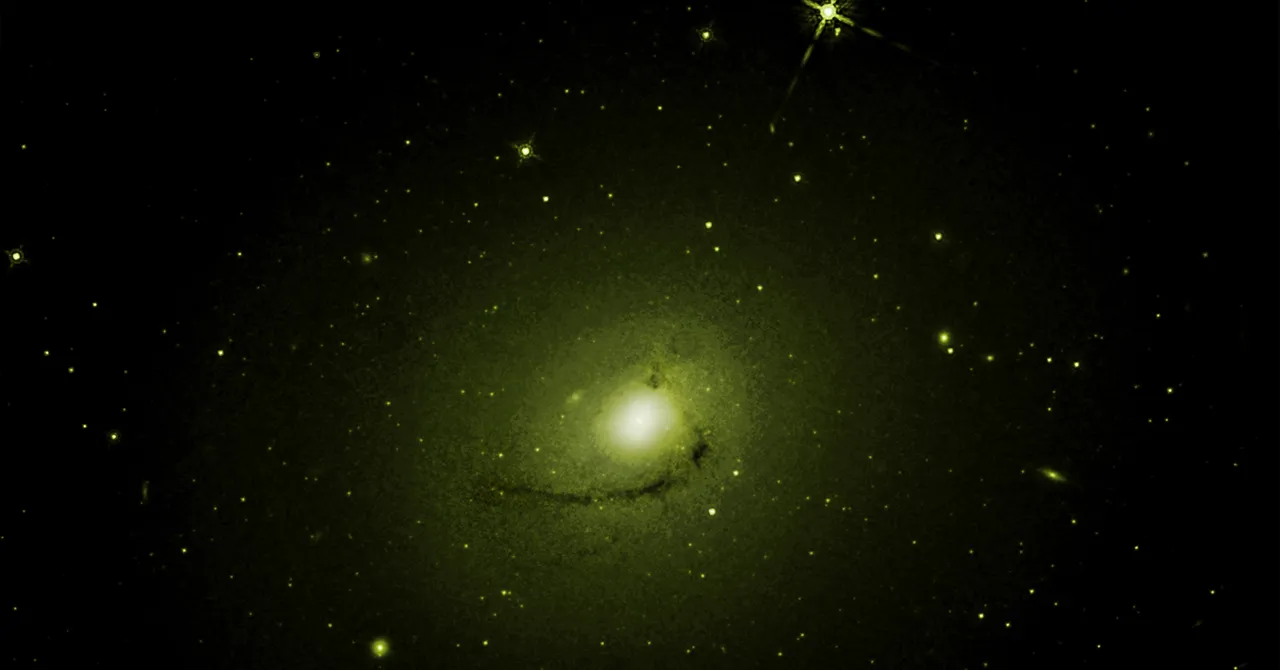
It is believed that nearly every large galaxy in the universe has a supermassive black hole at its center, with a mass ranging from millions to billions of times that of the sun.
Black holes grow by consuming surrounding matter, but in the process they also eject powerful energy jets. These jets heat the surrounding gas, delaying the formation of new stars and affecting the growth of the galaxy as a whole.
This has long presented researchers with a puzzle. As a black hole emits jets and heats the surrounding gas, the gas that would otherwise be consumed by the black hole—that is, its energy source—is dispersed far away. And yet, why is it that black holes do not “run out of fuel” and instead continue to grow?
To explain this mystery, researchers proposed the following hypothesis: Gas blown away by the heat eventually cools in interstellar space and condenses into thin, thread-like structures called filaments. These filaments then fall back toward the black hole.
A newly published study has brought researchers closer to confirming this idea. An international team led by Julie Hlavacek-Larrondo, a professor at the University of Montreal, observed the central galaxy NGC 4696 in the Centaurus Cluster and demonstrated a connection between such filaments and its central black hole.
A “Cosmic Recycling System” of Heating and Cooling
NGC 4696 is located about 145 million light-years from Earth. It has been the subject of extensive observation in the past, including the discovery of an S-shaped spiral structure around its central black hole.
For this study, the team observed the galaxy’s central region for approximately eight hours using the James Webb Space Telescope’s (JWST) Near-Infrared Spectrograph (NIRSpec). The observations achieved a resolution fine enough to distinguish structures only about 30 light-years across. To put this into perspective, if a galaxy 300,000 light-years wide were scaled to the size of a soccer field, this would be equivalent to identifying a single marble placed on that field from a distance of 50 kilometers.
The observed motion of the gas revealed that the S-shaped spiral is actually a rotating disk of gas orbiting the black hole. The disk is about 800 light-years in diameter, with gas pulled by the black hole’s immense gravity rotating at several hundred kilometers per second. A velocity difference of roughly 600 kilometers per second was measured between opposite edges of the disk.
The observations also showed that filaments—formed from condensed gas—flow directly into the edge of the disk. The gas travels along these filaments, accumulates in the disk, and is ultimately supplied to the black hole as “fuel.” For the first time, this entire pathway has been directly visualized.
“What JWST is revealing is that black holes may be the ultimate cosmic recyclers,” says Hlavacek-Larrondo. “They release enormous amounts of energy that heat their surroundings, yet that same gas can later cool into thin filaments that fall back inward and feed the black hole again. We are finally seeing this self-sustaining cycle in action.”

Black Holes Control the Growth of Galaxies
In addition to the observations, the research team carried out computer simulations, which led them to the following theory:
As filamentary gas falls toward the black hole, stretched magnetic fields act like ropes, exerting torque that removes the gas’s angular momentum. As a result, the gas falls into the disk rather than being scattered away.