dailynewsnblog
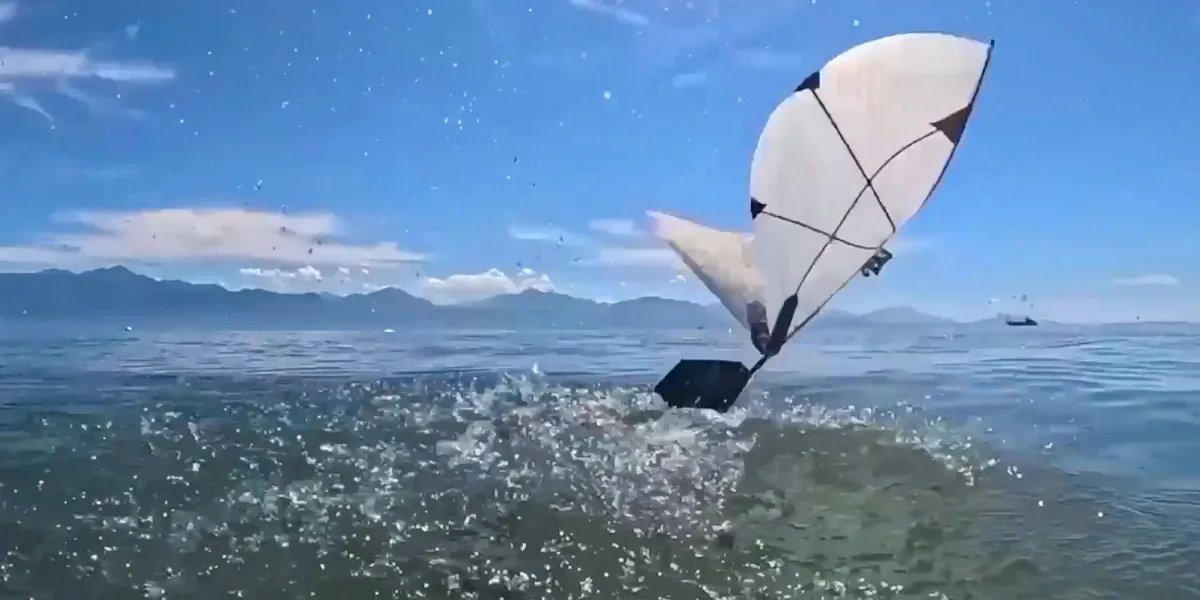
Given that water is 1,000 times denser than air, moving through those two mediums requires very different mechanics—or so one might assume. Yet birds like gulls and puffins can plunge into the sea, swim underwater, and leap back into the air to fly away. And now engineers at MIT and EPFL in Lausanne, Switzerland, have designed a robot that can do likewise.
The “flapping-wing aerial-aquatic vehicle,” or FAAV, weighs less than 300 grams (about half a pound) and is equipped with a central fuselage, two flexible wings, and a steerable tail. The body contains a battery and a waterproof electric motor that drives a crankshaft, which pumps the wings up and down at preset frequencies. The wings are made of thin membranes that are coated with hydrophobic nanoparticles to help wick away water. And the tail is motorized, enabling it to change its angle to help the robot fly up or dive down.
In experiments carried out in a water tank and at Lake Geneva, a team led by Raphael Zufferey, an assistant professor of mechanical engineering at MIT, identified combinations of wing size, flapping frequency, and tail angle that enable the robot to smoothly transition from swimming to flying.
The best results came with medium-size wings that were flexible enough to minimize flapping amplitude in water and also firm enough to keep the robot aloft in the air. The speeds and flapping frequencies were similar to those used by actual birds, and a pitch of 70 degrees—a relatively steep angle—allowed the robot to make the leap from water to air. Interestingly, although many diving birds paddle their feet to help them take off from the water’s surface, the team found that the bot didn’t need feet at all.
The engineers’ results could help pave the way for a new class of drones and vehicles that could fly to and sample from aquatic regions too dangerous for traditional vessels to access.
“Our dream vision is for oceanographers, marine biologists, and members of coastal communities to launch this robot from a boat, or from shore, and it would fly close to the area of interest, such as an iceberg or a port facility, or over a pod of whales,” says Zufferey. “It would dive into the water to take a measurement or collect a sample, and fly back to deliver the data at a fraction of the cost of traditional methods. Then it could go back out to dive for more.”
The researchers are now trying to design wings that can turn as well as flap. They will also test the robot’s performance under turbulent conditions, such as swimming in choppy waters and flying through wind. Then they hope to deploy the vehicle to help answer questions in ocean science.
“One of the major challenges in ocean science is collecting data both frequently and across many locations, which is something this robot could do in the future,” Zufferey says. “You could send this out not just every week, but every hour. It could fly out at high speeds, dive in, fly back, deliver its data, and go back out, multiple times.”