dailynewsnblog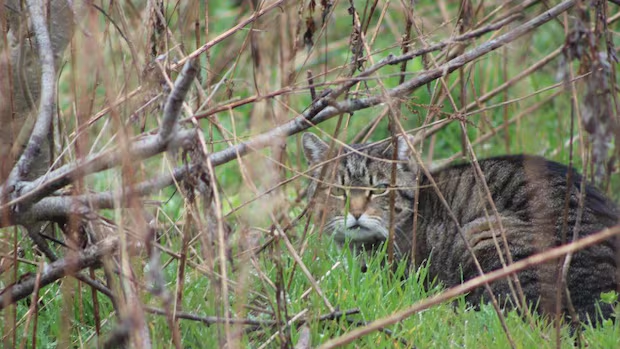
A Godmanchester, Que., woman says she was outside her home on July 16 when a cat suddenly lunged at her.
“I came up my laneway, nothing on the laneway, and then out of nowhere a cat latched onto my leg,” Mary Elizabeth Doyle said. “It was biting and scratching.”
She said she tried to pull the animal away with her hand, but it bit her again.
“I hit my hand against the Jeep to dislodge the cat,” she said. “I called 911.”
Doyle said the cat attacked a second time after paramedics arrived, biting an ambulance driver before it was restrained.
She was taken to hospital, where her wounds were cleaned and stitched before doctors administered preventive rabies treatment.
Days later, Doyle said she received a call confirming the cat had tested positive for rabies.
“I’m concerned about other animals being around, other cats being infected,” she said.
3 people treated after possible rabies exposure
This is Quebec’s first case of raccoon rabies in a stray cat. It was confirmed last week by the province’s Ministry of Agriculture, Fisheries and Food.
On Thursday, the local health authority announced three people have been treated for possible rabies exposure in the Montérégie region.
In an email, Chantal Vallée, spokesperson for the regional health authority, said the three people received preventive treatment — post-exposure prophylaxis — in connection with exposure to a rabid animal.
She said treatments are sometimes administered to individuals who had contact deemed risky with the animal to prevent the development of the fatal disease.
“We wish to emphasize the importance for anyone who has been bitten, scratched or in contact with the saliva of a suspicious animal to wash their skin for 15 minutes and call Info-Santé at 811 immediately so that preventive treatment can be administered,” Vallée wrote.
She said it is important to avoid any contact with wild or unfamiliar animals — even if they appear harmless, healthy or are dead.
Dr. Alex-Ane Mathieu, a doctor in the Montérégie, said rabies is spreading fast in the region and the health authority is working to make residents aware of the risks and encouraging people to get evaluated if they had contact with an unknown or wild animal.
If the exposure is considered at risk, the prophylaxis treatment is “very effective at preventing rabies from developing,” Mathieu said. Those treatments may be administered even if the animal, such as a bat, can’t be tested for rabies, she said.
Disease can be transmitted to domestic animals
The rabid cat case shows that the disease, already present among wild animals in some regions of Quebec, can also be transmitted to domestic animals, according to a news release this week from the Ministry of Agriculture, Fisheries and Food.
Dr. Michael Libman is the director of the J.D. MacLean Centre for Tropical Diseases at McGill University. He said rabies is not new to Quebec, usually found in bats, but any mammal can catch the disease.
“Animals typically transmit to each other and to humans with a bite,” he said, and while raccoons aren’t agile or fast enough to easily catch a dog or cat, it can happen. In most of the world, it’s dogs transmitting it, but pets here tend to be vaccinated.
“If you own a pet, the easiest by far is to have your pet get its various shots. One of them is rabies. It’s very effective.”
Since Jan. 1, 2026, 118 cases of raccoon rabies have been confirmed. The number has been climbing drastically in recent years.
Raccoon rabies primarily affects raccoons and striped skunks. Between 2006 and 2009, there were some cases in Quebec as the disease likely arrived from the state of Vermont through the natural movement of raccoons.
In 2015, only one case was detected in Quebec, near the border with Ontario and the United States. Thanks to control and surveillance operations, this rabies variant was successfully eliminated from Quebec territory at that time, the ministry says on its website.
However, in late 2024, raccoon rabies returned to Quebec from Vermont. Cases have been detected in the Eastern Townships and Montérégie regions.
Residents of the Eastern Townships, Montérégie and Centre-du-Québec are being asked to report raccoons, skunks or foxes that are dead, injured, disoriented, paralyzed or displaying unusual aggressive behaviour.