dailynewsnblog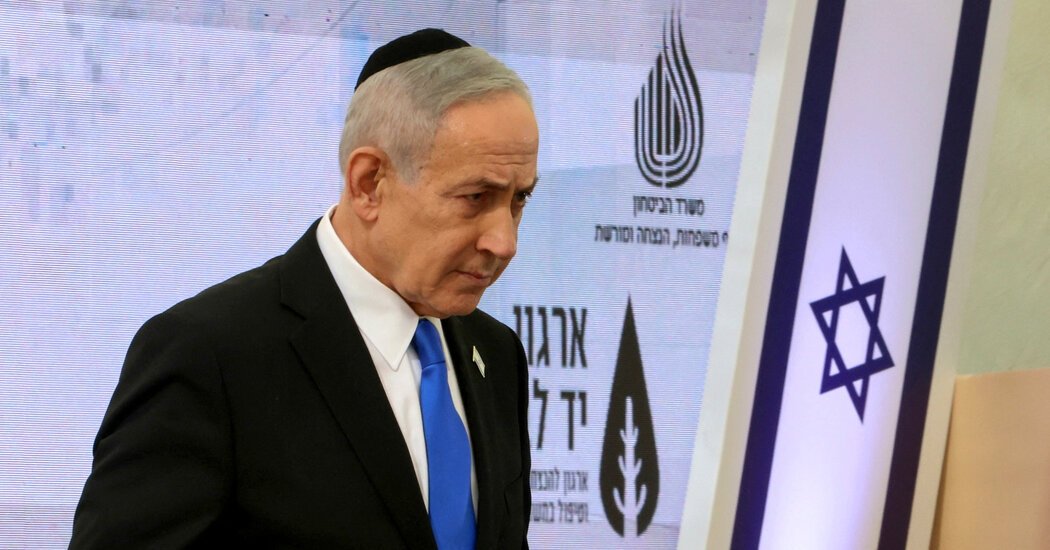
Prime Minister Benjamin Netanyahu of Israel said on Sunday evening that he and President Trump remained united in their stance on preventing Iran from obtaining nuclear weapons, in his first statement on an emerging peace deal.
A senior U.S. official said on Sunday that the United States and Iran had agreed to a preliminary deal that would fully reopen the Strait of Hormuz and see Iran dispose of its stock of highly enriched uranium. He cautioned that a deal had not been signed and would have to be approved by President Trump and Iran’s supreme leader.
Many of the most intractable problems between the countries, including the future of Iran’s nuclear program, were put off to future negotiations, the official added.
Mr. Netanyahu’s remarks came more than 18 hours after Mr. Trump first announced the unfolding agreement on Saturday evening in Washington.
Mr. Netanyahu’s long silence throughout most of the day on Sunday was not a sign of contentment, according to experts.
Analysts said it reflected the uncertainties and anxiety inside Israel that this deal could ultimately fall far short of the country’s aims of shutting down Iran’s nuclear program and curbing its missile capabilities.
“You don’t hear much enthusiasm for this deal in Israeli government circles,” said Michael Herzog, who served as Israel’s ambassador to Washington from 2021 to early 2025 and is now a fellow at the Washington Institute for Near East Policy.
While the joint U.S.-Israeli assault that began in late February significantly degraded Iran’s capabilities, he said, the general sense in Israel was that the outlines of the deal so far represented “an insufficient translation of the American and Israeli achievements in the war.”
This raises concerns about “the gap between the unprecedented military cooperation and the diplomatic outcome,” he added.
Mr. Netanyahu said at the outset of the war that it was “designed to remove the existential threats” to Israel. That meant destroying Iran’s nuclear threat and its ballistic missile program, as well as “creating the conditions” for the Iranian people to topple the government, he added.
Israel also demanded an end to Iranian support for anti-Israel proxies in the region, including Hezbollah in Lebanon and Hamas in Gaza.
Initial reports of the deal suggested Mr. Trump was focused on other priorities. The president said in a social media post that Washington was close to reaching a preliminary agreement with Tehran toward ending the war and reopening the Strait of Hormuz, a vital waterway for oil and gas shipments.
“A willingness to discuss the nuclear issue doesn’t mean the sides will get to an agreed-upon or desirable solution,” said Assaf Orion, a retired Israeli brigadier general and defense strategist, referring to the decision to defer questions pertaining to Iran’s nuclear program to future talks.
“It’s clear that the United States doesn’t want to escalate,” Mr. Orion said, adding that leverage over Iran would shrink, and “that doesn’t augur well for what is to come.”
When Israel went to war against Iran for the first time, in June 2025, Mr. Netanyahu identified Iran’s rapidly increasing production of ballistic missiles as a primary threat almost on a par with Tehran’s nuclear efforts, and said the industry had been “destroyed” after 12 days of fighting.
By the time the next campaign started in late February, Israel was surprised at the speed with which Iran had begun to rebuild its ballistic missile production capability.
“They bounced back quicker than we anticipated,” Mr. Orion said then.
In the current proposal, there appears to be no mention of limits on Iran’s ballistic missile production at all.
Opening the Strait of Hormuz was never an Israeli war goal, but a card that Iran has played well, according to Israeli experts. And far from the Iranian government being toppled, the United States would continue to negotiate with it. Israel has not been a party to the talks.
Mr. Netanyahu added in his statement on Sunday that Mr. Trump reaffirmed Israel’s right to defend itself against threats on every front, including Lebanon, where Israel’s forces are mired in a standoff with Hezbollah, the Iranian-backed organization.
But Israel has already seen its freedom to strike Hezbollah curtailed since the April cease-fire in Lebanon, under American pressure. Most of Israel’s activity is now confined to the swath of territory its forces have invaded in southern Lebanon, along the border with Israel, where its largely static forces are vulnerable to Hezbollah drone fire.
One of Israel’s many fears, Mr. Herzog said, is that the nascent agreement with Iran would “not tie Iran’s hands in supporting its proxies, but would tie Israel’s hands in fighting those proxies.”
Still, the few signals emanating from the Israeli government suggested that the vagueness of the deal meant that all might not be lost.
Mr. Netanyahu will likely use the period when a final agreement is being negotiated to try to influence the result, although his clout may be limited. Mr. Trump has already stated publicly that Mr. Netanyahu “will do whatever I want him to do.”